About this clown

My photo
I often feel that we're all spinning slowly... like a mirror ball. Yes, we are all mirrors to each other. And so, it is the Light between us that I hope to help reveal and celebrate. /// J'ai souvent l'impression que nous sommes une boule disco qui tourne lentement. Nous sommes tous des miroirs pour les uns les autres. C'est donc la lumière qu'il y a entre nous que j'espère contribuer à souligner et à célébrer.
Showing posts with label education. Show all posts

Thursday, July 31, 2014

Rick Tarnas and Stan Grof

This is an article from RealitySandwich.com. I wanted to copy it here as a memo to myself, and as as way to expose you to this unusual yet absolutely compelling work. Stan Grof and Rick Tarnas were two teachers of mine at the California Institute of Integral Studies, in SF. 
I've been renewing with astrology lately. These were the people that introduced me to it.
Thank you teachers. 

Stanislav Grof and Richard Tarnas: The Birth of a New Worldview


The following is excerpted from Pathways to Wholness: Archetypal Astrology and the Transpersonal Journey, published by Muswell Hill Press. 
Breakthrough in Europe
In the mid-1960s, Stanislav Grof, a young Czechoslovakian psychiatrist working at the Psychiatric Research Institute in Prague, made some extraordinary discoveries concerning the fundamental structures of the human psyche. Conducting sessions with a wide range of individuals in a program of systematic LSD psychotherapy, Grof and his clients encountered experiences that gradually and then irrevocably challenged the orthodox Freudian model in which he and his colleagues were working.
The experiences that emerged during these sessions suggested a far deeper understanding of the human psyche and the cosmos itself than had been previously imagined in any existing psychological theory. After supervising over 3000 sessions and studying the records of another 2000 from colleagues around the world, Grof eventually introduced a far-reaching new model that accounted for the observations of his clients’ sessions, integrated a number of other psychological theories, and reached into areas of human spirituality described by the great mystical traditions of the world.
Grof’s research, although representing a dramatic breakthrough in Western psychiatry and psychology, is supported by many precedents in non-Western and preindustrial societies. Since the dawn of history, guided non-ordinary states of consciousness have played a central role in the spiritual and ritual life of humanity. Stretching back more than 30,000 years, the shamans of ancient cultures began their healing professions through a spontaneous or induced experience of death and rebirth. In a firsthand way, they explored territories of the psyche that transcend the boundaries of normal individual awareness. Similarly, in the rites of passage, initiates were guided into non-ordinary—or what Grof has termed holotropic (from holos, meaning “wholeness”; and trepein, meaning “moving toward”)— states of consciousness and had a personal experience of higher realms that transcend the physical world.

In the ancient mystery religions of the Mediterranean, neophytes participated in various mind-expanding processes in order to move beyond the limits of individual awareness and experience directly the sacred or numinous dimensions of existence. The celebrated Mother Goddess mysteries of Eleusis, for example, which were held near Athens for almost two thousand years, we are now virtually certain used ergot, a naturally occurring form of LSD.1 Many of the creative and intellectual giants of Western culture, including figures such as Pythagoras, Plato, Aristotle, Epictetus, Euripedes, Sophocles, Plutarch, Pindar, Marcus Aurelius, and Cicero, all attest to the life-changing power of their experiences at Eleusis or one of the other mystery sites.
As well as the ritual use of psychedelic substances, many cultures have used methods such as trance dancing, rhythmic drumming, sensory overload and sensory deprivation, sleep deprivation, breathing maneuvers, fasting, meditation, and other techniques to enter holotropic states. Preindustrial cultures around the world understood an important fact of human nature that we in the modern West have forgotten—that exploring the psyche can mediate a profound reconnection with the cosmic creative principle, helping people to heal a range of emotional and physical problems, transcend their fear of death, and reach a more integrated level of functioning in everyday life.
Modern consciousness research, such as that conducted by Grof, has found that individuals who undergo these transformative processes automatically develop an interest in spirituality of a universal, non-sectarian, and all-encompassing nature. They also discover within themselves a sense of planetary citizenship, a high importance given to warm human relationships, and the desire to live a more simple and satisfying life in harmony with nature and ecological values.
The considerable time and resources that other cultures devoted to finding effective techniques for exploring the inner terrains of the psyche is in marked contrast to the values in our modern industrial society. The dominant world view in Western civilization is concerned primarily with the external and physical layers of reality. In many ways it denies the existence of the human psyche altogether, and especially of higher spiritual or transpersonal states.
Grof’s research thus provides an unexpected gateway to a deeper knowledge of the long-neglected inner world. As we will see, the systematic exploration of the unconscious in holotropic states can initiate a profound transformation of awareness—a transformation that many now believe is urgently needed if we are to face and successfully overcome the great problems of our time. However, the journey into the heart of the psyche can be an immensely challenging process, exposing individuals to the depths and heights of human emotional experience. A map of the inner terrain, a way of understanding and predicting what might take place during holotropic-exploration sessions, would therefore be of invaluable benefit.

An Unexpected Rosetta Stone
For years, Grof and his colleagues had looked unsuccessfully for some kind of diagnostic system—such as the Minnesota Multiphasic Personality Inventory test (MMPI), Shostrom’s Personal Orientation Inventory (POI), the Rorschach Inkblot Test, and others—to predict the experiences of their clients in deep self-exploration. Decades later, when the cultural historian Richard Tarnas discovered and systematically applied what Grof would later call the “Rosetta Stone” of archetypal astrology to this problem, Grof had to ironically concede that the one successful predictive technique turned out to be a system that was even more controversial and beyond the range of conventional science than his research in psychedelic therapy. Despite their deep initial skepticism toward astrology, however, the correlations that he and Tarnas observed were striking and consistent over time. Whether the catalyst was Holotropic Breathwork, a psychoactive substance, or a spontaneous eruption of unconscious contents during a psychospiritual crisis, archetypal astrology provides, in Grof’s words, “the only system that can successfully predict both the content and timing of experiences encountered in non-ordinary states of consciousness in experiential psychotherapy.”2

Given the widespread misunderstanding of and skepticism toward astrology in the modern era, a brief preface is required before we proceed. Although many of the founders of modern science—notably Johannes Kepler and Galileo Galilei—retained a deep belief in the principles as well as the practice of astrology, and of a higher cosmic intelligence or God, subsequent generations would later discard this understanding as the relic of an older time. Although the astrological vision became deeply discredited in the modern scientific West, the world view underlying it maintained credibility and continued to flourish in the philosophical movements of late Neoplatonism, Idealism, and Romanticism, in a direct lineage from Socrates and Plato.
This situation began to change in the mid-twentieth century, however, with the work of the pioneering psychiatrist C. G. Jung. Jung’s discovery of the archetypes of the collective unconscious, his formulation of synchronicity (“an acausal connecting principle”), and his speculations concerning the anima mundi (world soul) provided a conceptual framework for the mature rebirth of a more psychologically oriented and nuanced form of astrology. Brought to fruition through the writing of figures such as Dane Rudhyar, Robert Hand, and Liz Greene, this new approach drew on the insights of Jungian depth psychology while leaving behind many of the fatalistic dogmas of the old astrological tradition. Hand’s work also set the stage for a much more rigorously self-critical and self-questioning discipline.
Then Grof’s friendship and collaboration with Tarnas was to initiate another major leap in the field. A highly respected philosopher and psychologist, as well as historian, Tarnas gained international acclaim with his best-selling The Passion of the Western Mind (1991), which went on to become required reading in a number of university courses around the world. He followed this in 2006 with Cosmos and Psyche, in which he presented over five-hundred pages of systematic and compelling evidence to support his groundbreaking theory.
Tarnas begins by introducing the concept of archetypes that has played such an important role in the Western philosophical tradition. For now, we can describe the archetypes simply as primordial patterns of experience, which influence all people and cultures in the form of basic habit patterns, instincts and emotions. In Cosmos and Psyche’s bold hypothesis, Tarnas suggests that the dynamic interplay of these timeless universals that have shaped our history occurs in coincidence with geometric alignments between the planets and the Earth, intelligible through an emerging epistemology and method of analysis which he calls archetypal astrology.
In contrast with traditional astrological belief and practice, the archetypal approach that Tarnas introduces is non-fatalistic and non-deterministic. The archetypes are recognized at all times as being complexly multivalent and multidimensional—taking different forms in different situations and at different times in people’s lives. Each archetypal complex can manifest in a wide range of possible expressions, while still being true to its basic thematic character. Tarnas carefully demonstrates that the methodology he presents is archetypally predictive rather than concretely predictive. Although planetary alignments can illuminate many essential characteristics of an historical epoch or individual life experience, and even suggest basic expected characteristics of an upcoming period, he emphasizes that the specific concrete expression the archetypes will take at any time remains indeterminate—contingent on additional factors such as cultural context, free will, co-creative participation, and perhaps unmeasurables such as karma, grace, and chance.
It should be acknowledged that many of the fundamental tenets of the emerging archetypal world view concerning the nature of the human psyche and of the universe itself are compatible with the most recent branches of modern science, including quantum-relativistic physics, Pribram’s holographic model of the brain, Sheldrake’s study of morphogenetic fields and morphic resonance in biology, Prigogine’s study of dissipative structures, systems theory, chaos theory, cybernetics and information theory, the anthropic principle in astrophysics, and others.
Grof also mentions the pioneering attempts of Ken Wilber and the successful accomplishment of Ervin Laszlo in integrating transpersonal psychology into a new comprehensive paradigm.6 I would further note Keiron Le Grice’s work in The Archetypal Cosmos, which draws on the implications of Tarnas’ research and integrates many of the new scientific theories in direct support of an archetypal or holotropic world view.7 Perhaps the most concise way to describe this emerging paradigm in science is the realization that consciousness, rather than being an accidental by-product of neurophysiological and biochemical processes in the brain, is an integral component of the universe itself.
The most well-known area of Tarnas’ study to most readers has been his exploration of cyclically unfolding archetypal dynamics in human history and culture, deeply informed by the principles of Jungian and transpersonal depth psychology. A less widely known aspect of his inquiry, and the area on which this book concentrates, is based on his research with Grof into holotropic states of consciousness. In 1990, I proposed the term holotropic astrology to describe this facet of Tarnas’ research that is specifically concerned with holotropic states.
Tarnas refers to astrology as a kind of “archetypal telescope” directed on the psyche, a way of understanding and contextualizing the material that emerges in deep self-exploration. Grof similarly concludes that the role of holotropic and psychedelic states of consciousness in psychology is comparable to that of the microscope in biology and the telescope in astronomy. When responsibly combined, the therapeutic effectiveness of these powerful magnifying processes of the psyche cannot be overstated. During my own three decades of research with workshops, consultations and personal experience, I have come to believe that archetypal astrology and holotropic exploration have the potential to revolutionize humanity’s relationship with its deeper nature and help us to rediscover a more harmonious relationship with each other, the natural world, and the larger cosmos.

Tuesday, July 23, 2013

Puisque tout est politique.

Un texte pouvant peut-être sembler un peu décousu.
C'est que le fil est transparent.
N'hésitez pas à commenter!


Une amie me racontait: ''Pour moi tout est politique.  Des fois... ça devient un peu fatiguant.''

Je me dis, en effet:
J'aimerais, par exemple, savoir comment prendre le temps
de prendre soins de jeunes plantes

Parce que 1) prendre le temps est un geste radical, à contre-courant du mode compétitif effréné dans lequel se vautre notre culture économique; et parce que  2) prendre soins est un geste radical et trop peu valorisé: ça ne fait pas partie du PIB!
S'appliquer, s'engager, s'efforcer à faire émerger la vie, à fournir la juste dose de tout ce qu'il faut pour que prennent racines: c'est radical. Imaginer une production alimentaire significative à même nos milieux urbain, faire respirer la cité-bitume, semer sur les toits de nos appartements, dans les craques des trottoirs, dans nos bacs à double-fond et nos jardins grimpants...
Ça requiert tout un engagement.

Cultiver.

Naturer.

Arrêtons de prétendre que nous ne comprenons pas ce qui nous arrive. Certes, encore aujourd'hui, tous les angles ne sont pas visibles.  Mais ne pourraient-on pas rendre compte de ce qu'on a appris et de ce qu'on continue d'apprendre? Je continue de croire qu'il nous faut créer des espaces dans lesquels on se permettrait d'explorer, c'est-à-dire de ressentir, les sentiments qui se rattachent à l'Histoire.

Reconnaître notre ignorance et notre vulnérabilité en tant qu'espèce. Intégrer ce que nous avons appris depuis Nietzsche, Freud, Fromm, etc. Célébrer le chemin parcouru. Considérer les motivations psychologiques derrière la tendance réactionnaire et la puissance grégaire. Expliciter le phénomène et se donner les outils pour ne plus commettre de telles violences.  Car c'est nous-même qu'on continue de mutiler.


Des outils comme le discours critique, ou comme la compassion! Nous sommes en train d'apprendre à nous émanciper.  Nous y oeuvrons maladroitement depuis 2500 ans (avénement de la philosophie occidentale. Le processus émancipatoire tient sans doute de bien plus loin...) L'apprentissage est là, étape par étape.

Ce qui me fait penser... aux Lumières!


Par exemple, pourquoi ne pas outrepasser la philosophie des Lumières? Questionner le libéralisme, la science moderne, le capitalisme industriel... l'État!  La philosophie des Lumières, ce n'était pas l'aboutissement de l'histoire, la ligne d'arrivée!  Pourquoi ais-je l'impression que ''la société en générale'' en est demeurée avec les idôles de ce temps? ''Liberté, raison, ... égalité''.  Le culte de l'individu et de sa supposée raison!  Démocratie?  ''Droit fondamental''?  Pourrait-on seulement continuer de porter une pensée critique sur ces Idées ?

Je ne suis pas la première à dire vouloir rappeler le lien qu'il existe entre l'État moderne et nos pires cauchemars: holocauste, hiroshima, génocide au Rwanda, corruption, violence policière, etc.  La justice et la liberté n'existent qu'en Idée. C'est autre chose qu'on choisit, il faut arrêter de se leurrer.  J'appellerais ça le Sentiment de Sécurité?

On le voit bien qu'il faut questionner!  On le sent, et c'est pour ça qu'on s'entre-mêle dans des tirades émotives et des rassemblements de peuple - tant de phénomènes que nous le savons voués à nous faire perdre la raison.

Rassemblons-nous alors!  Je sais que plusieurs philosophes contemporains sont derrière moi, entre autre parce pour ce qu'ils ont influencé ma vision du monde : Le sauvage, le non-ordre, le courant libre et créatif.. tout ça se doit d'avoir une place dans nos vies!
C'est dommage que la société québécoise du spectacle ait co-opté tout ça.


Le carnaval existait bien longtemps avant le cirque du soleil, le festival de Jazz de Montréal. Le carnaval existait avant Jésus-Christ, avant les Romains, avant Gilgamesh! Peut-être parce que l'être humain a bel et bien besoin de ces rites (de purification?), de cette intoxications, de cet ex-stasie (hors d'état).  C'est nécessaire, pour l'équilibre des choses.

Il y a une charge, une énergie, qui coure et constitue le flot des choses.  On ne perçoit que les presq'équilibres; on n'en sent que la tension, que la réverbération d'un mouvement minuscule qui devient séisme dès qu'on arrête de se tenir occupé.

Pourquoi, à quoi résister?
Quand on s'arrête de bouger, le cosmos lui tourne encore.
Résister au changement? Résister au status quo?
Les deux forment un tout.
(Y aurait-il un tierce élément à considérer?)

Bref.


Notre sensibilité est palpable.

Alors pourquoi nier?  Pourquoi tout enfouir?  Nos déchets et nos échecs, notre incapacité à gérer l'affaire. Les dépotoirs comme l'ombre de nos Lumières. Du matériel inconfortable à gérer, dont on préfère rester inconscient. Un barrage mental - qui a servi sa fonction - prêt à exploser.


''Je ne pense pas que je sois si politisée que ça''.
Mon amie était surprise.
 - ''Toi? Une fille qui étudie et qui va enseigner la science politique... et qui n'est pas politique!...Ah!''
On a bien rit.

Les cégeps existent depuis 46 ans.
Avant, la grande majorité des francophones du Québec
ne poursuivaient pas d'études au-delà du secondaire. Qu'est-ce qu'on a appris ?
Bien sûr que je suis politique.  Comme toi, je vois un système et je suis curieuse de le comprendre. C'est seulement qu'il y a quelques années j'ai aussi compris que mon intellect et mes efforts de logique servent d'abord à apaiser un feeling.  Je ne suis pas la seule.  Il faut en parler.

Tout est politique.

Alors je choisis de vivre en communauté et de chercher à définir le sens du terme, de créer des espaces de croissance et d'émancipation, d'enrichissement et de résilience.


Qu'il est sublime de voir un plant de haricots spiralé son chemin vers la lumière!


Monday, July 8, 2013

Mes bouquins, suivi de Rimbaud

Je suis debout devant ma bibliothèque et je regarde mes livres.  Je fais souvent cela. C'est un geste chargé..
Je regarde tous ces titres, ces ouvrages, ces richesses... et je flirt avec l'abysse tentation de plonger dans un verre d'eau à moitié vide: comment pourrai-je jamais mémo... absorber tout ça ?!

J'ai passé les sept derniers mois à réfléchir sur la pédagogie, l'apprentissage, la cognition, ''l'acquisition de connaissances''... la méta-cognition.  (Finalement un nom pour ce qui me passionne... m'enfin, l'une des choses qui me passionnent...).  


J'ai toujours aimé étudier le contenant en même temps que le contenu.

Comment aider les étudiants à apprendre? Pardon! Je devrais plutôt dire ''à développer des compétences''?  Pour ça, j'ai des tonnes d'idées!
D'ailleurs, j'aurais tellement voulu pouvoir tenir mon blogue durant les sept derniers mois passés au microprogramme en enseignement! Parce que j'en ai eues des réflexions et des réalisations! J'en ai eues... des bribes de révolutions. 
Le temps, l'espace, et ma psyché ne m'ont pas permis de tenir journal.  J'ai préféré laisser mijoter en me disant que je finirais bien par créer un nouveau blogue dédié à la pédagogie.

Mes puisque l'intention qui alimente Fool of Love est d'être et de partager l'ensemble de mes expériences autant émotives/affectives que réflexives/analytiques, je me permets cette fois à nouveau d'explorer et de laisser place à ce moi décousu.  

Je fais l'inventaire de mes bouquins. J'en ai lus la plupart, au cours les dix dernières années. Ces bouquins, ils ont contribué à faire l'être que je suis aujourd'hui.

Assise devant ma bibliothèque.  J'imagine enseigner la philosophie...

Comme j'aimerais pouvoir mémoriser tout ça!
Pouvoir en discuter avec éloquence
Par exemple.
Épistémologiquement parlant, 
vous raconter tout ce que je comprends;
Ou empiriquement... tout ce que je ressens.
Empiriste ou rationnaliste transcendantaliste?
Phénoménologiquement, définitivement, existentialiste.
L'Anarchisme est-il/elle vraiment un humanisme?

D'avoir lu toutes ces oeuvres... Pour me construire un monde.  Pour me représenter ''le monde''.
Comme j'aimerais pouvoir expliquer tout ça! 


Je compte bien élaborer davantage sur le thème de la pédagogie, sur les contenus et sur les contenants, et sur les vases communicants.

Mais pour ce soir, une pause.  On dira que c'était une introduction.


Parmi mes livres...

Poésies d'Arthur Rimbaud 
(Derniers vers/ Une saison en enfer/ Illuminations) 
Édition parue au Livre de Poche, Librairrie Générale Française, 1972. 


Extraits donc, d'un poème de Rimbaud.

Pour Annabelle,
 et pour Guillaume.
Et pour la poésie, oubliée.


Comédie de la soif

1. Les parents

Nous sommes tes Grands-Parents
 Les Grands!
Couverts des froides sueurs
De la lune et des verdures.
Nos vins secs avaient du coeur!
Au soleil sans imposture
Que faut-il à l'homme?  boire.

Moi - Mourir aux fleuves barbares.

Nous sommes tes Grands-Parents
    Des champs.
L'eau est au fond des osiers: 
vois le courant du fossé
Autour du château mouillé.
Descendons en nos celliers;
Après, le cidre et le lait.

Moi - Aller où boivent les vaches

Nous sommes tes Grands-Parents
    Tiens, prends
Les liqueurs dans nos armoires;
Le Thé, le Café, si rares.
Frémissent dans les bouilloires.
--- Vois les images, les fleurs.
Nous rencontre du cimetière.

Moi - Ah! tarir toutes les urnes!


2. L'Esprit

Éternelles, Ondines, 
     Divisez l'eau fine.
Vénus, soeur de l'azur, 
      Émeus le flot pur.

Juifs errants de Norvège,
    Dîtes-moi la neige.
Anciens exilés chers, 
    Dîtes-moi la mer.

Moi- Non, plus ces boissons pures;
        Ces fleurs d'eau pour verres;
Légendes ni figures
        Ne me désaltèrent; 

Chansonnier, ta filleul
        C'est ma soif si folle,
Hydre intime sans gueules
       Que mine et désole.

(...)
p.141-42

Monday, December 3, 2012

Apoca-postmod-idiosyncratisme... et Jean Gebser

Just do it.
Write it down.  It doesn't matter if it makes no sense at first.  Eventually, it will.
Because I feel it in my being.
Visions that come from instincts.  Now I want to use conscious projection, now that I have come to see it clearly: The world is made up of psychic projections.  Call it Maya, or the Veil.  And that's what I mean when I say I want to talk about: the Apocalypse.  (Okay I admit, I don't actually say that often. But in my head I do.)  For,
An apocalypse (Ancient Greekἀποκάλυψις apocálypsis, from ἀπό and καλύπτω meaning 'un-covering'), translated literally from Greek refers to a revelation of something hidden, although this sense did not enter English until the 14th century.[1] In religious contexts it is usually a revelation of hidden meaning - hidden from human knowledge in an era dominated by falsehood and misconception.
Isn't it time we lift the Veil of ignorance, together, so as to acknowledge how we've been going down a path of falsehood and lies, which seems to be leading us towards catastrophic times?  Isn't time we dare to recognize the impact of our behaviors?  Modern man has prided himself on the capacity to use logic and lay out the laws of cause and effect.  Modern man has gone too far in wanting to use these sciences in order to control the world, for his own ends.  Modern man doesn't have control...

But do not despair!  For ''post-modernity'' has been formulating responses!  Tadam!  Thanks to Nietzsche, Freud, Jung, Einstein, Derrida, Heisenberg, etc.  (Some womyn in there ??)

If all that is human is projection, if God is finally dead (thank God!) and humanistic morality has showed itself to be but another unsatisfying panacea against the depth of our existential guilt and anxiety,  if relativism today gets thrown around by social and natural scientists alike... what can postmodernism give us?


I have picked up Jean Gebser's book ''The Ever-Present Origin'' again.  I'd started reading it two or three years ago but had lost momentum (this is one thick and dense piece of philosophical work!); today, the timing feels just right...

Structures of consciousness: archaic, magic, mythical, mental... integral.
I won't get into all of this right now, but my idea was to try and put some of the myriad of concepts and intuitions in ''order''.  (How faithful to the mental's obsession with ''dividing and conquering''!)

So as a point of departure, let's sample a few quotes:
It is of fundamental importance that we clearly distinguish between ''irrational'' and ''arational,'' for this distinction lies at the very heart of our deliberations.  Arationality has nothing to do with irrationality; their only connection exists in the fact that a rationality is not possible without irrationality, or far that matter without the pre-rational or the rational.
Wow.  I was just thinking about this recently!! Well, that's what I was coming closer to express, though my thinking was incomplete.  I was pondering the anti-rationalist stance I seem to have gradually adopted over the last decade.  How can I become a CÉGEP philosophy teacher (I'm about to go back to school and get some teaching tools and credentials) when I can also picture myself writing a Ph.D dissertation on the topic of wildness and the necessity to overcome and transcend rational thinking?!  Would that make me a hypocrite?

Gebser says it so well.  It's time we integrate all structures of consciousness.

Furthermore addressing my conundrum and the fear I have about teaching, he writes:
Two difficulties present themselves in these deliberations with which we must contend.  The first is inherent in the demand of any treatise for a sequential presentation, which is necessarily contrary to the simultaneity of an integral mode.
Believe it or not, this actually speaks to what I was telling my mom, just last week!
''I don't know if I can be a good teacher,'' I was admitting to her, ''because I don't consider myself very eloquent when it comes down to conveying the knowledge I'd like to share.''  She said she thought I'd be a great teacher, on the contrary.  ''I don't know.  I feel disillusioned and borderline resentful towards half the curriculum, and whatever I am passionate about, I have such a hard time verbalizing in a clear, concise, and linear fashion!  I feel like a webpage with dozens of hyperlinks: I want to open them all, enter in every concept, explore all angles and all directions so as to really get the whole picture!''

My mother laughed.  I felt that she understood and it felt good.

No doubt I could keep this blog entry unfold to great lengths.  I mean, I didn't even get to explore my first idea in sitting down to write a blog today!  I wanted to reflect a bit on Gebser, but I also wanted to explore the intuition I've been having, that my addiction to food (it's so intense these days!! Compulsion galore!) could have something to do with the shift we-I are going through.

Making loose parallels between the fast burning, highly concentrated energy which is characteristics of fossil-fuels consumption (along with their long-term consequences), and the energy resources I am fueling my own body with: carbohydrates and simple sugars.  Isn't there a parallel there?

Immediate gratification versus health.  Why can't I stop reaching for breads and sugars, when I am perfectly well aware that it is not good for me?!  I call this an addiction.

The good thing about this is that I get to belong and remain part of the collective.  (Belonging is a vital and primary need.)  Observing my addictive behavior fills me with empathy for all the addictive behaviors everyone is grappling with.
The ecological crisis is a question of addiction.

Oh! There's got to be a thread linking the contents of this entry... the apocalypse, postmodernism, Jean Gebser's genius work, and my idiosyncratic challenges and ways of making sense of them...

The thread?  Consciousness.


Monday, May 28, 2012

Réflexions sur le St-Laurent


Life goes on... so fast!
Je ne sais pas quoi penser de se qui se passe.

Le Québec, ma tête,
en effervescence,
À voir une identité se forger,
les tensions qui l'habitent
Les peurs et les espoirs les plus fous

À parler de la langue
le français et l'anglais co-habitant sur une île
depuis 370 ans
Ville-Marie l'utopie
...

En ces temps politiquement chauds
En ce printemps de l'année 2012
Des manifestations d'hommes et de femmes
d'enfants et d'aînés
d'étudiants, de générations,

Des voisinages qui s'animent finalement
Des jardins communautaires

I am getting a privileged perspective into what it might be to be anglophone and live in Montréal, because I am seeing my friends looking for work and facing a reality I never considered before... to work here, you need to speak French.
And that's a good thing, I think.  I think I think.
This is how we preserve a language.  This is how we keep it alive.  The money, the economy, drives exchanges and thus keeps our connections alive.  What happens to our beautiful français if we let English take over the world of our daily transactions?
(C'est comme ça qu'on préserve une langue!  C'est comme ça qu'on la garde en vie.  L'argent, l'économie, c'est ce qui créer nos échanges et garde en vie nos connections. Non?  Qu'arrive-t-il à notre français si beau, lorsque l'anglais commence à s'imposer comme unique langues du monde des transactions?)  (C'est ce qui est arrivé au 20e siècle.)

The reality is that Montréal has always been populated by both Anglos and Francophones.  And there were Native inhabitants too, and soon came the Irish, the Italians, the Portuguese, the Chinese, the Vietnamese, the Haïtians... (who am I forgetting?) and now the Arabs, the Africans.. the Canadians, the French!

I asked my friends, ''Do you feel... discriminated against?''

''I love French and I think we should all learn to speak it'', responded K.
''I think one should come here and expect (I always rather thought ''to respect'', perhaps in my feeling victimized?) to live in a new language.  It's like going to Spain.  You can't say 'I should be able to work in English!''', explained E.

Québec is another, different place.

It's not too late to make something of it.

It's not the Berlin Spree, but it's still gorgeous.
(coucher de soleil au Canal Lachine)

Métro quelconque
We've been living in two ghettos, and that's perfectly okay.  in a way.
Two cultures of different values, or business meets religion.
(Two fundamental activities for humankind, I must say.)
...


Civil engineering
 
''It's a very interesting dynamic here,'' added E., ''because you can easily live and go by in Montreal without speaking a word of French.''

C'est bien vrai.

Quoi que tout le monde n'ose pas parler de politique.  ''On ne devrait pas parler de politique dans sa  famille.  Ça enflamme souvent les discours.  On le prend personnel.  C'est trop désagréable.''
''Oh! Je ne pourrais jamais afficher mes opinions politiques au travail!''

Quelle tristesse!  Pourquoi ne pourrions-nous pas débattre des meilleurs façons de vivre ensembles?  Pourquoi ne pourrions nous pas apprendre, dans nos écoles, à discuter et à écouter, à dialoguer et à médier, à s'organiser et à gérer tous ensembles les secteurs de nos vies qui nous concernent tous?

Je sais, je sais. Mais pourquoi ne pourrions-nous pas au moins essayer?


Je reviens encore à Nietzsche, mon éternel compagnon... Il y a ceux qui choisissent encore de se faire mener.  Ils préfèrent la loi du moindre confort, ils ne prenne qu'un minimum de responsabilités et se contente d'un minimum de liberté.
Et ils y a les sauvages, les illuminés, ceux qui ont le besoin de faire pousser la barrière du possible.  Ceux qui voient au-delà de la servilité confortable et se sentent appellés à la Créativité...
Ils y a ceux qui se veulent maîtres d'eux-même.

Bien sûr personne ne l'est vraiment.  Les forces du subconscients sont bien réelles après tout.  Il faut rester humble dans cette histoire d'Übermensch.

Orion nebulla / La nebuleuse Orion

Monday, May 21, 2012

From Spring to Summer... the Movement keeps on...

Helicopters are filming everything.  In the streets, violent clashes are taking place.. at this very moment.
The government of Québec just passed a ''special law'' making popular assemblies illegal.  Bad move: now it's explicit: you are fascists.
It's a strong word, but it's a reality: the government is desperately trying to repress the revolution.  Riot squads are out, day after day.
It's been 98 days.

The temperature has been particularly hot here in Montreal, and it got me thinking...

We are entering Summer season.  This means that Spring is ending, and what does that mean for the movement?  We've been calling it the Québec Spring, but now a new season is at our door...  What will it look like?  How long can the students persist?

They have been made to look like their are alone with their cause.  Everyday we talk about the situation, and everyday I raise the same point: for change to occur, there needs to be more sectors of society that join the movement.  Students don't have much power... they are just a bunch of idealists.  They're not part of the machine yet, so they can't actually stop it.  They can make a lot of noise, but it's easy for the common people to overlook what they are trying to say.

Who can say that this crisis does not concern them?  Who can say that education isn't the concern of everyone?  Who can say that they wish for education to become accessible only to those who 1) can afford it, or 2) play the game and get into debt?  Who can say that this isn't going to increase the gap between the rich and the 99%?

Now, some may say that they understand all of this, and they still choose to denounce the student movement.  Those people do not value socialism.  They have opted for the race... to the mountain top; they may believe it's a matter of ''survival of the fittest.''
They haven't understood the concept.

The fittest are those who know how to work together, how to share, how to communicate.  The fittest are those who understand that we are all interconnected.

I don't understand how the movement can be so isolated still.  Their are plenty of supporters: teachers, parents, professors, workers, thinkers, artists, doctors even... They are out there, marching every night.  They march in peace, by the thousands, and not a single newspaper is talking about that.  The media focus on the violence...

It must be the movement's ''fault'', in part.  How come they didn't try to get more unions to show support?  Now is the new season.  This Summer, every one who believes in a more equal and loving society must get up from in front of the tv screen and get out to see what is happening.

Historically, revolutions happen when the discomfort becomes too great; when too many mothers become unable to feed their families.  Then, they take to the streets.  It is true, many of us are quite comfortable and well-fed in today's Québec.  (Though many struggle, too.)
History is a spiral, however.  There seems to be a pattern unfolding... a mix of repetition and linearity.  And to me, something very special has the potential to take place.

Sure, we have made it this far.  Sure, we take long hot showers and we eat fancy foods.  We have worked hard to acquire all of this, we deserve it, and we shouldn't complain with our mouths full.  We shouldn't make a fool of ourselves by raising up our hopes, or ideals, our utopias...

Or should we?
Québec is a relatively comfortable nation.  It is a nation, yes.  We are proud of our unique identity, even though we are still working at defining it.  But the world is One now, more than ever.  My generation barely remembers a time before the internet.  We can choose to travel or work abroad, we are fully aware of the global village and of the issues other nations struggle with.  We are well aware, also, that we are all in it together.
This is why we march in the street.
This is why we want to bring about a revolution.   From our place of privilege, we want to create an even better world for our children to grow up in and take care of.  We want the integrity and equality of all human beings to be recognized.  We want to organize in ways that can reflect and sustain that.

If you are reading this from another country, please tell me, have you heard about the Student Protests?  Do you know about the DAILY confrontations between the police and the people?  Do you understand what I'm talking about?

Sunday, April 29, 2012

The sap of r)evolution

It's hard to make sense of what's been happening; there are moments when I wonder: how I can consider myself to be a writer, when I'm not actually writing?  Though )at the risk of being redundant) somehow it also makes so much sense:The readjustment, the adaptation, the unceasing movement of impressions and emotions... my need to let this process unfold within, in its own time, and away from the screen.  There is so much happening inside, that I can't keep up the transparent and immediate processing the way I usually do.

Transparent and immediate processing has been a cause of mine.  Lately, I've embraced what I consider to be a yin approach (my own sense)... no words, no conceptualization... only this ineffable mystery of unconscious gestation and silence.


... Meanwhile...
in the streets of Montréal city...
a revolution is wanting to take place.

The students are still on strike!
Protests and marches are happening daily now.


Two days ago (April 25th), I watched this video on Facebook:


I watched this video and I thought of one thing: Prague.

Such mobilization, such fervor, such numbers... It's so important that we remember the amount of power that a people can have, if only enough individuals dare get out and stand up, together.  ''Un pueblo, undo, nunca sera vincido!''
Hold on seers, revolutions take months to unfold... evolutions take centuries.

Now let me say this,
My roommates have been passionately involved in the student movement, while I have personally found it more difficult to fully identify with the arguments and the cause.  I am not in school anymore, for one thing; but that's not a real reason, because I still consider the education system to be the concern of all citizens.  So the reason why I've been tentative about wearing ''the red square'' - the symbol of this strike - is because I don't think we're highlighting the real issues, the real incentives, the real needs...

 And besides, I am after all a good Libra; I can very well empathize with multiple perspectives.

''These students are complaining with their mouths full; tuition in Québec is still one of the lowest in America, and in the world.''
True, and...

''Education is at the very foundation of a society.  In a true democracy, it should be public and free.''
This needs more exploration and nuancing, but I'd say that I basically agree.

''The costs of living have increased so much over the past thirty years; if we want the employees of those institution to earn a fair wage, we need to raise the prices we pay to attend schools.  If we want to keep the universities open, we need to raise tuition.''
Are we talking about finally valuing the work of our teachers?  Then I'm in.  But even here, we'd only be  talking about professors... intellectuals... the elite.  What I really want to see happening is for society to acknowledge the most fundamental role and function of all the people who educate our children, starting with parents, and nannies, kindergarden ''technicians'' (as we call them here) and high school teachers.

One more thing on this.  We need to ask about the management of university funds.  Where would the extra money would be going exactly?  Those currently earning the highest salaries are not our professors, they are the top administrators, those whose job is to bring more funding to the busin... I mean, the school.
Well it's out now, I've said it: Yes, universities are businesses.
(I played four years of NCAA soccer.  I saw it from the inside.)

That's what the strike is really about.
It's not about a few hundred dollars.  It's about capitalism hijacking and corrupting what should be our most valued and noble insitutions.  It's about the mixing of money and knowledge.  It's about something that's not turning quite right.  Something in the equation sounds contradictory... if we live in a popular democracy, where equal citizens get to exercise their reason... that critical thinking... should we not teach how to thing critically?  Should we not focus on emancipation rather than student loans?

Slogans are easy to shout.
The issue is so much more complex and it runs so deep.  We are having a hard time verbalizing what it is.

As far as I'm concerned, that's why the movement is unstoppable.  It is bigger than us.  
 I am talking about that unconscious undercurrent, el rio abajo, that invisible power streaming under the surface... sweet maple sap rising up : we have termed it: 

''Le printemps érable'' (a pun on ''arab Spring'' and ''maple Spring'').

When discussing the situation, I always make sure to underline that what's going on is part of a global transition.  We generally seem to agree.  Nations stand up to their tyrants, corrupted bankers are being uncovered, ice caps are melting faster than ever.  The temperature is rising.
(What year is this again? Oh yeah... it's 2012.) 


From Berlin to Warsaw, Istanbul, Toulouse, and Cadiz.
The revolution is breathing...
(All pictures I took this Fall)


But to get back to the topic at hand.

''If we make university free, people will stop valuing it.  Kids won't take it seriously, and they won't have the incentives to take their responsibilities.''
Really?
Sure, it's true that my debts are ''forcing me'' to get on the boat and join the system.
That's where the problem lies.  Too many westerners are stuck in jobs that alienates them.  Depression is a real plague.  (I bet xanex has a lot of money to put towards university research programs!)  Wouldn't it cost less to society in the long run, if we invited students to try all the classes and the programs they might be interested in, so that they'd be able to choose what really sparks their interest?  Wouldn't we be glad and impatient to take responsibilities in a world that aligns with the values of our generations?

Do we truly need monetary incentives to wanna contribute to the world as best as we can?  Could we not learn to value things for its own sake?

Nietzsche prophesized it: transvaluation is needed.

To be continued...


Feel free to post your opinion and enter the conversation.

Saturday, March 24, 2012

Student Spring in Montréal

I'm feeling very torn.  I want to write in French, but I don't want to let you English readers down.  I guess I should start a new blog in French uh?

For now, I want the world to know that Montréal is experiencing a lot of socio-political heat.  Have you heard?  University students have been on strike for over five weeks now.

All the separate departments of different post-secondary institutions have gathered in their own general assemblies.  One by one, they have voted to join the movement.   This past Thursday, they were between 200 000 and 308 000 supporters (students and non-students) to take to the streets during the general strike!


Their cause?  The provincial government announced a raise in tuitions: 325$ per year for the next five years (for a total of 1,625$).  If you're reading this blog from Norway, or Germany, you might think this is appalling.  If you're in the US of A, you're probably wondering what the big fuss is about.

I spent almost 30,000 dollars on my tuition when I got my Masters degree in California.  Why did I do that!!!?  Well, there was no other ''Philosophy, Cosmology, and Consciousness'' program to be found in Canada.  I decided to be wild...  bold and carefree.
And I was in love.

It's ironic that I should move back to Québec at this specific point in time.
Here, the tuition has been more or less ''frozen'' since 1968.  Sure, there were small increases here and there.  Still, between 1994 and 2007, students paid 1,668$ per year.  Then it got raised by 100$ per year over the span of five years, so that it is currently 2,168$.
With this new raise announced by the Liberal government, tuition fees will come up to 3,793$ a year (by 2016)

That's still less than half the price of what American undergraduates have to pay each year...  But hey, that's still 13,000 dollars for an undergraduate degree!


I just don't understand how we're supposed to start ''an adult life'' with such debt.  It doesn't make us excited to become active members of society, it holds us back, keeps us down, frightens us.  Some of us will take whatever job we can find just because we need to start making money quickly.  In these conditions, how many will push their sense of ethics aside?
We could build a much better society, we could make better choices, we could channel our energies into positive and sustainable endeavors if we weren't so caught up in the rat race!

Elsewhere in Canada people are commenting on what's been happening in Québec.  The media are portraying the students as ''spoiled brats'' who feel entitled to their privilege.  I must acknowledge that I've had the debate with myself too.  But that's before I did the math.  That's before I realized that we're no better than the Americans when we ask students to pay such a price in order to get access to the education we are told we need.

This is not about being spoiled.  This is about an entire generation trying to make itself heard by those in powers.  It's not just about tuitions either.  It's about coming together and pondering the choices we make as a society.  It's about the need to look at our definition of democracy.  It's about resource management.  It's about the future we want to see...

How far will students go on with this strike now that the government has officially presented the budget?  How long will their political involvement last?  Will they still care when the elections come around?  Will they vote in greater numbers?  Or are they forever disillusioned with this so-called liberal democracy?

The climate is warming up.  2012... how exciting to be living at this time!


Monday, February 27, 2012

8e Feu: je me souviens.

Hier soir, j'ai écouté un excellent documentaire, à la fois très divertissant et instructif.

8e Feu: Les autochtones et le Canada
(Il y a quatre épisodes, j'en suis au milieu du deuxième)

Saviez-vous que les autochtones canadiens représentent le plus haut taux croissance démocratique au Canada?  Saviez-vous que plus de 50% des autochtones vivent en ville, et que la moitié d'entres eux ont moins de 25 ans?

Pourquoi y a-t-il deux fois plus de jeunes autochtones que de blancs qui vivent sous le seuil de la pauvreté?  Pourquoi se suicident-ils à chaque semaine?  Pourquoi tant de problèmes de dépendances, et de violence conjugale?


Encore une fois, il est difficile de se pencher sur ces questions sans se buter à la ''culpabilité blanche''.  Le concept (''white guilt'') est généralement utilisé dans le contexte de l'histoire et des répercussions de l'esclavage aux États-Unis, mais il peut tout aussi bien être appliqué à la réalité Canadienne et Québécoise.


En fait, c'est peut-être encore plus complexe lorsqu'un peuple se sent déjà victimisé, comme le sont souvent les Québécois francophones.  Comment peut-on être coupables lorsque nous avons nous mêmes été victimes des Anglais?  Tel est le narratif, l'histoire qu'on se raconte.
Il est vrai que la couronne Britannique a prit le pouvoir sur les terres des colons de la Nouvelle-France et que c'est elle qui a conçu la Loi sur les Indiens.
Mais encore.  Aujourd'hui, ce sont autant d'anglophones que de francophones qui sont portés à nier la discrimination systémique qui afflige les nations autochtones.
Qui est le plus victime?  Il serait temps qu'on révise toute cette histoire et qu'on se donne l'opportunité de regarder de l'avant et de célébrer les différentes cultures qui constituent notre pays.  Culturellement, les Québécois francophones ont besoin de s'auto-déterminer au de toujours se définir par l'antagonisme et rce sentiment de victimisation.  Les autochtones aussi ont besoin de s'auto-déterminer... seulement jusqu'à présent on ne leurs a pas beaucoup donné la chance.

Personne n'aime baigner dans la culpabilité.  C'est plus facile d'éviter et de nier, de couper court en se référant aux stéréotypes: ''Les Amérindiens sont des lâches, des alcooliques, et des joueurs compulsifs, etc.''  (Saviez-vous que le jeu de hasard faisait autrefois partie d'un contexte sacré?)  ''Ils n'ont pas à se plaindre! Ils ne paient même pas de taxes!''

Faux.

Pour qu'une personne autochtone n'ait pas à payer d'impôt ou de taxes, elle doit résider et travailler dans la réserve.  Est-ce inutile de préciser qu'il n'y a pas beaucoup de boulots offerts dans les réserves?  Donc, la vérité c'est qu'au moins la moitié des autochtones canadiens paient les mêmes taxes que tout le monde.  Et oui, ils paient également leur comptes d'Hydro-Québec.

D'autres feront plutôt comme moi, qui ai tendance à romancer et idéaliser.  ''Les Amérindiens n'étaient-ils pas les experts du développement durable?''  D'autres encore s'approprieront la culture et les pratiques spirituelles des peuples autochtones sans même avoir la décence de demander la bénédiction de ceux-ci.  Cette question (i.e. l'appropriation culturelle) en est une autre que je trouve assez complexe.  J'aimerais beaucoup en discuter avec les principaux concernés.


Bref, il y a des choses dont on doit parler.  Pour le l'ensemble des habitant du territoire canadien puisse vivre sainement, il faut que tout le monde prenne part au débat.  Il faut qu'on s'écoute et qu'on se donne le temps et l'espace pour vivre et partager les émotions et les questions qui nous habitent.

Visioner ce documentaire est un bon point de départ et c'est pourquoi j'en fais la promotion:

8e Feu: Les autochtones et le Canada

Québec: je me souviens.  Mais de quoi?  Et dans quel but?

Monday, February 20, 2012

A Miroir Flashmob in Montréal!! Exeko..

I mentioned Exeko in a recent post.  Exeko is a wonderful non-profit organization based in Montréal, which I actually heard about a few years ago, back when I lived in San Francisco. Mi amiga Lara is a good friend of the co-founder, and she often told me about how amazing a project it is.


''Canadian Food''
On the door, a note: ''We are retiring.  Thank you
to all our customers duing all these years.''
(paraphrased)
So you can imagine how much I flipped out when I found out they had a job opening.  
I read the job description for a ''chargée des communications'' position, and I decided I would apply regardless of the fact that I don't have the exact qualifications.  I knew I could do it; I would learn the ropes quickly.  I write, I communicate, I relate, I create... I can learn the rest. 
I could learn the specifics of it, the right formats and the rules of the communiqué, the press conference, the bulletin... I could deepen my mastery of social medias, depict a good image of the organization.  I could do it.
I crafted several drafts of that damn cover letter... trying to convey... how much I have to work with them.  
I hoped I could show how motivated (I don't like this word, actually.  It sounds euphemistic to me) and competent I am... so I can at least get through to the next level of ''the game'' and get that prized interview.. 


And ... I got a call!


Turns out there is actually no opening for the comm. position (?!) , but I was invited to meet the famous Nadia next week.  She said we should talk about other opportunities they might have  for me!


The Dragonfly is a symbol of Transformation...


I will not say more for now, because I don't know much more that than.  Like we say in French: ''you can't sell the skin of the bear before you kill the bear.'' 


What I know, is that their motto is:
Inclusion through innovation in culture and education  
Yeah, that could mean anything.  But in this case it means something very special.  It means a visionary team working for ''the empowerment and social inclusion of underprivileged (and marginalized) populations, i.e. in jails, in indigenous communities, with intellectually disabled (I'm not fond of this word either) people, homeless people, etc.

I am meant for this job.  I feel like I've wanted to do this since I was twelve years old.  Inclusion through innovation in culture and education... 


Now.  People of Montréal, check this out:

On Saturday the 25th, Exeko takes advantage of Montréal en Lumière and of La Nuits Blanche to create A FLASHMOB downtown and throw some light on the issue of Inclusion. 

So... Come and be part of a most creative and poetic gesture for social change:
Exeko - le blog officiel: Flashmob Midi2 Montréal : confirmation de l'heure ...: Une foule éclair pour une bonne cause? Rejoignez tout de suite le mouvement et participez à un Flashmob pour l’inclusion! Rendez-vous...


----

Montréal is a hot bed of activism!

Guerilla Theater on VDay
 -not veterans Day, rather an opposite-

The M.O.U.S.T.A.C.H.E collective offers a spontaneous course
on feminine sexual pleasure for the occasion of
Valentine's Day.


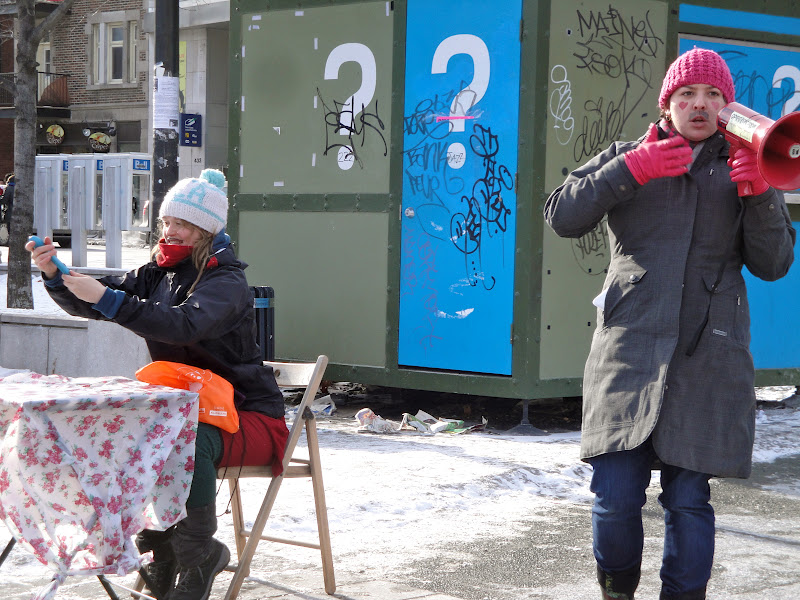
Oh!  Magda is delighted!