About this clown

My photo
I often feel that we're all spinning slowly... like a mirror ball. Yes, we are all mirrors to each other. And so, it is the Light between us that I hope to help reveal and celebrate. /// J'ai souvent l'impression que nous sommes une boule disco qui tourne lentement. Nous sommes tous des miroirs pour les uns les autres. C'est donc la lumière qu'il y a entre nous que j'espère contribuer à souligner et à célébrer.
Showing posts with label spirituality. Show all posts

Thursday, July 31, 2014

Rick Tarnas and Stan Grof

This is an article from RealitySandwich.com. I wanted to copy it here as a memo to myself, and as as way to expose you to this unusual yet absolutely compelling work. Stan Grof and Rick Tarnas were two teachers of mine at the California Institute of Integral Studies, in SF. 
I've been renewing with astrology lately. These were the people that introduced me to it.
Thank you teachers. 

Stanislav Grof and Richard Tarnas: The Birth of a New Worldview


The following is excerpted from Pathways to Wholness: Archetypal Astrology and the Transpersonal Journey, published by Muswell Hill Press. 
Breakthrough in Europe
In the mid-1960s, Stanislav Grof, a young Czechoslovakian psychiatrist working at the Psychiatric Research Institute in Prague, made some extraordinary discoveries concerning the fundamental structures of the human psyche. Conducting sessions with a wide range of individuals in a program of systematic LSD psychotherapy, Grof and his clients encountered experiences that gradually and then irrevocably challenged the orthodox Freudian model in which he and his colleagues were working.
The experiences that emerged during these sessions suggested a far deeper understanding of the human psyche and the cosmos itself than had been previously imagined in any existing psychological theory. After supervising over 3000 sessions and studying the records of another 2000 from colleagues around the world, Grof eventually introduced a far-reaching new model that accounted for the observations of his clients’ sessions, integrated a number of other psychological theories, and reached into areas of human spirituality described by the great mystical traditions of the world.
Grof’s research, although representing a dramatic breakthrough in Western psychiatry and psychology, is supported by many precedents in non-Western and preindustrial societies. Since the dawn of history, guided non-ordinary states of consciousness have played a central role in the spiritual and ritual life of humanity. Stretching back more than 30,000 years, the shamans of ancient cultures began their healing professions through a spontaneous or induced experience of death and rebirth. In a firsthand way, they explored territories of the psyche that transcend the boundaries of normal individual awareness. Similarly, in the rites of passage, initiates were guided into non-ordinary—or what Grof has termed holotropic (from holos, meaning “wholeness”; and trepein, meaning “moving toward”)— states of consciousness and had a personal experience of higher realms that transcend the physical world.

In the ancient mystery religions of the Mediterranean, neophytes participated in various mind-expanding processes in order to move beyond the limits of individual awareness and experience directly the sacred or numinous dimensions of existence. The celebrated Mother Goddess mysteries of Eleusis, for example, which were held near Athens for almost two thousand years, we are now virtually certain used ergot, a naturally occurring form of LSD.1 Many of the creative and intellectual giants of Western culture, including figures such as Pythagoras, Plato, Aristotle, Epictetus, Euripedes, Sophocles, Plutarch, Pindar, Marcus Aurelius, and Cicero, all attest to the life-changing power of their experiences at Eleusis or one of the other mystery sites.
As well as the ritual use of psychedelic substances, many cultures have used methods such as trance dancing, rhythmic drumming, sensory overload and sensory deprivation, sleep deprivation, breathing maneuvers, fasting, meditation, and other techniques to enter holotropic states. Preindustrial cultures around the world understood an important fact of human nature that we in the modern West have forgotten—that exploring the psyche can mediate a profound reconnection with the cosmic creative principle, helping people to heal a range of emotional and physical problems, transcend their fear of death, and reach a more integrated level of functioning in everyday life.
Modern consciousness research, such as that conducted by Grof, has found that individuals who undergo these transformative processes automatically develop an interest in spirituality of a universal, non-sectarian, and all-encompassing nature. They also discover within themselves a sense of planetary citizenship, a high importance given to warm human relationships, and the desire to live a more simple and satisfying life in harmony with nature and ecological values.
The considerable time and resources that other cultures devoted to finding effective techniques for exploring the inner terrains of the psyche is in marked contrast to the values in our modern industrial society. The dominant world view in Western civilization is concerned primarily with the external and physical layers of reality. In many ways it denies the existence of the human psyche altogether, and especially of higher spiritual or transpersonal states.
Grof’s research thus provides an unexpected gateway to a deeper knowledge of the long-neglected inner world. As we will see, the systematic exploration of the unconscious in holotropic states can initiate a profound transformation of awareness—a transformation that many now believe is urgently needed if we are to face and successfully overcome the great problems of our time. However, the journey into the heart of the psyche can be an immensely challenging process, exposing individuals to the depths and heights of human emotional experience. A map of the inner terrain, a way of understanding and predicting what might take place during holotropic-exploration sessions, would therefore be of invaluable benefit.

An Unexpected Rosetta Stone
For years, Grof and his colleagues had looked unsuccessfully for some kind of diagnostic system—such as the Minnesota Multiphasic Personality Inventory test (MMPI), Shostrom’s Personal Orientation Inventory (POI), the Rorschach Inkblot Test, and others—to predict the experiences of their clients in deep self-exploration. Decades later, when the cultural historian Richard Tarnas discovered and systematically applied what Grof would later call the “Rosetta Stone” of archetypal astrology to this problem, Grof had to ironically concede that the one successful predictive technique turned out to be a system that was even more controversial and beyond the range of conventional science than his research in psychedelic therapy. Despite their deep initial skepticism toward astrology, however, the correlations that he and Tarnas observed were striking and consistent over time. Whether the catalyst was Holotropic Breathwork, a psychoactive substance, or a spontaneous eruption of unconscious contents during a psychospiritual crisis, archetypal astrology provides, in Grof’s words, “the only system that can successfully predict both the content and timing of experiences encountered in non-ordinary states of consciousness in experiential psychotherapy.”2

Given the widespread misunderstanding of and skepticism toward astrology in the modern era, a brief preface is required before we proceed. Although many of the founders of modern science—notably Johannes Kepler and Galileo Galilei—retained a deep belief in the principles as well as the practice of astrology, and of a higher cosmic intelligence or God, subsequent generations would later discard this understanding as the relic of an older time. Although the astrological vision became deeply discredited in the modern scientific West, the world view underlying it maintained credibility and continued to flourish in the philosophical movements of late Neoplatonism, Idealism, and Romanticism, in a direct lineage from Socrates and Plato.
This situation began to change in the mid-twentieth century, however, with the work of the pioneering psychiatrist C. G. Jung. Jung’s discovery of the archetypes of the collective unconscious, his formulation of synchronicity (“an acausal connecting principle”), and his speculations concerning the anima mundi (world soul) provided a conceptual framework for the mature rebirth of a more psychologically oriented and nuanced form of astrology. Brought to fruition through the writing of figures such as Dane Rudhyar, Robert Hand, and Liz Greene, this new approach drew on the insights of Jungian depth psychology while leaving behind many of the fatalistic dogmas of the old astrological tradition. Hand’s work also set the stage for a much more rigorously self-critical and self-questioning discipline.
Then Grof’s friendship and collaboration with Tarnas was to initiate another major leap in the field. A highly respected philosopher and psychologist, as well as historian, Tarnas gained international acclaim with his best-selling The Passion of the Western Mind (1991), which went on to become required reading in a number of university courses around the world. He followed this in 2006 with Cosmos and Psyche, in which he presented over five-hundred pages of systematic and compelling evidence to support his groundbreaking theory.
Tarnas begins by introducing the concept of archetypes that has played such an important role in the Western philosophical tradition. For now, we can describe the archetypes simply as primordial patterns of experience, which influence all people and cultures in the form of basic habit patterns, instincts and emotions. In Cosmos and Psyche’s bold hypothesis, Tarnas suggests that the dynamic interplay of these timeless universals that have shaped our history occurs in coincidence with geometric alignments between the planets and the Earth, intelligible through an emerging epistemology and method of analysis which he calls archetypal astrology.
In contrast with traditional astrological belief and practice, the archetypal approach that Tarnas introduces is non-fatalistic and non-deterministic. The archetypes are recognized at all times as being complexly multivalent and multidimensional—taking different forms in different situations and at different times in people’s lives. Each archetypal complex can manifest in a wide range of possible expressions, while still being true to its basic thematic character. Tarnas carefully demonstrates that the methodology he presents is archetypally predictive rather than concretely predictive. Although planetary alignments can illuminate many essential characteristics of an historical epoch or individual life experience, and even suggest basic expected characteristics of an upcoming period, he emphasizes that the specific concrete expression the archetypes will take at any time remains indeterminate—contingent on additional factors such as cultural context, free will, co-creative participation, and perhaps unmeasurables such as karma, grace, and chance.
It should be acknowledged that many of the fundamental tenets of the emerging archetypal world view concerning the nature of the human psyche and of the universe itself are compatible with the most recent branches of modern science, including quantum-relativistic physics, Pribram’s holographic model of the brain, Sheldrake’s study of morphogenetic fields and morphic resonance in biology, Prigogine’s study of dissipative structures, systems theory, chaos theory, cybernetics and information theory, the anthropic principle in astrophysics, and others.
Grof also mentions the pioneering attempts of Ken Wilber and the successful accomplishment of Ervin Laszlo in integrating transpersonal psychology into a new comprehensive paradigm.6 I would further note Keiron Le Grice’s work in The Archetypal Cosmos, which draws on the implications of Tarnas’ research and integrates many of the new scientific theories in direct support of an archetypal or holotropic world view.7 Perhaps the most concise way to describe this emerging paradigm in science is the realization that consciousness, rather than being an accidental by-product of neurophysiological and biochemical processes in the brain, is an integral component of the universe itself.
The most well-known area of Tarnas’ study to most readers has been his exploration of cyclically unfolding archetypal dynamics in human history and culture, deeply informed by the principles of Jungian and transpersonal depth psychology. A less widely known aspect of his inquiry, and the area on which this book concentrates, is based on his research with Grof into holotropic states of consciousness. In 1990, I proposed the term holotropic astrology to describe this facet of Tarnas’ research that is specifically concerned with holotropic states.
Tarnas refers to astrology as a kind of “archetypal telescope” directed on the psyche, a way of understanding and contextualizing the material that emerges in deep self-exploration. Grof similarly concludes that the role of holotropic and psychedelic states of consciousness in psychology is comparable to that of the microscope in biology and the telescope in astronomy. When responsibly combined, the therapeutic effectiveness of these powerful magnifying processes of the psyche cannot be overstated. During my own three decades of research with workshops, consultations and personal experience, I have come to believe that archetypal astrology and holotropic exploration have the potential to revolutionize humanity’s relationship with its deeper nature and help us to rediscover a more harmonious relationship with each other, the natural world, and the larger cosmos.

Sunday, August 4, 2013

''Présence Autochtone'', racines et aspirations


Je songeais à un truc...

Il leur fallait ''la foi'' pour survivre ces hivers, pour défricher et bâtir sur ces terres.  Il leur fallait une enceinte où produire de la chaleur humaine. Combien d'églises ont joué ce rôle rassembleur?  La religion catholique est partie intégrante de notre histoire et j'aimerais qu'on en discute.

Je ne parle pas verser nos économies dans la dîme des prêtres, de se laisser marcher sur la tête, ou de sacrifier nos corps pour la procréation de la race (bien que, comme je tiens toujours à le rappeler, il nous fasse aussi reconnaître que nous ne parlerions peut-être pas français aujourd'hui n'eût été de l'injonction de procréer ). Je ne parle surtout pas de poursuivre dans la voie de la négation de notre élan vital, de baigner dans la culpabilité et la peur. (Car nous devions aussi être ''sauvage'' pour apprendre à vivre ici.)


Je m'adresse au peuple québécois tout en m'adressant à tout le monde.


Cette semaine à Montréal se tenait la vingt-troisième édition du Festival ''Présence Autochtone''. Que dire...

Entre le sentiment malaisant que me procure ''La place des Arts'' et ses odeurs de Panopticon (ou comme si l'art pouvait se restreindre à des espaces choisis, prédeterminés, bétonnés, encerclés, commandités!), et la part de soulagement que je ressens à voir cette présence...
Un teepee moderne, géant, accroché à 40pieds dans les airs par une grue. Malheureusement la photo que j'ai prise est prisonnière de mon appareil photo qui est vraisemblablement kaput (émoticon triste) (Serait-ce le moment de m'offrir la caméra de qualité dont je rêve depuis un long moment?), mais la scène est génératrice de sens... (Quelques photos que je ne peux pas partager - vivement les Creative Commons- et qui vous donneront une idée se trouve sur le site de nul autre que... Loto-Québec, fier commanditaire! (Émoticon ''ironique'')

Je tergiverse tant! Ève, reviens dans le droit chemin.

Bref. J'ai adoré mon expérience de ce ''festival''.
1) Découverte de l'artiste Shauit, musicien et chanteur reggae, natif de Maliotenam sur la Côté-Nord: du rap-reggae en Innu! (Talk about reclaiming a language et prendre la parole!) 

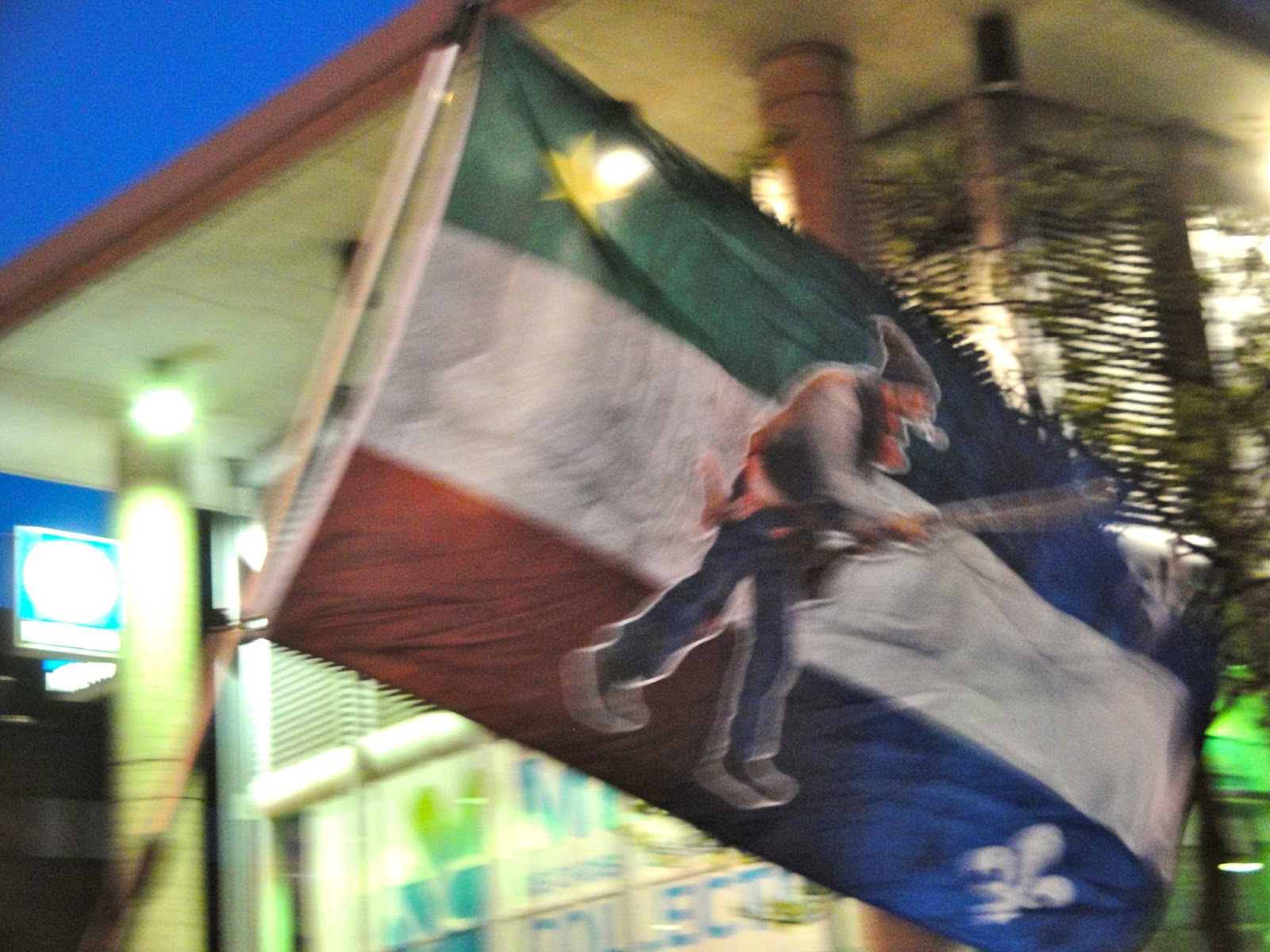
2) Rencontre et conversation avec Yvan.  J'ai vu Yvan pour la première fois mercredi soir dernier, lors de la projection du film ''Ramer d'une seule voie'' ( Cliquez ICI pour le voir: ça vaut le 15minutes.) au Musée McCord.  Il était dans l'audience, tout simplement.  Dans le film, un drapeau que j'aperçois pour la première fois:


Vendredi soir donc, sur la place des Arts, le même drapeau.  Je m'approche pour m'enquérir un peu au sujet du symbole, etc.  Je me faufile dans la foule et me retrouve devant cet homme, Yvan, longs cheveux raides et noirs, yeux pétillants, ceinture fléchée et colliers traditionnels. Dans sa contenance par contre: la vibe d'un ''québécois''. Son accent, son nom, son aura.  Bref, j'apprends que le signe d'infini a été adopté par la communauté Métis.
'' On est tous issus du métissage.''
''Nos ancêtres se sont alliés. Les colons étaient des hommes et des femmes courageuses, notre culture est une culture de la terre d'ici, des conditions et des besoins d'ici.  Notre culture est remplie de la présence autochtone: nos canots, nos raquettes, nos textiles, notre courge et notre maïs, notre langue...  Notre emphase tend à porter sur l'inimité, sur la blessure et les autres facettes souffrantes de la colonisation.  Certes, il est essentiel qu'on se fasse ce devoir de mémoire.  Mais serait-ce possible que le temps soit venu pour outrepasser la grande blessure et pour entreprendre un dialogue qui continue d'aller de l'avant?

Un autre drapeau déjà aperçu: blanc avec un arbre dessiné dessus: La famille. ''Et ce drapeau-là, tu peux m'en parler un peu?'' ai-je demandé à Yvan.
''Ça c'est La famille. Ça veut dire qu'on est tous une famille et qu'on doit se rappeler ça, des racines vers le tronc, puis les branches, nos parents, d'autres branches, nous-mêmes, et nos enfants...''
''Et notre connexion avec la terre'' je rajoute.
Il me sourit. ''Oui'' ''Et y'a les racines surtout, parce que si on coupe les racines, l'arbre meurt.''
''Nos aînés, nos ancêtres...''

Euh...
Partage d'un ''pregnant silence'' (une belle expression que les anglophones utilisent). Et je lui confie, ''sauf que c'est justement quelque chose qui me fait peur; au Québec, cette relation défectueuse avec nos aînés, notre incapacité à conjuguer la ''vie moderne'' et le prendre soins de nos parents. (À ce sujet, un l'Institut du Nouveau monde entretient un dossier TRÈS intéressant: http://www.inm.qc.ca/a-propos/paroles-de-linm/la-declaration-des-generations-2011) Ça ne me donne pas beaucoup d'espoir.''

Yvan me regarde et me dit, d'un ton scintillant:  ''C'est pour ça qu'il faut qu'on regardes dans les yeux des enfants. C'est eux qui nous montre la Vie.''

Une conversation de quinze minutes, droit au fond des choses. Amen

Je n'ai pas fini ma tirade sur l'Église et la spiritualité au Québec.  C'est évidemment un travail en cours/ work in progress.  But you get the point...
J'ai dis qu'il fallait la foi.  J'aimerais qu'on parle du mot.

Église sur une réserve près de New Richmond, dans la Baie des Chaleurs.


Wednesday, August 1, 2012

politics and the phenomenology of paradox

Sitting in my former school, the California Institute for Integral Studies. Soaking in. Reading and meditating on the different objects of my attraction.  On the one hand, mysticism and the taste for a free, unconditioned experience of Life.  On the other hand, visions and fears concerning the condition of matter, humankind, society, and Mother Earth.
I've been reading Mircea Eliade on Yoga.  I've also been seeking those with explicit inclinations towards consciousness studies... taking full advantage of this special Bay Area spirit.  It's clear to me, a region produced by the frontier mentality had to be permeated by idealism.  This place was born out of the necessity and capacity to see further, to open up paths into the unknown, to envision riches and dig for it.  The gold rush is of the past, but furher riches are being unearthed here. 
We've colonized land to the very edge of the new continent, and so came facing the unchartered territories of the mind, aided by the wisdom of Indigenous (behind) and Asian (ahead) cultures... This to me is one of the greatest gifts of San Francisco.

I am re-membering the pieces of my own journey.
I am considering the nature of time, and space.
I miss Montreal and the nation of my ancestors.  And in the material plane I wonder, I feel, that I can contribute something of what I've been learning...

Back in Quebec, the elections have been officially announced by the prime sinister - uh, minister.  Given what has sprung out of the "Printemps Erable", Charest might be right on one point: these could be the most important elections in the history of the province.  Or not.

It's 2012.  How many are able to dare and be visionaries?  How many would agree with my intuition; that we too are of a certain frontier mentality?  We are made up of pioneers (though we were first enslaved to the Catholic Church, and since then, to our fears and victim mentality.), ingeneers (for we had to keep ourselves warm and sufficiently fed) and hard-working families.  We were multicultural from the start, all immigrants on indigenous territory.  We have wide spaces and tons of ressources; water, minerals, wood.  We have circumstances, which point to warmer climates and future population growth.

We have so much potential.  If we acknowledge it.
If we can truthfully consider the power structure and the dynamics that are making up our society.  If we can keep talking amongst neighbours to revitalize the connections we have with one another; if we can let this be a strength that helps us out of fear and stagnation.  If we can imagine what is possible through emancipation and cooperation.

I cannot deny my vocation for political philosophy.  I also cannot deny my understanding that there is an Ultimate reality, beyond the illusion of separation and the fear of ego death.
I wonder how to honor both.
I am sitting at the California Institute of Integral Studies.

Thursday, May 31, 2012

A Day in a De-Growth Life

I like the work set up that I have going on right now.  I work three shifts per week at the restaurant, and I have four days off.  That's barely part-time...
So what do I do with the rest of my time?  (How do I make ends meet?)
I'm living very well, thank you.

Actually, I've now found a complementary job. Yep, I'll be joining the ''Echo'Scouade'', a team of animators-educators, which tours some of the biggest festivals in order to raise awareness on the topic of waste management, i.e. recycling your bottles while on site...and at home.
Between the two jobs, I should be able to feel a certain financial stability this summer.
And I still get to have about three days off each week.

My point in sharing all of this is to share one example of a life that is possible... A life of quality, of not being ruled by a work schedule, a boss, a mortgage.
What I'm really talking about is tied to a concept I've been musing over for some time: de-growth.

A couple of weeks ago I attended an international De-Growth Conference.  There, eminent professors and lecturers talked about different aspects of the transition our civilization might want to get into.
De-growth means stepping away from the illusion of happiness as progress and profit.
To me, it seems to point towards greater sanity and health, as well as creativity... and intimacy.  Instead of isolating ourselves by spending forty hours tiring ourselves out at work, coming home being exhausted, watching tv as an easy way into mindless relaxation, and wondering about that yearning for deeper and more meaningful relationships... We could work half, or even three-quarters of that time, and spend the remaining hours enjoying the presence of people we love, perhaps growing some plants that will give us food, and coming to terms with our fears of nothingness...
Don't you think?

I fear nothingness.
I fear the changes that are happening.  But I love the changes that are happening.
It has to do with Time, in part.

Am I inhabited by that old millennial, apocalyptic thinking?  I don't think so.  I don't think the end of the world is coming.  At worst, the human species would perish within the next fifty to two hundred years.  At best, we create a more sustainable world for ourselves.  Chances are, we're shifting from His-story to another kind of story...

Either way, Life and our Consciousness of it All is Divine and Beauty-full.

We could really use more networks of bike lanes and installations that make it easier for everyone who can use bicycles to get around.  We could rush less, move more.  We could spend less, and help each other more.  We could take time to communicate with our neighbors, get to know each other.  We could solve problems together.

Today, I ate breakfast with seven other people.  Then I cut my friends hair on the balcony, and after that I gave an intro of an astrological reading to a friend and I cleaned around the house.  After lunch I juggled a little bit outside while waiting for my other friend to return with his bicycle.  We talked about the choices he's trying to make, his aspirations and his fears.  We talked about going for a bike ride to the Canal Lachine.  But then a girl from work - she's gorgeous! - happened to walk by our house as we were sitting on the porch, so we invited her to sit with us a little bit.  We hung out, with two of my roommates.  We talked about synchronicities, about ''the hundredth monkey effect'', morphic fields (we didn't have the names for those phenomenon but that's what we were talking about), and collective consciousness.  We talked about sharing our greatest potential within the communities you are part of.
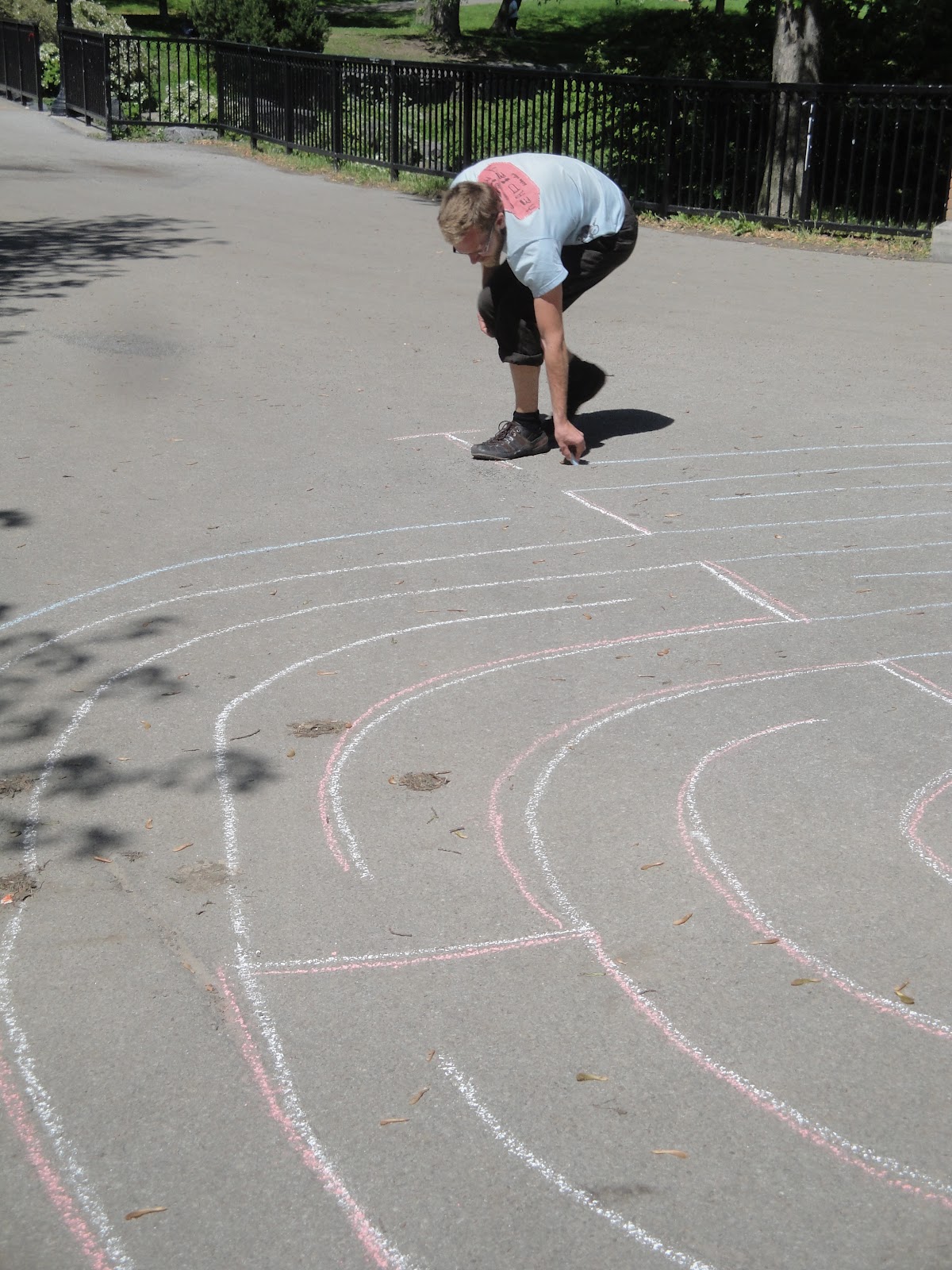
And then A. and I went to Parc Lafontaine, and we drew a huge chalk maze in the middle of a path.  People walked by with a smile.  They asked a few questions.  They wanted to walk it and they did once we finished the piece.  Two park workers drove by. ''We're making ephemeral art,'' I told them.  ''I was just taking a look'', one of them said with a smile.

We went to the market and bought lettuce and radishes (grown ''in Québec''), some pears, a mango, grapes, and avocados (grown far away), roasted sunflower seeds (where from?) and some balsamic and oil to make a fresh salad.  We made dressing out of mango pulp, garlic, ginger, lemon, balsamic, grape, and sesame oil.  We sat on the balcony and feasted while reminiscing about the intensity of yesterday's storm...
Yesterday, a crazy storm fell on Montréal.  Dark clouds and thunder quickly led to heavy... heavy rains, which, we soon learned, turned into flooded tunnels and metro stations!!!
Nature is mighty.

The climate here is so different than what it is in the Bay Area... I loooove these warm summer storms!

And tonight, I'm finally going out to dance!  It's been months since I've made it to a good dubstep party...

You can follow your bliss.  Take part in the beauty of existence.


Thursday, February 16, 2012

Bios-que-faire?

Psychic tension.  Tension psychique.
I've been offered a job... in a wonderful independent bookstore!  Biosfaire offers books on everything from permaculture to Buddhism, to anthroposophy, holistic health, and transpersonal psychology, to community living, consciousness studies, and super foods...

I had walked in there out of curiosity, and did something I never quite dare to do by asking, ''Do you guys happen to have a job opening?''
''Well yes, actually, in March.  You can give us your résumé.''
So I did.  I printed the appropriate version and walked over there (It's 10 minutes from where I live right now, and it'll be a ten minute bike ride once I move to my new place ... and get a bike) to find the owner doing her inventories.
''I studied Philosophy, Cosmology, and Consciousness'', I said, handing my résumé.  ''So your place pretty much feels like home!''
''Where did you study that?'' she asked.
''In San Francisco.  I just returned.''

She called me about a week later, that is, a few days ago.  ''Honestly,'' she told me, ''you are over qualified for this retail and service job... However, I do think you would have a good time working with us.''
I do too.  The problem is that it doesn't pay anything.  I mean, 16$/hour at a community center is already quite basic... But this.. is not even close to that.

I don't know what to do.
I just turned in an application for a position with the most amazing Non-Profit organization, called Exeko.  There, I'd get to use words, and symbols, as well as my social skills (I'd work in communications), in order to represent and promote artistic, cultural, and educational programs which are taking place with indigenous, incarcerated, and mentally disabled populations!  I mean, talk about an integration of my interests!
But what if I don't get it?

Maybe working in the hub of holistic health would be just as perfect...
I'd get to smell everything that's being published (oh! the scent of a freshly-printed book!), I'd certainly get to discuss eco-psychology, power of intention, and planetary wisdom with clients; I'd be able to speak that language on a day-to-day basis.  I'd be surrounded by the work of those I emulate.  I'd be inspired... and-or overwhelmed.
I was just telling a friend about feeling overwhelmed when I'm in a bookstore sometimes.  I want to read them all, and comment on them all.      I want to write them.  (But not all).

I was just telling another friend, that regardless of my stance against capitalism and consumerism I actually want to be financially comfortable.  I don't know exactly how that's done.  I guess the more you have and the more you fear of losing it anyway.  And what's being ''comfortable'' ?  I've lived with the premise that keeping my needs in check is a good start.  Do not succumb to the consumerisssss serpent.  Do not get fooled by advertisement.  So many get into debt trying to fulfill an emotional gap with stuff.  I just have to make sure I don't do that.  I just have to make sure I spend my money on what really matters...

But. 9, 75$ for an hour?

Acting out of fear? (of not finding something else)
Or acting out of love? (I've always dreamed of working in a library... and this is the best independent library in town!)

What do to?

Sunday, December 18, 2011

Catalonia throughout His-story

Processing a visit at the Museu d'Història de Catalunya...

I finally shook myself up after two strange days of energetic and emotional tumult (more on this in another post), to take myself to one of the museums I had intended to visit during my week in Barcelona.
It has been a most unsettled kind of week through which I have learned A LOT.  But I'd like to attempts not to disgress into the personnal sphere quite yet and focus my writing on the experience I just had at the museum.
Of course, it is all related.  We call it Life.

We call it History.  Mainly indeed: his-story.  Words upon words, artifacts and media of all sorts, exhibitions to trace the line of a place.
I wanted to see this particular museum because I don't know anything about Catalonian nationalism and its roots and aspirations.  There is a conception, an assumption, of a connection between Quebec and Catalonia.  It´s true, we are minority languages (and thus cultures) with long standing struggles for recognition and independence.
But I think it's actually much more complicated and nuanced than that.  Nothing can be isolated or singled-out so easily anymore.  We have learned that much.

This was yet another journey down the ages... (How many museums have I visited in the past three months?) This one starts in the lower paleolithic era.  Fossils from some long gone homo erectus ancestors were unearthed around here.  Four hundred fifty thousand years that is. 450,000 years - most of which were not conceived on a Roman calendar.
So I'm walking around trying to imagine that concept, trying to imagine the most primitive conditions and technologies, the most ancient modes of human lifestyles.  Nomads.  Cave dwellers.  Very small carbon footprint.  Yet so many other short-comings I'm sure.

It's precisely that phenomenon that blows my mind.  I cannot help myself, I look at everything through utopian lenses!  I'm there, studying, reading, pondering images and objects, while some part of my consciousness is always searching for connections, for clues if not examples, of "good" living.
Meanwhile another part of my brains smiles like a buddha, asking gently and humbly: "what is good?  justice?  what is justice?"  The Buddha would have more than evidence from this exhibition: life is suffering.

O such [beautiful] complexity!  Complexity of power structures, of misery and labor, of blood and soil and migrations and multiculturalism, and occupations and wars and political and religious systems, and technological discoveries and developments, and social classes, and power structures.... and power structures.
Another part of my mind is gathering information with what appears to be a attempt to situation myself and find answers to my current quest.  What is my role in society, at this time, in this body, with this conditioned reality?

I'm a young woman, from a middle class family.  One of my grand-fathers worked in a paper mill, the other one on his family farm.  My parents moved to the city as soon as they could; they bought a freshly-built house in a pleasant suburb.  Quebec has [only] been colonized for 400 hundred years.  What did my ancestors do, back in Normandy and Brittany?  What social class did they belong too?  I'm a global citizen, fruit of a cultural globalization movement that began... well... over 450,000 years ago.  I'm educated, out of touch with industrial and agricultural means of production.  I'm a mind, a spirit, a body, a heart.  I'm a philosopher, a spiritual being, a political thinker, an artist.  All these used to be the domain of men.  All these, used to be (and to some extent, they still very much are) valued, and as such they were sponsored by those with money, with ranks, with land.

I want land.  I think I'd be able to learn how to keep it alive.  But I'm a lazy-ass generation Y kid (why!?), living off the historical struggles of peasants and syndicalists, who toiled and fought with their lives for some minimal changes in labor conditions.
And I'm here, in Barcelona, typing on a macbook Air in an Irish Pub, pondering the state of the planet and the next steps to take in order to... in order to what?
To fight for Liberty, Fraternity, and Equality?  It's such a relatively recent concept, though we can obviously trace it back to Jesus Christ, (and most likely, to other people before him.)  But they killed Jesus!  And they still have the power and the weapons and the capacity to blow it all up if they feel like it!  They still have the power to kill anyone they choose, to occupy the land.  Do they know how to make food grow?  I'm not sure.  But they have gunpowder, and satellites.
So what's the point if there's no spiritual realm in which to find redemption?  I'm not talking about another life in the Kingdom of Heaven.  I'm only thinking dignity, in promoting love and wholeness, and dying when the time comes, even if it's at their hands.

History is a strange and wonderful thing.  Wholeness, for instance, takes a whole new meaning in today's world!  Wholeness is a scientific fact!  We can see it on one of the greatest photos ever taken: Earth Rise.

NASA, Apollo 8. December 24, 1968.

The world is one.  No denying.  Physically at least, so economically too.  For eco-logy is eco-nomy is oikos: home.
I wouldn't mind a peaceful home where I can age with some kind of security, within a community, which to me, is Spirit.

Wow.  Who said museums were boring?
;)

Oh.  I remember now... Catalonia.  Well I learned it's a national identity that emerged out of several many a lot of geopolitical dynamics and fluctuations.  But what's new with that?  It's always the case.  In the case of Catalonia, we're talking NorthEastern part of today's Spain, which was inhabited by Iberian people prior to conquests and settlements by Greeks, Carthaginians, and then Romans.  (A pattern very similar to that of most of the Mediterranean coast).  Here the Visigoth kingdom then took over and briefly ruled until the Moorish empire spread its Al-Andalus territory (8th cent.) to include the Iberian Peninsula.  The Franks coming from the North eventually made their presence known, and somehow in 795 Charlemagne created a buffer zone - called Marca Hispanica - between his empire and that of Al-Andalus.
I think this buffer zone thing is very interesting.  I don't know enough of the details and the history, but it looks like that zone included those parts of country where nations would later demand cultural recognition and autonomy.  It's the Pyrennes; and it's the Basques and the Catalans, etc.

Anyway.  The catalans became stuck between the French (Franks) and Spanish (Aragon) kingdoms at some point.  It was ruled by a bunch of counts who ended up not buying into French nor Spanish feudalism.  They had a different system, a more democratic, decentralized one.  They worked some sort of consensus organization between the different ruling groups (priests, counts, merchants? Don't remember.  But certainly no peasants nor women!)

Then it was the maritime age of commerce, and cities popped up and the plague came through and the peasants rebelled against tyrannical kings and the Americas were conquered and Catholic authorities came in and then brought the Inquisition, and more commerce happened and soon the first phase of industrialization with its capitalism and the formation of new social classes and the ebullient anarchist-syndicalist movement and a civil war and a bloody dictatorship...

And today.  A neoliberal, global economical crisis is affecting Spain quite badly, with about 24% unemployment.  Cell phones, immigrants, political apathy and young adults spraying graffitis...

It has changed so much and it is so much the same.


Wednesday, December 14, 2011

Bus ride with Allah

23:30, I step on the bus and walk to my seat: the very last row, the one that doesn't recline. Oh well.  I almost didn't get a ticket in time, so I guess I can't complain.  Sitting next to me is a young woman.  She's wearing a hijab, and a beautiful smile.

"¿Adonde te vas?" she asks with a sweet voice.
"Hasta Barcelona."
"Pues, que lejos!" she says.  "¿Vives allá?"
"No.  Soy de Canada."
"Oh! No eres Espanola?"
I'm flattered.  
We exchange names and more background information.  I tell her the same story I've carried with me around the old continent:
"No estoy de vacaciones como de transición.  Por que soy de Canadá, pero viví en los Estados Unidos por los diez años pasados.  Y después d'este viaje yo regresso para vivir en Montreal."

She tells me she's from "Al-Jazeer", or something like that, close to Cadiz.  Al-Jazeera? I heard that word before.  I did a bit of research and didn't find an Andalusian city by that name, but the point is that it's in the South of Spain, and obviously has that wonderful arabic influence.
She tells me she's originally from Marrueco (Morroco).  She has seven siblings; six brothers and one sister.  Two live in France, one in Deutschland, two (including herself) in Spain, and two in England.  (Who knows where the other one is!)  She asks if I'm married.  I smile.  I guess at this point it's not so much a cultural difference.  I know a lot of folks my age, who are getting married.  "No."
"Por que?"
"Por que... por que viajo mucho y quiero buscar mi proprio camino ante de casar me."
"Tu no quieres casar con alguien de otro país?  Por que?"
I explain that it's quite the opposite.  I tend to fall for foreigners.  And that creates a bit of a conundrum because I'm left with my family and my native land on one side, and a potential future and family of my own, that would be far away from them.  I find that very problematic.

She does have a husband.  She tells me he's much older than her.  She's thirty-one; her husband is fifty-six!  She says love knows no age, no race, no language.  Fifty-six!?  I gotta admit that I find that hard to imagine for myself... but she's got my respect.  Her presence is so sweet and loving.  I like her.

The bus is making its way North-East in the dark night; we are chatting away.  She asks about Canada.  She depicts her home in Morocco, her home in Spain.  She's in love with life and with the beautiful landscapes she's daily surrounded with.  She says I have a place to stay when I come to Morocco.  (I should have asked her if there's an expiration date on the offer or if I can show up in, let's say, five years?!)
  
She asks what I do for work in Canada.  I remind her that I haven't lived there in a decade, and tell her I worked as a nanny in San Francisco.  "Una kangaroo", as they say here.  She is a cook in a Moroccan restaurant.  Her husband is the chef.  She asks if I like to cook and what I like to eat.  "Comiste carne?"
"Pues.  No puedo decir que soy vegetariana... pero yo quería ser.  Es que, aquí, quiero probar la comida de las diferentes culturas."
She's silent.  I'm wondering where she stands on the issue.  I explain, "para mi, no es necesseramente que no quiero comer animales, pero a mi es una pregunta de la manera que los tratan.  Por que no se como es la industria aqui, pero en America, hay muchas fincas muy grande y industriales donde que les tratan los animales de una manera súper inhumana, sabes?"
Still silent.  "Para mi, es importante tener respecto.  Y si comio carne, yo digo gracias ante."

"Y comes puerco?" she finally utters.
"Eso no."
"Yo no comió puerco tampoco.  Y tu fumas?"
"Pues. As veces, si."
"Bebes?"
"Eso también.  Me gusta tomar, pero no para estar borracha.  Y tu?  Bebes?"

She tells me she has never had a drink, or a smoke... "por causa de la religion."  She says with a big smile and pointing at her headscarf.  "Lo hizo todo, el hijab, el Ramadan, todo."  She has the most radiant and pure look on her face.  She looks proud, but in a calm, humble way.
I'm so interested in this conversation!  I've been wishing to interact with an arabic woman for some time.  I had given up on that wish, actually.  But here it is now.  I have so many questions and I want to be careful... respectful.  I ask if she prays five times a day?  What time is the first call to prayer?  Do she go to the Mosque for all of them?  I tell her that I like the idea of stopping everything you're doing, five times a day, to remember and bow down to something greater than you."
"Y es bueno ejercicio también!" she says half serious.
I had never seen it that way!

She tells me that Islam is a very healthy religion.  Pork is very fatty, and it apparently contains some hormone, which is cancerous to humans.  That's why muslims don't eat it.  She says the holy book is full of recommendations that are targeting health.  She tells me about Ramadan.  The first two days are the hardest: no eating, no drinking, no sex.  But then, one gets used to it and the rest of the month gets easier.  She's been doing it her whole life, since she was eleven.  I learn that women begin to take part in Ramadan when they have their first menstruations.  Boys start around fourteen or so, when their voice begins to chance and they are becoming men.  When a woman has her period, she can eat normally.  Same thing when she's pregnant, or when she's breastfeeding.  Old and sick people also can eat.  It's important to remain healthy.

ablution facility
I guess ablutions can be seen in this light as well.  It's good to wash your hands and face, and feet, five times a day!


Prayer Hall
Blue Mosque, Istanbul
Our connection is very good and I feel that I can ask her the question that's burning me.  I want to know why women sit on the sides during prayer at the Mosque.  She smiles and explains to me... The woman's body has these... curves... (I see!!)  With the set up and proximity of congregants in the prayer hall, and with the multiple getting up and bowing down that is muslim prayer, it would certainly be very distracting to men!!
From what I understand, it's the same thing with the veil.

I've come to think that, in a big way, I've developed this tom-boyish attitude and dress as a way to protect myself from the other sex.  Sometimes I think wearing the hijab would be so liberating.

It's about two in the morning now and my being is filled with a peaceful kind of love and gratitude.  "Eres cansada?" she asks.
"Si. Un poco. Y tu?"
"Si. Descansamos un poco, si?"

These non-reclining seats are uncomfortable, but I think I shouldn't have a problem falling into that altered state of consciousness, between sleep and awareness.  I've gotten used to it.  I kinda like it.  She is trying to find a way to rest her head.  I tell her she can use my shoulder.
And I sit straight up, close my eyes, and thank God for this beautiful encounter.

Alhamdulillah! 

"One Love.
Let's get together and feel alright!"


Thursday, December 8, 2011

Cadiz to Albolote, always now

I just went for a short walk through the sleepy streets of Albolote, a small town of 15000 inhabitants, resting at about seven kilometers from Granada.  I slept here last night, in my own quarters.  I found a guitar, which was already tuned, and played a little bit.  (The area is actually famous for its guitar makers, which makes sense when you make the connection: this is Flamenco land!)
But more on this later.  First, I would like to back track to twenty-four hours ago, as I spent the preceding night in yet another historical location: Cadiz...


I had spoken with my mom the day before, while still in Sevilla, and she had asked: "Prends tu un peu le temps de relaxer, de juste... rien faire, genre t'installer sur la plage avec un livre?'' (''Do you take time to just hang out and do nothing, like, sit down on the beach with a book?")
"Well I haven't really been around beaches much, except in Nice... and even there I just took a twenty minute stop to skinny dip in the Mediterrean, before catching the train to Ventimiglia."

I have taken time to stop.  I have been meditating, actually, and I've sat in many a bus doing about nothing.  But it's also true that I've walked quite a lot over the past two and a half months.  Faithful to myself - for better and for worst - I've been curious and I've made a point to take in as much as possible about everything I get to see while being on the old continent.  However, my mother's words sounded timely and significant when I sat down with the map of Cadiz (and a cerveza fria) from the office of tourism.  My hosts lived on the other side of town (though it is a small one, on a peninsula) so there were a few "historical points of interest" on the way; but I decided I had seen enough churches already (and honestly, I just didn't feel like rolling my noisy suitcase around those paved streets), so I chose to pass on the architectural tour of "the oldest city in Europe" (Cadiz is 3000 years old!) and go for a walk along the Atlantic Ocean instead.  Only one day in Cadiz?   So be it!

This is where Christopher Colombus set sail from.
And this is where he came back to, with loads of exotic products
from "the Indias": potatoes, tomatoes, corn, etc.
  

The day was gorgeous.  "December 7th ?"  I laughed inside: "Como me gusta el sol!  Como me gusta esa luz!"

I got lost once - faithful to myself - but eventually arrived in la calle Angel.  I crossed my fingers and rang the doorbell.  I knew my host wouldn't get home until 8pm, but she'd said her roommate Clement would be there.  I don't have credits in my "handy" anymore, and it's very much starting to look like I'm not going to recharge it before I leave, in less than two weeks, so I couldn't call to notify of my arrival!  But someone did answer the door.  "Eres Clement?" I asked.  "Si."
"Eres frances?"
"Oui.  Et toi.. canadienne?"
"Ouais."

I think that every single French person I've met so far calls us Canadians instead of Québécois.  You'd think they'd be more precise, you'd think they sympathize.  But no.  They don't even say "Canadiens français"... just.. ''Canadiens'', who speak.... canadien!.   They don't make the difference, they don't necessarily know or care about our dear crise d'identité.  It seems that for them we are already different, since we live on that far away continent called America.
Clement offered me a cup of tea and a plate of noodles he had made for lunch.   We chatted a little bit, and I found out I had landed in one of those Erasmus flats, just like in that movie ''L'Auberge Espagnole''.  There lived five exchange students: from Lithuania, Poland, France, and who-knows-where-else, and they all came to Cadiz to study, learn Spanish, have a cultural experience... and to fiesta, of course.
"And you often host couchsurfers?" I asked.
"All the time!" he said, "We once slept eleven people in here!  There were three girls on the kitchen floor, and three more sharing my roomate's room. Plus all of us."

I noticed a French novel on a shelf and asked if he'd perhaps be interested in trading it for the one I had just finished.  It was Jack Kerouac's "Le vagabond Solitaire" (The lonesome traveller).  Que bueno!
Then he went on to study some more, and I took the book, as well as my juggling clubs, and went for a walk.  Screw all these landmarks; Cadiz is a maritime city, and I decided I'd just hang on the coast some more.  I walked and walked and smiled and sat for a cup of cafe con leche, until the sun began to set.


I don't know what goes on in the streets of Cadiz, but my sense is that the beach is where it's at.  People tranquilo.  People playing guitarra on the boardwalk, singing Flamenco.  Couples strolling.  Quite a romantic setting indeed.  A group of teenagers setting up for a most clever and impressive game: an exercise ball buried in the sand, and they used it as a trampoline, to practice saltos and other acrobatics!


After sundown I walked some more, guiding myself according to the changing qualities of light on buildings, and following the sounds that suddenly came out of small neighborhood bars, here and there, where locals - and their children- gathered for happy hour and a bit of soulful Flamenco. 

Back to the apartment I had a chat with M., attempting to explain, once more, what I studied in San Francisco.  She was especially eager: "Tell me what you learned."

So I tried once more; first in espagnol but eventually switching to English.  "Well, I've learned that everything we see is a projection of our psyche - it's all one - so that our sanity is directly connected to the health of our environment."  
3000 year old Magnolia?

"Everything is deeply and intrinsically interconnected: psyche, nature, one another..."  
"I learned that everything is already perfect, but that it doesn't mean we should do our best to change the world for better.  It's called paradox, and it pervades everything."
"And finally, I found that changing one's self - or ones relationship with one's self - is the hardest.  I'm still working on that, big time!"
"Tell me more," she said.  "Do you meditate?  I think we're all so addicted to thinking."
Right on hermana. "I do'' I answered. ''I try."
"I have a really hard time meditating." she said defeatedly.
"That's all there is," I said to validate her experience.  "But I read somewhere, and I always like to remember... that meditation simply is such a great opportunity to practice self-love, as in, forgiving one's self.  Because we always fail at it, and we can choose to judge, or to forgive."

"Tell me more."
"What if we just sat together, right now?"

So we did.
And afterwards, she went to sleep and I went out with the others.  It was already midnight and they were just getting ready!  
We went to a bar called Woodstock.  We met a friend of theirs, who also had a couchsurfer with her.  Around the table, there were now five different nationalities: Spanish, Russian (Lithuanian), French, Quebecoise (Canadian), German.  We spoke Spanish, French, German.  We drank tinto de verano and cervezas.  We sang Bob Marley: One Love.

L'Auberge Espagnole!
This morning I got up before all of them, made myself some tea to go, and went to catch the bus in direction of Granada... well... via Sevilla.
And here I am.  I'm staying in a family home and it is gorgeous.  Cold at night, but gorgeous.  And tomorrow I have plans to help out in the garden.  I could go to the city and visit the Alhambra  (''not to be missed!'', they all say), but I'd much rather learn how to prune the lemon tree!!

Love it!

Wednesday, November 30, 2011

Soul talks in Carcassonne

''Ça cogne dans les neuronnes comme un boulet dans les murs de Carcassonne''
-Loco Locass

I've spent the last two nights in the small city of Carcassonne, not too far from Toulouse where I am heading in a few hours.  I came here because I remembered how my brother had been impressed when he came through, many years ago.  Carcassonne is famous for its impressive Medieval Cité.  It was founded around the fifth century, changed hands several times throughout history, and was restored in the mid-19th century so that it still stands seemingly whole, entirely fortified, castle and all.  Today, it is inscribed on the list of the UNESCO's World Heritage Sites.

There is not much than that here, however.  And I have visited enough castles by now that I've sort of become a bit immune to the feelings of awe that initially ran through me as I held these historical monuments in contemplation.

So I found out that I didn't come to Carcassonne to witness its famous Cité.  It turns out, that I came here to meet and exchange with a man that would validate and enrich my experience of life on Earth.

Y. picked me up from the train station on Monday afternoon, after he finished his day of teaching electronics at the Lycée.  On his couchsurfing profile, he'd listed 'meditation' as one of his interests, so I had asked if he'd host me, and ''perhaps we could have a little sangha going on'' while I'd be there.  He is sixty-something and lives by himself in a little apartment at the outskirt of town, surrounded by vineyards stretching far into the horizon.  I was pleased he'd accepted to host me, for I thought I'd be a good transition back from Torri.


Upon walking into his place I noticed a certificate of 'master in alternative medicine' hanged on the wall.  I put my bags down in a corner, accepted the cup of tea he offered; quickly and directly, I then asked, ''Do you do a combo of acupuncture and herbs and everything, or what is this?''
''Non,'' he said, ''it's meditation''.  I looked a him with a inquisitive smile, and he added: ''You know about the chakra system?''

(A really good book about the chakra system and developmental psychology is: Eastern Body Western Mind, by Anodea Judith, Ph.D.)


Morning walk along "Le canal du midi"


Within five minutes, Y. and I were talking about consciousness and subtle energies, and about the habits and dangers of so-called logic (i.e. our so-called democracy is based on a perpetuation of the belief that we are reasonable/rational creatures, even though it has been demonstrated, with the advent of psychology - thanks Sigmund - that it's the unconscious that generally drives human beings.)

We talked about the difference between reflecting and thinking... (Note: the conversation was in French, so the words and nuances were actually somewhat different.)
''Thoughts just come in, and our job is to stay open to seeing them without grasping.''
''Oh,'' I said, ''do you mean like when I feel that the words write me, or come through me, instead of me writing them sometimes.''
''Oui, it's kind of like that,'' he acquiesced.
''And reflections are the type that bounce back and forth in your head without leading anywhere, right?''
''That's it.''

And so we chatted, energetically, about energy and the challenges of integrating the lower animal parts of us with the higher spiritual ones.  "Our job is to help the lower energy centers (first three chakras), and to get help from the three upper ones."


I asked about the method he uses to meditate.  He explained that focussing on the third eye (or rather, the place where the pineal and the pituitary glands ''connect'') brings a level of concentration that can be used to synthesize with others.  As long as one remains centered into one's self and one's own energetic field, such a transfer of energy has the potential to help others find their own center as well.  It brings harmonization... and healing.
(I am paraphrasing a longer and more complex conversation, but I think it's fairly accurate.)

''But what about the heart?'' I said.  ''I thought that integration, and thus healing, happened at the heart center?''
He paused to think a bit.
''Yes, the heart is the center.  But perhaps most of us are not evolved enough to reside in that place yet.''
We both fell silent for a moment.  It was good.

I spent two days at his house, sharing meals and conversations.  We talked more, about travels and languages.  About the relationship between etymologies and metaphysics, between metaphysics and political systems, about work, the human condition, and the dual nature of evolution-devolution.  We talked about the [needed interplay] of globalization and decentralization, and about the hidden reality of a very few individuals actually holding the strings, behind our governments, behind the media, behind mainstream culture.

I remembered I want to create a play inspired by Plato's allegory of the cave.

How I love this Life!  Bless!

Other directions


Say what?