About this clown

My photo
I often feel that we're all spinning slowly... like a mirror ball. Yes, we are all mirrors to each other. And so, it is the Light between us that I hope to help reveal and celebrate. /// J'ai souvent l'impression que nous sommes une boule disco qui tourne lentement. Nous sommes tous des miroirs pour les uns les autres. C'est donc la lumière qu'il y a entre nous que j'espère contribuer à souligner et à célébrer.
Showing posts with label prague. Show all posts

Thursday, July 31, 2014

Rick Tarnas and Stan Grof

This is an article from RealitySandwich.com. I wanted to copy it here as a memo to myself, and as as way to expose you to this unusual yet absolutely compelling work. Stan Grof and Rick Tarnas were two teachers of mine at the California Institute of Integral Studies, in SF. 
I've been renewing with astrology lately. These were the people that introduced me to it.
Thank you teachers. 

Stanislav Grof and Richard Tarnas: The Birth of a New Worldview


The following is excerpted from Pathways to Wholness: Archetypal Astrology and the Transpersonal Journey, published by Muswell Hill Press. 
Breakthrough in Europe
In the mid-1960s, Stanislav Grof, a young Czechoslovakian psychiatrist working at the Psychiatric Research Institute in Prague, made some extraordinary discoveries concerning the fundamental structures of the human psyche. Conducting sessions with a wide range of individuals in a program of systematic LSD psychotherapy, Grof and his clients encountered experiences that gradually and then irrevocably challenged the orthodox Freudian model in which he and his colleagues were working.
The experiences that emerged during these sessions suggested a far deeper understanding of the human psyche and the cosmos itself than had been previously imagined in any existing psychological theory. After supervising over 3000 sessions and studying the records of another 2000 from colleagues around the world, Grof eventually introduced a far-reaching new model that accounted for the observations of his clients’ sessions, integrated a number of other psychological theories, and reached into areas of human spirituality described by the great mystical traditions of the world.
Grof’s research, although representing a dramatic breakthrough in Western psychiatry and psychology, is supported by many precedents in non-Western and preindustrial societies. Since the dawn of history, guided non-ordinary states of consciousness have played a central role in the spiritual and ritual life of humanity. Stretching back more than 30,000 years, the shamans of ancient cultures began their healing professions through a spontaneous or induced experience of death and rebirth. In a firsthand way, they explored territories of the psyche that transcend the boundaries of normal individual awareness. Similarly, in the rites of passage, initiates were guided into non-ordinary—or what Grof has termed holotropic (from holos, meaning “wholeness”; and trepein, meaning “moving toward”)— states of consciousness and had a personal experience of higher realms that transcend the physical world.

In the ancient mystery religions of the Mediterranean, neophytes participated in various mind-expanding processes in order to move beyond the limits of individual awareness and experience directly the sacred or numinous dimensions of existence. The celebrated Mother Goddess mysteries of Eleusis, for example, which were held near Athens for almost two thousand years, we are now virtually certain used ergot, a naturally occurring form of LSD.1 Many of the creative and intellectual giants of Western culture, including figures such as Pythagoras, Plato, Aristotle, Epictetus, Euripedes, Sophocles, Plutarch, Pindar, Marcus Aurelius, and Cicero, all attest to the life-changing power of their experiences at Eleusis or one of the other mystery sites.
As well as the ritual use of psychedelic substances, many cultures have used methods such as trance dancing, rhythmic drumming, sensory overload and sensory deprivation, sleep deprivation, breathing maneuvers, fasting, meditation, and other techniques to enter holotropic states. Preindustrial cultures around the world understood an important fact of human nature that we in the modern West have forgotten—that exploring the psyche can mediate a profound reconnection with the cosmic creative principle, helping people to heal a range of emotional and physical problems, transcend their fear of death, and reach a more integrated level of functioning in everyday life.
Modern consciousness research, such as that conducted by Grof, has found that individuals who undergo these transformative processes automatically develop an interest in spirituality of a universal, non-sectarian, and all-encompassing nature. They also discover within themselves a sense of planetary citizenship, a high importance given to warm human relationships, and the desire to live a more simple and satisfying life in harmony with nature and ecological values.
The considerable time and resources that other cultures devoted to finding effective techniques for exploring the inner terrains of the psyche is in marked contrast to the values in our modern industrial society. The dominant world view in Western civilization is concerned primarily with the external and physical layers of reality. In many ways it denies the existence of the human psyche altogether, and especially of higher spiritual or transpersonal states.
Grof’s research thus provides an unexpected gateway to a deeper knowledge of the long-neglected inner world. As we will see, the systematic exploration of the unconscious in holotropic states can initiate a profound transformation of awareness—a transformation that many now believe is urgently needed if we are to face and successfully overcome the great problems of our time. However, the journey into the heart of the psyche can be an immensely challenging process, exposing individuals to the depths and heights of human emotional experience. A map of the inner terrain, a way of understanding and predicting what might take place during holotropic-exploration sessions, would therefore be of invaluable benefit.

An Unexpected Rosetta Stone
For years, Grof and his colleagues had looked unsuccessfully for some kind of diagnostic system—such as the Minnesota Multiphasic Personality Inventory test (MMPI), Shostrom’s Personal Orientation Inventory (POI), the Rorschach Inkblot Test, and others—to predict the experiences of their clients in deep self-exploration. Decades later, when the cultural historian Richard Tarnas discovered and systematically applied what Grof would later call the “Rosetta Stone” of archetypal astrology to this problem, Grof had to ironically concede that the one successful predictive technique turned out to be a system that was even more controversial and beyond the range of conventional science than his research in psychedelic therapy. Despite their deep initial skepticism toward astrology, however, the correlations that he and Tarnas observed were striking and consistent over time. Whether the catalyst was Holotropic Breathwork, a psychoactive substance, or a spontaneous eruption of unconscious contents during a psychospiritual crisis, archetypal astrology provides, in Grof’s words, “the only system that can successfully predict both the content and timing of experiences encountered in non-ordinary states of consciousness in experiential psychotherapy.”2

Given the widespread misunderstanding of and skepticism toward astrology in the modern era, a brief preface is required before we proceed. Although many of the founders of modern science—notably Johannes Kepler and Galileo Galilei—retained a deep belief in the principles as well as the practice of astrology, and of a higher cosmic intelligence or God, subsequent generations would later discard this understanding as the relic of an older time. Although the astrological vision became deeply discredited in the modern scientific West, the world view underlying it maintained credibility and continued to flourish in the philosophical movements of late Neoplatonism, Idealism, and Romanticism, in a direct lineage from Socrates and Plato.
This situation began to change in the mid-twentieth century, however, with the work of the pioneering psychiatrist C. G. Jung. Jung’s discovery of the archetypes of the collective unconscious, his formulation of synchronicity (“an acausal connecting principle”), and his speculations concerning the anima mundi (world soul) provided a conceptual framework for the mature rebirth of a more psychologically oriented and nuanced form of astrology. Brought to fruition through the writing of figures such as Dane Rudhyar, Robert Hand, and Liz Greene, this new approach drew on the insights of Jungian depth psychology while leaving behind many of the fatalistic dogmas of the old astrological tradition. Hand’s work also set the stage for a much more rigorously self-critical and self-questioning discipline.
Then Grof’s friendship and collaboration with Tarnas was to initiate another major leap in the field. A highly respected philosopher and psychologist, as well as historian, Tarnas gained international acclaim with his best-selling The Passion of the Western Mind (1991), which went on to become required reading in a number of university courses around the world. He followed this in 2006 with Cosmos and Psyche, in which he presented over five-hundred pages of systematic and compelling evidence to support his groundbreaking theory.
Tarnas begins by introducing the concept of archetypes that has played such an important role in the Western philosophical tradition. For now, we can describe the archetypes simply as primordial patterns of experience, which influence all people and cultures in the form of basic habit patterns, instincts and emotions. In Cosmos and Psyche’s bold hypothesis, Tarnas suggests that the dynamic interplay of these timeless universals that have shaped our history occurs in coincidence with geometric alignments between the planets and the Earth, intelligible through an emerging epistemology and method of analysis which he calls archetypal astrology.
In contrast with traditional astrological belief and practice, the archetypal approach that Tarnas introduces is non-fatalistic and non-deterministic. The archetypes are recognized at all times as being complexly multivalent and multidimensional—taking different forms in different situations and at different times in people’s lives. Each archetypal complex can manifest in a wide range of possible expressions, while still being true to its basic thematic character. Tarnas carefully demonstrates that the methodology he presents is archetypally predictive rather than concretely predictive. Although planetary alignments can illuminate many essential characteristics of an historical epoch or individual life experience, and even suggest basic expected characteristics of an upcoming period, he emphasizes that the specific concrete expression the archetypes will take at any time remains indeterminate—contingent on additional factors such as cultural context, free will, co-creative participation, and perhaps unmeasurables such as karma, grace, and chance.
It should be acknowledged that many of the fundamental tenets of the emerging archetypal world view concerning the nature of the human psyche and of the universe itself are compatible with the most recent branches of modern science, including quantum-relativistic physics, Pribram’s holographic model of the brain, Sheldrake’s study of morphogenetic fields and morphic resonance in biology, Prigogine’s study of dissipative structures, systems theory, chaos theory, cybernetics and information theory, the anthropic principle in astrophysics, and others.
Grof also mentions the pioneering attempts of Ken Wilber and the successful accomplishment of Ervin Laszlo in integrating transpersonal psychology into a new comprehensive paradigm.6 I would further note Keiron Le Grice’s work in The Archetypal Cosmos, which draws on the implications of Tarnas’ research and integrates many of the new scientific theories in direct support of an archetypal or holotropic world view.7 Perhaps the most concise way to describe this emerging paradigm in science is the realization that consciousness, rather than being an accidental by-product of neurophysiological and biochemical processes in the brain, is an integral component of the universe itself.
The most well-known area of Tarnas’ study to most readers has been his exploration of cyclically unfolding archetypal dynamics in human history and culture, deeply informed by the principles of Jungian and transpersonal depth psychology. A less widely known aspect of his inquiry, and the area on which this book concentrates, is based on his research with Grof into holotropic states of consciousness. In 1990, I proposed the term holotropic astrology to describe this facet of Tarnas’ research that is specifically concerned with holotropic states.
Tarnas refers to astrology as a kind of “archetypal telescope” directed on the psyche, a way of understanding and contextualizing the material that emerges in deep self-exploration. Grof similarly concludes that the role of holotropic and psychedelic states of consciousness in psychology is comparable to that of the microscope in biology and the telescope in astronomy. When responsibly combined, the therapeutic effectiveness of these powerful magnifying processes of the psyche cannot be overstated. During my own three decades of research with workshops, consultations and personal experience, I have come to believe that archetypal astrology and holotropic exploration have the potential to revolutionize humanity’s relationship with its deeper nature and help us to rediscover a more harmonious relationship with each other, the natural world, and the larger cosmos.

Saturday, October 13, 2012

Les Ts de David

Assise dans un David's Tea sur Queen's West, Toronto.  Canada.
Essayant de demeurer ouverte, en me sachant bel et bien au centre
Je suis encerclée de périphéries, de perspectives, d'opportunités, d'images, de souvenirs.
Le passé et le futur se buttent incessamment au carrefour de mes esprits.
Donc j'essaie, de rester dans la danse.  Yin et Yang qui ''jive'' et qui spinnent, 
Parce que: qui dirige.  Et qui suit?
Rester dans la Danse.  Y mettre du siens, écouter la poly-rhytmique.
Bien certaine que tout ça est un rêve.  Respirant grâce à la grâce des enseignements de tous les buddhas

À l'ombre de cette fameuse tour du CN, je relie dans mon esprit les références déjà vécues: la fameuse Fernehturm de Berlin, the tv tower.  Apparently,
The Fernsehturm is the fourth tallest freestanding phallic structure in Europe, after Moscow's Ostankino Tower, the Kiev TV Towerand the Riga Radio and TV Tower. 
(Yes, the words in bold italics were added.)

Il y a un an - seulement - je me trouvais tout autre part... à Berlin.  Dans l'automne de Berlin, pérégrinant ... presqu' exactement comme je le fais aujourd'hui.  Et pourtant: une année s'est écoulée.

Ce matin j'ai promené Luna sur des tapis de feuilles humides et bigarrées: rouge, orange, jaune, vertes, des érables, des chênes, des ... connaissez-vous les espèces d'arbres que vous côtoyer quotidiennement?    Pas moi.

Je marchais comme j'aime tant marcher  quand j'ai le temps pour marcher: sens aiguisés, coeur et poumons gonflés, pas léger et plus ou moins sans but.  Prendre le temps de prendre conscience de toute la beauté de ce qui nous entoure (= environnement).  La beauté dans tout ce qu'elle a de triste et de répugnant aussi.  La ville, c'est parfois ça aussi.

Je réalisai que je voyage souvent l'automne.  Je marche des rues qui me rappellent celles de Hamburg, puis de Prague, et me revoilà à traverser l'Europe.  Je repense à Portland, à San Francisco. Des rues d'automnes.
Des départs, des petites morts, des expirations.
Il faisait froid, à Prague, et c'était parfait parce qu'on buvait du vin chaud... Mmmhh.
À Istanbul, nous prenions le traversier en buvant de petits verres de thé noir.  Chaï.
À Toronto, je suis dans un David's Tea.  And it's pretty awesome, actually.

---

Méditations sur la fine ligne qui sépare la volonté du non-contrôle.  Je repense au dharma talk auquel j'ai eu le plaisir de participer hier soir, au Centre of Gravity.
Discussion sur la dualité et l'illusion du moi, Discussion sur le phénomène de la projection.  Say what!?  N'est-ce pas là mon sujet favoris!?  J'étais donc là auprès d'une vingtaine d'autres êtres humains, pour méditer et entendre la présentation de je-ne-sais-plus-qui, pratiquante de la lignée Tibétaine Shambala, et ''Gestalt therapist''.
Elle.  Assise à côté de moi.  En elle.  Que dire?  Une nouvelle amie.  Une nouvelle dynamique.  Une nouvelle flamme-en-effet, qui combuste lentement ce qu'elle a de carburant.  Qui se découvre. Une chaleur plaisante.
Feu feu, jolie feu.
---
Le familier.
C'est indéniable, désormais: cet '''état de voyage'' m'est devenu si familier.... si confortable, en quelque sorte.   C'est souvent dans cet ''état'' que je me suis sentie la plus fidèle à moi même: libre de m'émerveillée, de m'émerveiller.. libre d'être libre...

----


Sunday, April 29, 2012

The sap of r)evolution

It's hard to make sense of what's been happening; there are moments when I wonder: how I can consider myself to be a writer, when I'm not actually writing?  Though )at the risk of being redundant) somehow it also makes so much sense:The readjustment, the adaptation, the unceasing movement of impressions and emotions... my need to let this process unfold within, in its own time, and away from the screen.  There is so much happening inside, that I can't keep up the transparent and immediate processing the way I usually do.

Transparent and immediate processing has been a cause of mine.  Lately, I've embraced what I consider to be a yin approach (my own sense)... no words, no conceptualization... only this ineffable mystery of unconscious gestation and silence.


... Meanwhile...
in the streets of Montréal city...
a revolution is wanting to take place.

The students are still on strike!
Protests and marches are happening daily now.


Two days ago (April 25th), I watched this video on Facebook:


I watched this video and I thought of one thing: Prague.

Such mobilization, such fervor, such numbers... It's so important that we remember the amount of power that a people can have, if only enough individuals dare get out and stand up, together.  ''Un pueblo, undo, nunca sera vincido!''
Hold on seers, revolutions take months to unfold... evolutions take centuries.

Now let me say this,
My roommates have been passionately involved in the student movement, while I have personally found it more difficult to fully identify with the arguments and the cause.  I am not in school anymore, for one thing; but that's not a real reason, because I still consider the education system to be the concern of all citizens.  So the reason why I've been tentative about wearing ''the red square'' - the symbol of this strike - is because I don't think we're highlighting the real issues, the real incentives, the real needs...

 And besides, I am after all a good Libra; I can very well empathize with multiple perspectives.

''These students are complaining with their mouths full; tuition in Québec is still one of the lowest in America, and in the world.''
True, and...

''Education is at the very foundation of a society.  In a true democracy, it should be public and free.''
This needs more exploration and nuancing, but I'd say that I basically agree.

''The costs of living have increased so much over the past thirty years; if we want the employees of those institution to earn a fair wage, we need to raise the prices we pay to attend schools.  If we want to keep the universities open, we need to raise tuition.''
Are we talking about finally valuing the work of our teachers?  Then I'm in.  But even here, we'd only be  talking about professors... intellectuals... the elite.  What I really want to see happening is for society to acknowledge the most fundamental role and function of all the people who educate our children, starting with parents, and nannies, kindergarden ''technicians'' (as we call them here) and high school teachers.

One more thing on this.  We need to ask about the management of university funds.  Where would the extra money would be going exactly?  Those currently earning the highest salaries are not our professors, they are the top administrators, those whose job is to bring more funding to the busin... I mean, the school.
Well it's out now, I've said it: Yes, universities are businesses.
(I played four years of NCAA soccer.  I saw it from the inside.)

That's what the strike is really about.
It's not about a few hundred dollars.  It's about capitalism hijacking and corrupting what should be our most valued and noble insitutions.  It's about the mixing of money and knowledge.  It's about something that's not turning quite right.  Something in the equation sounds contradictory... if we live in a popular democracy, where equal citizens get to exercise their reason... that critical thinking... should we not teach how to thing critically?  Should we not focus on emancipation rather than student loans?

Slogans are easy to shout.
The issue is so much more complex and it runs so deep.  We are having a hard time verbalizing what it is.

As far as I'm concerned, that's why the movement is unstoppable.  It is bigger than us.  
 I am talking about that unconscious undercurrent, el rio abajo, that invisible power streaming under the surface... sweet maple sap rising up : we have termed it: 

''Le printemps érable'' (a pun on ''arab Spring'' and ''maple Spring'').

When discussing the situation, I always make sure to underline that what's going on is part of a global transition.  We generally seem to agree.  Nations stand up to their tyrants, corrupted bankers are being uncovered, ice caps are melting faster than ever.  The temperature is rising.
(What year is this again? Oh yeah... it's 2012.) 


From Berlin to Warsaw, Istanbul, Toulouse, and Cadiz.
The revolution is breathing...
(All pictures I took this Fall)


But to get back to the topic at hand.

''If we make university free, people will stop valuing it.  Kids won't take it seriously, and they won't have the incentives to take their responsibilities.''
Really?
Sure, it's true that my debts are ''forcing me'' to get on the boat and join the system.
That's where the problem lies.  Too many westerners are stuck in jobs that alienates them.  Depression is a real plague.  (I bet xanex has a lot of money to put towards university research programs!)  Wouldn't it cost less to society in the long run, if we invited students to try all the classes and the programs they might be interested in, so that they'd be able to choose what really sparks their interest?  Wouldn't we be glad and impatient to take responsibilities in a world that aligns with the values of our generations?

Do we truly need monetary incentives to wanna contribute to the world as best as we can?  Could we not learn to value things for its own sake?

Nietzsche prophesized it: transvaluation is needed.

To be continued...


Feel free to post your opinion and enter the conversation.

Wednesday, November 16, 2011

Museum of Communism (Prague)

Here's a blog I've meant to finish and post for a while... There is much more I'd like to add... maybe in time I will...
But for now.. a little story...
-----------------


Next to casino? How ironical!
(Czech humor?)

I took myself on a date last night, and went to the Museum of Communism.  What can I say?  I'm not as interested in fancy neon-coloured cocktails as much as I am into political history.
I am in the Czech Republic!  I am in the country of Pavlav Havel, of Milan Kundera, of the Velvet Revolution!  Uh.... what's the velvet revolution?
I didn't quite know.
And I was curious about the history of these people who I find so difficult to communicate with.  Call me sensitive maybe, but I find it hard that my interlocutors often frown and remain closed, even as I apologize for not speaking their language.  And I find it surprising that all the street signs, in this most touristic city of the world, are only in Czech.  
I don't remember where I got that, but somewhere I heard that there is indeed a smidge of xenophobia running in the culture.  I haven't spent enough time here to make my own opinion on this, but if it were true, I can actually sympathize.  After all, the Czech have a long history of dealing with outside occupation. 

I will skip the chapter on Nazy occupation and simply explain that the Communist Party of Czechoslovakia (KSU) became increasingly popular after the end of WWII.  They had been popular before the war, and now that the Soviets had "liberated" the country it only made sense to go ahead and think communism...
So there were an increasing number of communists in the coalition government.  Then, conflicts and powers struggles began to escalate.  The KSU took gradual but effective control of the police force, which was now undermining a lot of the citizens' basic civil liberties.  In the winter of 1948, the KSU - backed up by the Soviet Red Army - established themselves as the only ruling party.
The dictatorship lasted for forty-one years.


I walked around the museum reading the many explanatory signs - sometimes in English, sometimes in French - that described different facets of life under communist/Stalinist/Leninist/ rule: education, sports, agriculture, technology, fine arts, economy, propaganda, etc.
Interesting fact:  Stalin saw prosperous independent farmers as the main threat to communism.

The most interesting part of the exhibition, however, was a short film showing the people's struggle and dissent, and... being met by the system, if you know what I mean.
I didn't catch the beginning of the film, but what I saw was enough to bring up a few tears to my eyes, again.  What I saw were people gathering on the streets of Prague, asking for their basic rights to question authority, and being met with clubs and guns.  What I saw were students, women, workers, rising up against a network of propaganda and secret polices, asking to be told the truth.  What I saw were riots police behaving like trained animals and beating up nonviolent protesters.
That was 1989.
I also saw people with flowers in their hands, inviting the cops to come to their side.

And I got to hear the incredible story of Jan Palach one more time.
Palach was a young university student at the time of the Soviet invasion.  On January 16, 1969, he immolated himself on Wenceslas Square as an act of political protest.  In the After him, two more students committed suicide for the same reason.
On the twentieth anniversary of his death, demonstrations escalated in Prague and lasted for a whole week. The fall of communism in Czechoslovakia occurred eleven weeks later.

Of course, I am not advising that anyone commit suicide to protest against Wall Street.  If I am sharing this story it's because I am deeply moved by it.  In my lifetime, I've witness much despair, apathy, avoidance, and distraction in regards to the political challenges we must face.  It is mind-blowing to consider how committed (what an understatement!) some people can be.


Wencesla Square
Military urban design: for easy tanks circulation.)


Vaclav Havel, president (1989-2003)
Also playwright, essayist, poet!!


Reflecting on Karl Marx


Thank the Lord: capitalism has come!

Europe Smokes

It was disturbing in Berlin, living in an omnipresent cloud of cigarette smoke.  Inside their houses, their apartment, inside bars and train stations, everywhere, everyone smokes!  And as it turns out, it's been the same in Prague and now in Istanbul.


I even got on board for a while, seduced by that strange idea I got somewhere - movies? - that coffee (or wine) and cigarettes make for a good time.
Polluting one's body is not a good time.
Inhaling vitiated air, fighting for oxygen, feeling one's eyeballs dry up and itch, waking up with the breath of a train chimney… what's pleasurable about that?
Yet we do it, we roll and lit that tobacco like there is no tomorrow
Wait a second!
Is that why people smoke so much?  Is it because we believe there's no tomorrow?
I've come up with this loose theory that Europeans might have a more nihilistic/fatalistic attitude towards their health, because of they have that special flavor of existentialism, and that special relationship with the weight of history.  

"As the archeology of our thought easily shows, man is an invention of recent date.
And one perhaps nearing its end." (Michel Foucault)
(Istanbul)

When the streets you walk on have been the theater for corteges of emperors, and kings, for crusades and plagues, revolutions, trenches, bombs, dictators, and now still this heartless, ever-so-absurd neoliberalism… When your history is so blatantly filled with suffering and double-edged promises of "progress" … you might not see as much of a point in trying to keep yourself "healthy."

Nature and Civilization
(Berlin)
  When you know war first-hand, on your own land, you might have a harder time according importance to your own individual health.  You might even hope to die from lung cancer, before the atrocities happen again.

Smoking tobacco is not evil in itself.  Tobacco is a medicinal plant, after all.  Tobacco was used in ceremonies, in peace pipes that bounded treaties.  (I guess it has always brought people together, in a way.)  I'm all for medicinal plants. 
We gotta take the power back!
(Leipzig)
But I'm not too sure about tar, DDT, arsenic, cyanide, and everything else!!  I'm not too sure about the ethics of Malboro, Gauloises, and Camel.

In these times of truth speaking, of demanding for accountability and of acknowledging the gap in power dynamics, I wonder… why are we giving away so much of our will-power to them?
Why are we giving away our desire and ability to take care of ourselves?  Why are we following tobacco corporations down the dark sooty  tunnel of decay and death?  Why are we so eagerly contributing to the pollution of our atmosphere, treating our bodies the same way we treat the planet?

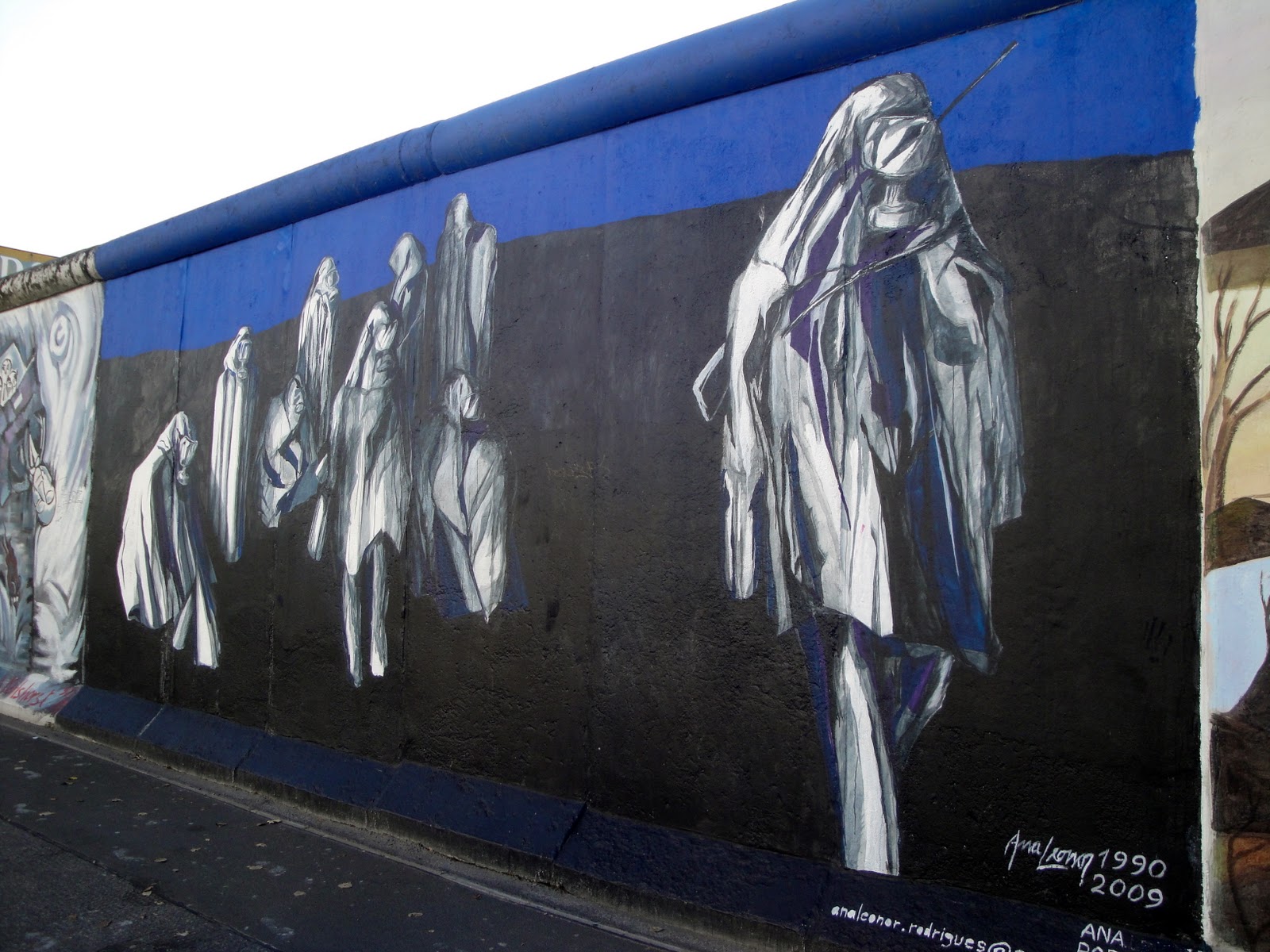
East Side Gallery
(Berlin)


I know, it's far from easy to quit.
Addiction is a phenomenon to ponder.  It is everywhere in many forms.  (We'll talk about sugar in a future episode.)  We tend to see addiction as a personal affair, but it is also-so-social... and in the case of tobacco, so gregarious.

I don't want to romanticize cigarette smoke anymore.  I don't want to feel the inside of my body turning black.

Yes indeed, a behavior reflects a state of mind.  Sometimes I imagine myself as that weightless stream of smoke, going up into the ether, eventually dispersing, free.  Somehow, I associate smoking with freedom; with taking a vacation from the buzz of modern life.  
Sometimes I need to regroup myself, get out of the crowd for a moment, be with my thoughts and feelings for a moment.  I don't need to smoke a cigarette to take that break, but for some reason that's the normal thing to do.  Sitting alone on the curb looking at the stars would raise too many questions on my state of mind.

Finally taking time to write these thoughts down,
(Thanks, perhaps, to rainy Istanbul.)

I've been feeling a bit alarmed, obviously.  I've been dreaming of clean air.  I wonder if there exists a city where it is easy to take care of one's body/self.  I could use their momentum.

Because everything is habit.
Everything is habit.

Monday, November 14, 2011

everywhere is..


Sitting at hafiz mustafa, a [Turkish] delight-full "şekerlemeleri"(bakery/confiserie) which is located a few steps away from Istanbul's main train station.  Drinking black tea and eating pistachio ... Tel kadayisi (According to the "brief guide and information section of my city map: "Threaded dough stuffed with pistachios and walnuts, soaked in syrup.") after an afternoon of tourism in the Sultanahmet.

I had a challenging afternoon.  I visited the Great Topkapi Palace; and for a sum of reasons, I felt kinda shitty... kinda angry.
What was going with me?  I had a marvelous morning at Ezgi's flat, had fresh orange juice and did yoga and everything, why couldn't I feel excited and amazed by this Great Palace, now a museum to the Sultans of the late Ottoman Empire.
Perhaps I was frustrated because I felt that I couldn't get it.
A parade of sultans and their generals, in great robes and precious stones, halls of marble, courts.  A harem! (I imagine that allowing a group of women to bind and play together would be a good and powerful thing to do!)  But I found out that there was an extra entrance fee to see the harem section of the Great Palace... and that pissed me off.
Or I could look at the discrepancy between my expect ions/wishes about Istanbul being a warm place and the windy, cold and rainy morning that greeted me outside the door.
Or I could say that it was difficult to appreciate the grandeur and glory of the Palace, because it just represented so much of that which I seem to be fighting against: imperialism... patriarchy... militarism...

What can I say?  That stuff just triggers me.
It must be a shadow side of me...

------------------


I was in this same place "hafiz" at 8am, yesterday morning, after that forty hour long train ride that took me from Prague to Istanbul.
I am barely keeping up with myself.
I thought I'd write a whole lot during my train ride, but I still felt a bit too overwhelmed to find the words.  I am trying to pull myself out of that state, because I have so much to say.

There was more I wanted to say about Prague.  I wanted to write about delicious hot wine to warm cold days.  I wanted to write about being offered a free beer as part of a play I went to see (literally, just see, since I couldn't understand what they were saying!  But it was movement theater, so it was all good.).  I wanted to write about beer pride, about smokey pubs in labyrinthine tunnels, and Czech reggae music.  I wanted to write about Stephanie (Swiss) and Martin (Czech), who met while she studied circus and him international politics... in Quebec city!   I wanted to muse over Czech psychology and the way it is reflected in their sense of humor and their art.  I wanted to process more of my feelings within that famous central European capital, but I was too much in the process to be able to find the words.

"Dancing Building"
Prage
Prague's TV Tower!
It was built (1985-92),
created by controversial artist David Cerny...
... complete with vertically crawling faceless babies!

Parodic sculptur of a famous Prague icon.
I'm told it's typical Czech dark humor.
Main train station.

And then there was the train ride.  I transferred twice, once in Budapest, and once in Belgrade.  I have heard that Budapest is a gorgeous city; but with only one hour of lay-over, all I saw was a Burger King and an H&M.


I wanted to write about my encounter with Filip, from Belgrade.  He was a tall and strong Serbian guy, who at twenty-four years old had already fought three wars.  He was coming back home after a weekend of partying in Novi Sad and seemed eager to practice his English with a pretty young Canadian woman.  He offered me a sip of Serbian "rakia", and for a moment I pondered the situation: sitting in a train cabin in the middle of the Balkans, alone with this guy... but his heart was good, I could tell.  And so I took a sip of his national drink, as a gesture.
Filip and I.
In Belgrade, he carried my luggage and helped me find my next train.  He asked me to be friends on Facebook, and I accepted.
I need to do some research about Serbia, Kosovo, and Yugoslavia.  
Where is Carmen SanDiego?

A typo or just another worldview?
Belgrade.  Serbia.


Some World Trade Center are more humble than others.

Train travels allow us to see the landscape change...


Border of Serbia and Bulgaria,
and for the eighth time they walk on board for "Passport Kontrol"

Québec, (philosopher? clown? writer?)
Istanbul (our wonderful generous and happy wagon... ''abba'.'),
Paris (quitting his economy degree to go be a mechanic in Sydney),
Bulgaria (getting her Ph.d in Dentistry in Turkey), Italy (architect and prophet)...
Humans.


I also wanted to write about Nicola and Melina from Milano, and about the economical crisis and the truth behind the capitalist money system (contrarily to what many people assume, money is produced/printed - and thus controlled - by private banks, and NOT by our governments.  This implies... ), and television and mind control and consciousness elevation and the lifting of the veil...

But time does not stop.. (and my laptop battery is running low!)


And now I'm in Istanbul.
First impressions?  Another cryptic language I wouldn't mind letting myself fall in love with.  The joy of finding a Bay Area sister here, of deepening a relationship and mirroring each other, the transitional space we are both in (post San Francisco and growing into adulthood, dreaming of revolution and justice.)
Rainy and cold whether.  Unexpected.  And I miss the sunshine.
Mosques sprouted here and there, outstanding sights with their tall pillars the symbolism of which I am very curious about.   And I also wonder if mosks have become invisible to the secular muslim eye, the same way that thousands of christian churches are ignored everyday by people living in the West.  They are just part of the landscape, relics of times gone.  Is it different here?  
Istanbul is the only city in the world that stands halfway in the West and halfway in the East.
The Sea!  How good it is to be with her, after living in Germany - surrounded by land- for a while.  Moving depths.

There are many stray cats and dogs walking the streets of Kadiköy, on the Asian Side where Ezgi lives.    Fresh fruits and vegetables.  Desserts.

Full circles.
Spirals.
And thoughts on becoming a drama therapist, and growing a lot of my own food, and living within an intentional community...

Thursday, November 10, 2011

A tour of Prague

The astronomical Clock is a beauty!
(but it's inaccurate, because it was made with the Earth as the center of the Universe!)
P.S. Kepler lived in Prague.


After two nights spent in Prague, I think I am beginning to adapt.  I still get lost when I go for walks, but at least I have learned how to say "Good day" and "Thank you"
"Dobri den!"
"Djekui!"


On my first night, I went out to the famous Cross Club.  The [quite lovely] receptionist at the hostel gave me all the information to get there by tram.  In that exotic Czech accent she added: "Beware of pickpockets, and if someone asks you for a cigarette, give it to them."  The problem is that I decided I wouldn't buy any more tobacco after Germany. (That's another story I've been wanting to write!!  People in Berlin smoke A LOT.)

The Cross Club is famous for its interior sculptural designs made of recycled iron, wood, and ceramics.    It's a whole lot of car and computer parts, along with moving lamps and neon lights. Everything in there is a sculpture!  The music?  It was good!  It was listed as Dubstep but I thought it slightly different than what I've experienced in the Bay Area; it was more brutal, more... industrial.  There was also a video-montage: bombs and soldiers and petroleum and oil spills and executions and consumerism... I danced, and I shed some tears.  I stood there among Czechs, moving to the hardcore sounds and samples of some French DJ-drummer duo... an immensity of feelings about humanity, our histories, and our common future.
I met a nice Czech couple at the coat check; they were retrieving their slackline!  We took the tram back together, and chatted a little bit.  Apparently, she is the best [female] high-liner in Eastern Europe, perhaps of all Europe.  They invited me to play the next day, on some island I could walk to.  I said I'd love to come.
But then I didn't.  Oh well.

Old Town Gate
at night.


I set up my alarm yesterday morning, because I wanted to join one of those "free walking tours" of Prague.


I made myself a German breakfast: dark bread, cheese, and [bio] salami; and then walked to the meeting point: a Starbucks coffee shop.  [...]

Our guide took us around relating the history of Prague,
which he peppered with "dark pieces of trivia."

Old Town Square with its vendors of local delicacies:
"Old Prague ham", "Haluski"(dish of potatoes, sauerkraut, and pork),
"traditional nuts", sausages, and the intriguing "Trdelnir" (a pastry heated up over charcoal!)


Old Town Square at night.


I must say that my first impressions of Prague had been a bit hesitant.  I hadn't expected anything in
particular, and the architecture looked very beautiful indeed... but only as long as one looks above the shopping windows!  I wasn't surprised as much as saddened.  I didn't come to Prague to shop at H&M or Lacoste!

But the guided tour eased my way further in...
I am absolutely uneducated when it comes to architectural styles, so I was glad to be introduced to some of the concepts of Art Nouveau, for which Prague is renown: lots of curved lines and structures that are meant to harmonize with the natural environment.  It is a "busy" styles with lots of details, and I like it a lot.

Art Nouveau


looking out on the Vltava River

looks heavy..

And of course, the political history of the Czech people is incredibly fascinating.  It's a shame I only have four days here, because I am starting to feel very curious and inspired to dig deeper.  For this is a history of slow and difficult emancipation.  First, there was Jan Huss. (Ever heard of the Hussites?)  He, was a priest, a philosopher, a University master, and a reformer.  He was, before Martin Luther, the first Church reformer.
He was judged for heresy in 1415, and condemned to be burned at the stake.

Jan Huss

A lot happened here.  I can't go into all of it now, unfortunately, but I'd like to list significant eras:
Prague was once the seat of Holy Roman Empire (during the Gothic and Renaissance era),
It became the capital of the Habsburg (Austrian) monarchy/Empire between 1583 and 1611.  Prague was also the center of the Autrio-Hungarian Empire, until WW1, after which it became the capital of Czechoslovakia, which was occupied by the Nazis during WWII, and then by the Soviet Communists.  The Czech Republic came into being in 1993.
That's about 1,100 years of fluctuations.  Some periods were times of great prosperity.  Others were harsh occupation.
I wish I could stay longer and learn more about the Czech psyche...
   

Kafka memorial
Makes me want to read more of his works...
Different windows...

The tour also included a stroll through the Jewish Quarters (Josefov), which in itself has undergone many changes over the centuries.  Jews are said to have settled there as early as the 10th century.  They were persecuted and segregated during the Crusades, and again later during Nazis occupation.  "Luckily" for the neighborhood, good ol' Adolf decided to leave its buildings standing, as a "exotic museum to an extinct race."
Oldest Synagogue in Prague
AND
Residence of the legendary Golem


A Hebrew clock spins in the opposite direction!


After the tour, I kept exploring on my own.  I walked another landmark: the St.Charles' Bridge, and on the other side I bought an overpriced [styrofoam] cup of hot wine... which, giving the cold temperature, was just perfect!


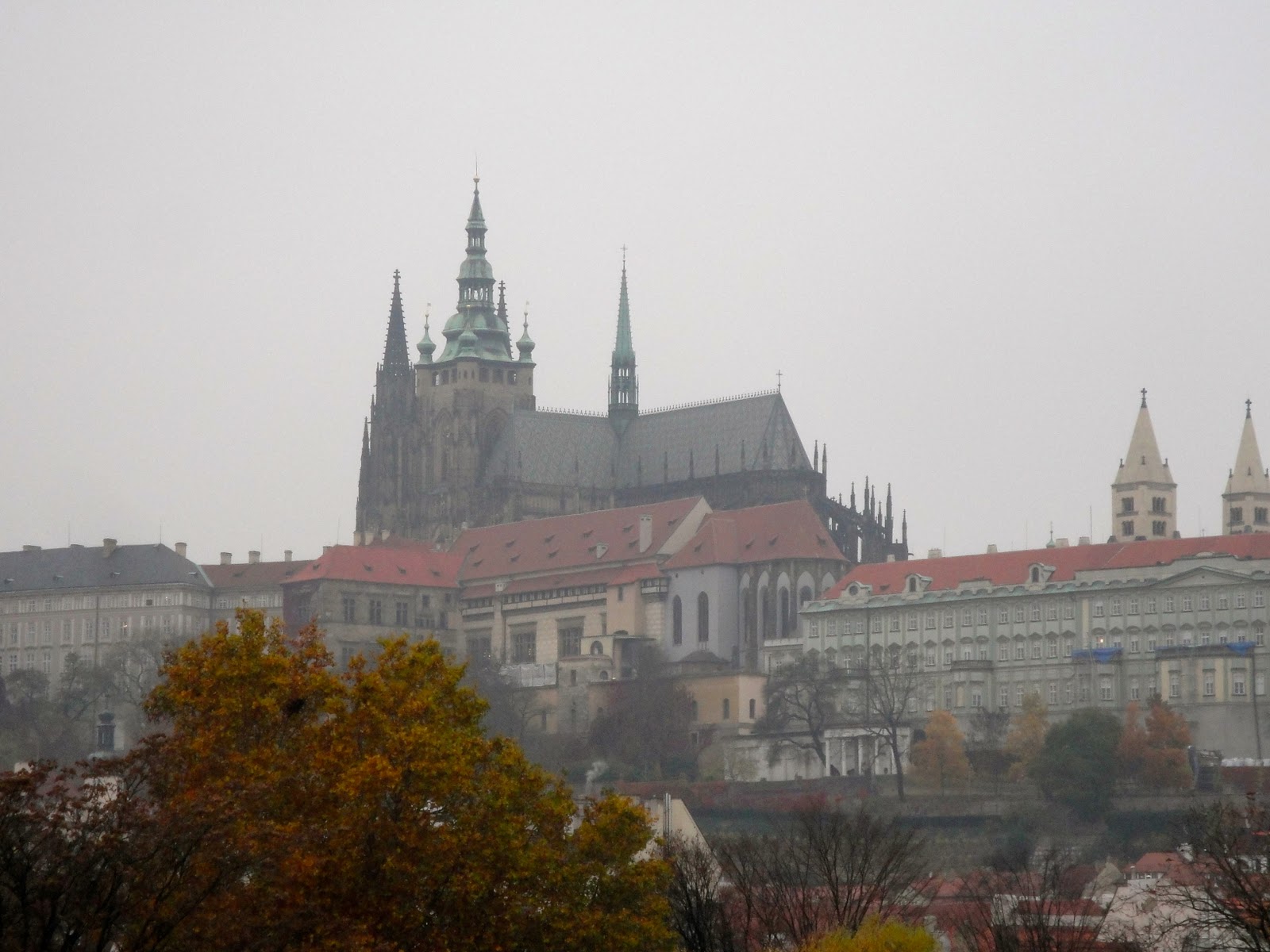
Prague's Castle is the biggest castle in the world.
It has long been the seat of whatever king, emperor, or leader
the Czech people have lived under.

St.Charles's Bridge in the background
Empress Ev in the foreground ;)

The bridge is populated with street artists and crafts.

Indeed, a sight to behold.

On the north side of the bridge... camera galore.

Czech puppet theater is notorious...
will I get to see a play?


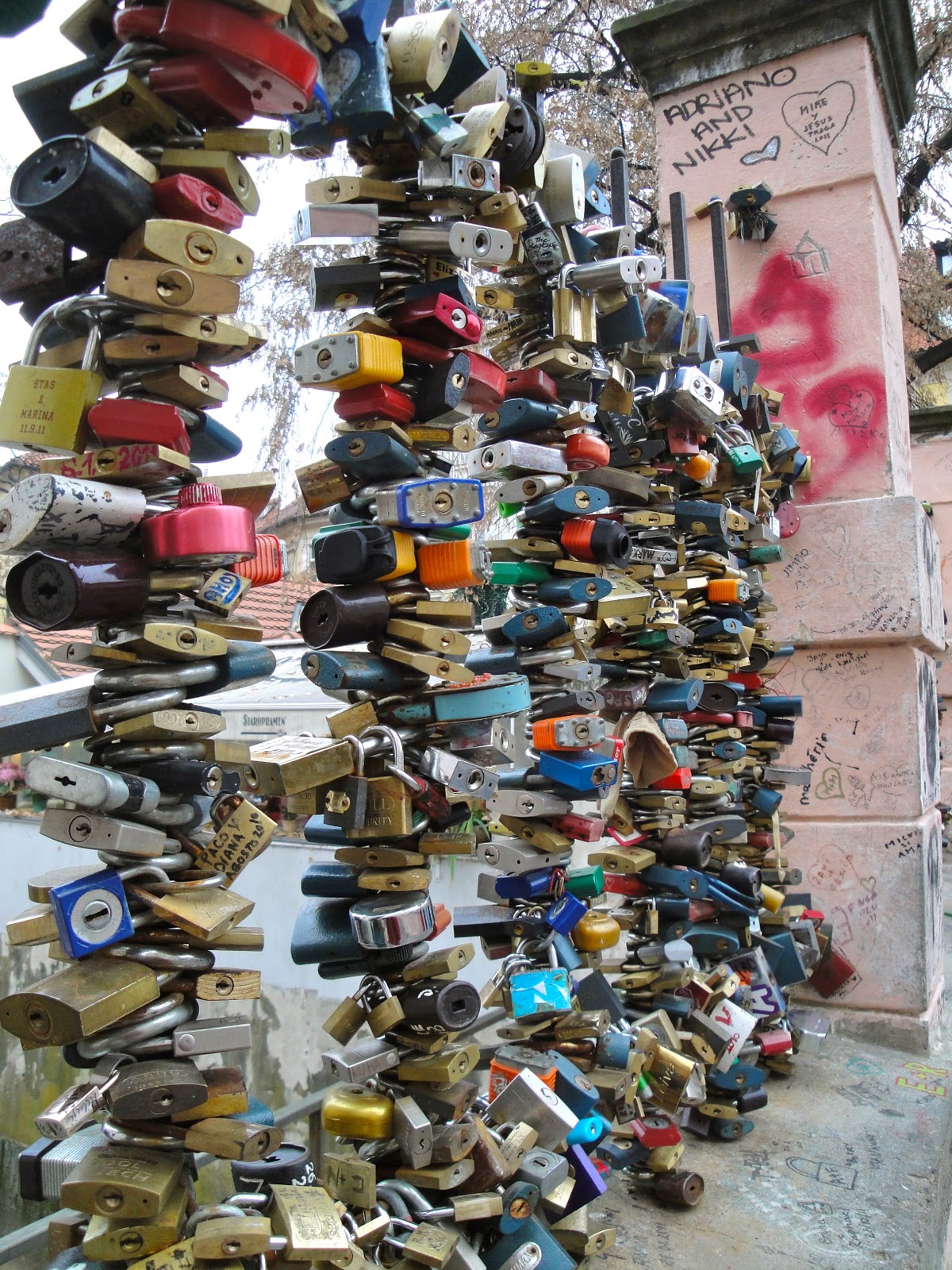
On my walk, I found also found this:


Apparently it is a new tradition in vogue throughout many European nations.  Couples who get married carve their names on a lock and leave it on a bridge.  I wonder if they keep the key in a jar at home.


John Lennon Wall.
Not so impressive, but I did like this image.