About this clown

My photo
I often feel that we're all spinning slowly... like a mirror ball. Yes, we are all mirrors to each other. And so, it is the Light between us that I hope to help reveal and celebrate. /// J'ai souvent l'impression que nous sommes une boule disco qui tourne lentement. Nous sommes tous des miroirs pour les uns les autres. C'est donc la lumière qu'il y a entre nous que j'espère contribuer à souligner et à célébrer.
Showing posts with label addiction. Show all posts

Monday, July 8, 2013

Mes bouquins, suivi de Rimbaud

Je suis debout devant ma bibliothèque et je regarde mes livres.  Je fais souvent cela. C'est un geste chargé..
Je regarde tous ces titres, ces ouvrages, ces richesses... et je flirt avec l'abysse tentation de plonger dans un verre d'eau à moitié vide: comment pourrai-je jamais mémo... absorber tout ça ?!

J'ai passé les sept derniers mois à réfléchir sur la pédagogie, l'apprentissage, la cognition, ''l'acquisition de connaissances''... la méta-cognition.  (Finalement un nom pour ce qui me passionne... m'enfin, l'une des choses qui me passionnent...).  


J'ai toujours aimé étudier le contenant en même temps que le contenu.

Comment aider les étudiants à apprendre? Pardon! Je devrais plutôt dire ''à développer des compétences''?  Pour ça, j'ai des tonnes d'idées!
D'ailleurs, j'aurais tellement voulu pouvoir tenir mon blogue durant les sept derniers mois passés au microprogramme en enseignement! Parce que j'en ai eues des réflexions et des réalisations! J'en ai eues... des bribes de révolutions. 
Le temps, l'espace, et ma psyché ne m'ont pas permis de tenir journal.  J'ai préféré laisser mijoter en me disant que je finirais bien par créer un nouveau blogue dédié à la pédagogie.

Mes puisque l'intention qui alimente Fool of Love est d'être et de partager l'ensemble de mes expériences autant émotives/affectives que réflexives/analytiques, je me permets cette fois à nouveau d'explorer et de laisser place à ce moi décousu.  

Je fais l'inventaire de mes bouquins. J'en ai lus la plupart, au cours les dix dernières années. Ces bouquins, ils ont contribué à faire l'être que je suis aujourd'hui.

Assise devant ma bibliothèque.  J'imagine enseigner la philosophie...

Comme j'aimerais pouvoir mémoriser tout ça!
Pouvoir en discuter avec éloquence
Par exemple.
Épistémologiquement parlant, 
vous raconter tout ce que je comprends;
Ou empiriquement... tout ce que je ressens.
Empiriste ou rationnaliste transcendantaliste?
Phénoménologiquement, définitivement, existentialiste.
L'Anarchisme est-il/elle vraiment un humanisme?

D'avoir lu toutes ces oeuvres... Pour me construire un monde.  Pour me représenter ''le monde''.
Comme j'aimerais pouvoir expliquer tout ça! 


Je compte bien élaborer davantage sur le thème de la pédagogie, sur les contenus et sur les contenants, et sur les vases communicants.

Mais pour ce soir, une pause.  On dira que c'était une introduction.


Parmi mes livres...

Poésies d'Arthur Rimbaud 
(Derniers vers/ Une saison en enfer/ Illuminations) 
Édition parue au Livre de Poche, Librairrie Générale Française, 1972. 


Extraits donc, d'un poème de Rimbaud.

Pour Annabelle,
 et pour Guillaume.
Et pour la poésie, oubliée.


Comédie de la soif

1. Les parents

Nous sommes tes Grands-Parents
 Les Grands!
Couverts des froides sueurs
De la lune et des verdures.
Nos vins secs avaient du coeur!
Au soleil sans imposture
Que faut-il à l'homme?  boire.

Moi - Mourir aux fleuves barbares.

Nous sommes tes Grands-Parents
    Des champs.
L'eau est au fond des osiers: 
vois le courant du fossé
Autour du château mouillé.
Descendons en nos celliers;
Après, le cidre et le lait.

Moi - Aller où boivent les vaches

Nous sommes tes Grands-Parents
    Tiens, prends
Les liqueurs dans nos armoires;
Le Thé, le Café, si rares.
Frémissent dans les bouilloires.
--- Vois les images, les fleurs.
Nous rencontre du cimetière.

Moi - Ah! tarir toutes les urnes!


2. L'Esprit

Éternelles, Ondines, 
     Divisez l'eau fine.
Vénus, soeur de l'azur, 
      Émeus le flot pur.

Juifs errants de Norvège,
    Dîtes-moi la neige.
Anciens exilés chers, 
    Dîtes-moi la mer.

Moi- Non, plus ces boissons pures;
        Ces fleurs d'eau pour verres;
Légendes ni figures
        Ne me désaltèrent; 

Chansonnier, ta filleul
        C'est ma soif si folle,
Hydre intime sans gueules
       Que mine et désole.

(...)
p.141-42

Monday, December 3, 2012

Apoca-postmod-idiosyncratisme... et Jean Gebser

Just do it.
Write it down.  It doesn't matter if it makes no sense at first.  Eventually, it will.
Because I feel it in my being.
Visions that come from instincts.  Now I want to use conscious projection, now that I have come to see it clearly: The world is made up of psychic projections.  Call it Maya, or the Veil.  And that's what I mean when I say I want to talk about: the Apocalypse.  (Okay I admit, I don't actually say that often. But in my head I do.)  For,
An apocalypse (Ancient Greekἀποκάλυψις apocálypsis, from ἀπό and καλύπτω meaning 'un-covering'), translated literally from Greek refers to a revelation of something hidden, although this sense did not enter English until the 14th century.[1] In religious contexts it is usually a revelation of hidden meaning - hidden from human knowledge in an era dominated by falsehood and misconception.
Isn't it time we lift the Veil of ignorance, together, so as to acknowledge how we've been going down a path of falsehood and lies, which seems to be leading us towards catastrophic times?  Isn't time we dare to recognize the impact of our behaviors?  Modern man has prided himself on the capacity to use logic and lay out the laws of cause and effect.  Modern man has gone too far in wanting to use these sciences in order to control the world, for his own ends.  Modern man doesn't have control...

But do not despair!  For ''post-modernity'' has been formulating responses!  Tadam!  Thanks to Nietzsche, Freud, Jung, Einstein, Derrida, Heisenberg, etc.  (Some womyn in there ??)

If all that is human is projection, if God is finally dead (thank God!) and humanistic morality has showed itself to be but another unsatisfying panacea against the depth of our existential guilt and anxiety,  if relativism today gets thrown around by social and natural scientists alike... what can postmodernism give us?


I have picked up Jean Gebser's book ''The Ever-Present Origin'' again.  I'd started reading it two or three years ago but had lost momentum (this is one thick and dense piece of philosophical work!); today, the timing feels just right...

Structures of consciousness: archaic, magic, mythical, mental... integral.
I won't get into all of this right now, but my idea was to try and put some of the myriad of concepts and intuitions in ''order''.  (How faithful to the mental's obsession with ''dividing and conquering''!)

So as a point of departure, let's sample a few quotes:
It is of fundamental importance that we clearly distinguish between ''irrational'' and ''arational,'' for this distinction lies at the very heart of our deliberations.  Arationality has nothing to do with irrationality; their only connection exists in the fact that a rationality is not possible without irrationality, or far that matter without the pre-rational or the rational.
Wow.  I was just thinking about this recently!! Well, that's what I was coming closer to express, though my thinking was incomplete.  I was pondering the anti-rationalist stance I seem to have gradually adopted over the last decade.  How can I become a CÉGEP philosophy teacher (I'm about to go back to school and get some teaching tools and credentials) when I can also picture myself writing a Ph.D dissertation on the topic of wildness and the necessity to overcome and transcend rational thinking?!  Would that make me a hypocrite?

Gebser says it so well.  It's time we integrate all structures of consciousness.

Furthermore addressing my conundrum and the fear I have about teaching, he writes:
Two difficulties present themselves in these deliberations with which we must contend.  The first is inherent in the demand of any treatise for a sequential presentation, which is necessarily contrary to the simultaneity of an integral mode.
Believe it or not, this actually speaks to what I was telling my mom, just last week!
''I don't know if I can be a good teacher,'' I was admitting to her, ''because I don't consider myself very eloquent when it comes down to conveying the knowledge I'd like to share.''  She said she thought I'd be a great teacher, on the contrary.  ''I don't know.  I feel disillusioned and borderline resentful towards half the curriculum, and whatever I am passionate about, I have such a hard time verbalizing in a clear, concise, and linear fashion!  I feel like a webpage with dozens of hyperlinks: I want to open them all, enter in every concept, explore all angles and all directions so as to really get the whole picture!''

My mother laughed.  I felt that she understood and it felt good.

No doubt I could keep this blog entry unfold to great lengths.  I mean, I didn't even get to explore my first idea in sitting down to write a blog today!  I wanted to reflect a bit on Gebser, but I also wanted to explore the intuition I've been having, that my addiction to food (it's so intense these days!! Compulsion galore!) could have something to do with the shift we-I are going through.

Making loose parallels between the fast burning, highly concentrated energy which is characteristics of fossil-fuels consumption (along with their long-term consequences), and the energy resources I am fueling my own body with: carbohydrates and simple sugars.  Isn't there a parallel there?

Immediate gratification versus health.  Why can't I stop reaching for breads and sugars, when I am perfectly well aware that it is not good for me?!  I call this an addiction.

The good thing about this is that I get to belong and remain part of the collective.  (Belonging is a vital and primary need.)  Observing my addictive behavior fills me with empathy for all the addictive behaviors everyone is grappling with.
The ecological crisis is a question of addiction.

Oh! There's got to be a thread linking the contents of this entry... the apocalypse, postmodernism, Jean Gebser's genius work, and my idiosyncratic challenges and ways of making sense of them...

The thread?  Consciousness.


Monday, February 27, 2012

8e Feu: je me souviens.

Hier soir, j'ai écouté un excellent documentaire, à la fois très divertissant et instructif.

8e Feu: Les autochtones et le Canada
(Il y a quatre épisodes, j'en suis au milieu du deuxième)

Saviez-vous que les autochtones canadiens représentent le plus haut taux croissance démocratique au Canada?  Saviez-vous que plus de 50% des autochtones vivent en ville, et que la moitié d'entres eux ont moins de 25 ans?

Pourquoi y a-t-il deux fois plus de jeunes autochtones que de blancs qui vivent sous le seuil de la pauvreté?  Pourquoi se suicident-ils à chaque semaine?  Pourquoi tant de problèmes de dépendances, et de violence conjugale?


Encore une fois, il est difficile de se pencher sur ces questions sans se buter à la ''culpabilité blanche''.  Le concept (''white guilt'') est généralement utilisé dans le contexte de l'histoire et des répercussions de l'esclavage aux États-Unis, mais il peut tout aussi bien être appliqué à la réalité Canadienne et Québécoise.


En fait, c'est peut-être encore plus complexe lorsqu'un peuple se sent déjà victimisé, comme le sont souvent les Québécois francophones.  Comment peut-on être coupables lorsque nous avons nous mêmes été victimes des Anglais?  Tel est le narratif, l'histoire qu'on se raconte.
Il est vrai que la couronne Britannique a prit le pouvoir sur les terres des colons de la Nouvelle-France et que c'est elle qui a conçu la Loi sur les Indiens.
Mais encore.  Aujourd'hui, ce sont autant d'anglophones que de francophones qui sont portés à nier la discrimination systémique qui afflige les nations autochtones.
Qui est le plus victime?  Il serait temps qu'on révise toute cette histoire et qu'on se donne l'opportunité de regarder de l'avant et de célébrer les différentes cultures qui constituent notre pays.  Culturellement, les Québécois francophones ont besoin de s'auto-déterminer au de toujours se définir par l'antagonisme et rce sentiment de victimisation.  Les autochtones aussi ont besoin de s'auto-déterminer... seulement jusqu'à présent on ne leurs a pas beaucoup donné la chance.

Personne n'aime baigner dans la culpabilité.  C'est plus facile d'éviter et de nier, de couper court en se référant aux stéréotypes: ''Les Amérindiens sont des lâches, des alcooliques, et des joueurs compulsifs, etc.''  (Saviez-vous que le jeu de hasard faisait autrefois partie d'un contexte sacré?)  ''Ils n'ont pas à se plaindre! Ils ne paient même pas de taxes!''

Faux.

Pour qu'une personne autochtone n'ait pas à payer d'impôt ou de taxes, elle doit résider et travailler dans la réserve.  Est-ce inutile de préciser qu'il n'y a pas beaucoup de boulots offerts dans les réserves?  Donc, la vérité c'est qu'au moins la moitié des autochtones canadiens paient les mêmes taxes que tout le monde.  Et oui, ils paient également leur comptes d'Hydro-Québec.

D'autres feront plutôt comme moi, qui ai tendance à romancer et idéaliser.  ''Les Amérindiens n'étaient-ils pas les experts du développement durable?''  D'autres encore s'approprieront la culture et les pratiques spirituelles des peuples autochtones sans même avoir la décence de demander la bénédiction de ceux-ci.  Cette question (i.e. l'appropriation culturelle) en est une autre que je trouve assez complexe.  J'aimerais beaucoup en discuter avec les principaux concernés.


Bref, il y a des choses dont on doit parler.  Pour le l'ensemble des habitant du territoire canadien puisse vivre sainement, il faut que tout le monde prenne part au débat.  Il faut qu'on s'écoute et qu'on se donne le temps et l'espace pour vivre et partager les émotions et les questions qui nous habitent.

Visioner ce documentaire est un bon point de départ et c'est pourquoi j'en fais la promotion:

8e Feu: Les autochtones et le Canada

Québec: je me souviens.  Mais de quoi?  Et dans quel but?

Thursday, December 8, 2011

Cadiz to Albolote, always now

I just went for a short walk through the sleepy streets of Albolote, a small town of 15000 inhabitants, resting at about seven kilometers from Granada.  I slept here last night, in my own quarters.  I found a guitar, which was already tuned, and played a little bit.  (The area is actually famous for its guitar makers, which makes sense when you make the connection: this is Flamenco land!)
But more on this later.  First, I would like to back track to twenty-four hours ago, as I spent the preceding night in yet another historical location: Cadiz...


I had spoken with my mom the day before, while still in Sevilla, and she had asked: "Prends tu un peu le temps de relaxer, de juste... rien faire, genre t'installer sur la plage avec un livre?'' (''Do you take time to just hang out and do nothing, like, sit down on the beach with a book?")
"Well I haven't really been around beaches much, except in Nice... and even there I just took a twenty minute stop to skinny dip in the Mediterrean, before catching the train to Ventimiglia."

I have taken time to stop.  I have been meditating, actually, and I've sat in many a bus doing about nothing.  But it's also true that I've walked quite a lot over the past two and a half months.  Faithful to myself - for better and for worst - I've been curious and I've made a point to take in as much as possible about everything I get to see while being on the old continent.  However, my mother's words sounded timely and significant when I sat down with the map of Cadiz (and a cerveza fria) from the office of tourism.  My hosts lived on the other side of town (though it is a small one, on a peninsula) so there were a few "historical points of interest" on the way; but I decided I had seen enough churches already (and honestly, I just didn't feel like rolling my noisy suitcase around those paved streets), so I chose to pass on the architectural tour of "the oldest city in Europe" (Cadiz is 3000 years old!) and go for a walk along the Atlantic Ocean instead.  Only one day in Cadiz?   So be it!

This is where Christopher Colombus set sail from.
And this is where he came back to, with loads of exotic products
from "the Indias": potatoes, tomatoes, corn, etc.
  

The day was gorgeous.  "December 7th ?"  I laughed inside: "Como me gusta el sol!  Como me gusta esa luz!"

I got lost once - faithful to myself - but eventually arrived in la calle Angel.  I crossed my fingers and rang the doorbell.  I knew my host wouldn't get home until 8pm, but she'd said her roommate Clement would be there.  I don't have credits in my "handy" anymore, and it's very much starting to look like I'm not going to recharge it before I leave, in less than two weeks, so I couldn't call to notify of my arrival!  But someone did answer the door.  "Eres Clement?" I asked.  "Si."
"Eres frances?"
"Oui.  Et toi.. canadienne?"
"Ouais."

I think that every single French person I've met so far calls us Canadians instead of Québécois.  You'd think they'd be more precise, you'd think they sympathize.  But no.  They don't even say "Canadiens français"... just.. ''Canadiens'', who speak.... canadien!.   They don't make the difference, they don't necessarily know or care about our dear crise d'identité.  It seems that for them we are already different, since we live on that far away continent called America.
Clement offered me a cup of tea and a plate of noodles he had made for lunch.   We chatted a little bit, and I found out I had landed in one of those Erasmus flats, just like in that movie ''L'Auberge Espagnole''.  There lived five exchange students: from Lithuania, Poland, France, and who-knows-where-else, and they all came to Cadiz to study, learn Spanish, have a cultural experience... and to fiesta, of course.
"And you often host couchsurfers?" I asked.
"All the time!" he said, "We once slept eleven people in here!  There were three girls on the kitchen floor, and three more sharing my roomate's room. Plus all of us."

I noticed a French novel on a shelf and asked if he'd perhaps be interested in trading it for the one I had just finished.  It was Jack Kerouac's "Le vagabond Solitaire" (The lonesome traveller).  Que bueno!
Then he went on to study some more, and I took the book, as well as my juggling clubs, and went for a walk.  Screw all these landmarks; Cadiz is a maritime city, and I decided I'd just hang on the coast some more.  I walked and walked and smiled and sat for a cup of cafe con leche, until the sun began to set.


I don't know what goes on in the streets of Cadiz, but my sense is that the beach is where it's at.  People tranquilo.  People playing guitarra on the boardwalk, singing Flamenco.  Couples strolling.  Quite a romantic setting indeed.  A group of teenagers setting up for a most clever and impressive game: an exercise ball buried in the sand, and they used it as a trampoline, to practice saltos and other acrobatics!


After sundown I walked some more, guiding myself according to the changing qualities of light on buildings, and following the sounds that suddenly came out of small neighborhood bars, here and there, where locals - and their children- gathered for happy hour and a bit of soulful Flamenco. 

Back to the apartment I had a chat with M., attempting to explain, once more, what I studied in San Francisco.  She was especially eager: "Tell me what you learned."

So I tried once more; first in espagnol but eventually switching to English.  "Well, I've learned that everything we see is a projection of our psyche - it's all one - so that our sanity is directly connected to the health of our environment."  
3000 year old Magnolia?

"Everything is deeply and intrinsically interconnected: psyche, nature, one another..."  
"I learned that everything is already perfect, but that it doesn't mean we should do our best to change the world for better.  It's called paradox, and it pervades everything."
"And finally, I found that changing one's self - or ones relationship with one's self - is the hardest.  I'm still working on that, big time!"
"Tell me more," she said.  "Do you meditate?  I think we're all so addicted to thinking."
Right on hermana. "I do'' I answered. ''I try."
"I have a really hard time meditating." she said defeatedly.
"That's all there is," I said to validate her experience.  "But I read somewhere, and I always like to remember... that meditation simply is such a great opportunity to practice self-love, as in, forgiving one's self.  Because we always fail at it, and we can choose to judge, or to forgive."

"Tell me more."
"What if we just sat together, right now?"

So we did.
And afterwards, she went to sleep and I went out with the others.  It was already midnight and they were just getting ready!  
We went to a bar called Woodstock.  We met a friend of theirs, who also had a couchsurfer with her.  Around the table, there were now five different nationalities: Spanish, Russian (Lithuanian), French, Quebecoise (Canadian), German.  We spoke Spanish, French, German.  We drank tinto de verano and cervezas.  We sang Bob Marley: One Love.

L'Auberge Espagnole!
This morning I got up before all of them, made myself some tea to go, and went to catch the bus in direction of Granada... well... via Sevilla.
And here I am.  I'm staying in a family home and it is gorgeous.  Cold at night, but gorgeous.  And tomorrow I have plans to help out in the garden.  I could go to the city and visit the Alhambra  (''not to be missed!'', they all say), but I'd much rather learn how to prune the lemon tree!!

Love it!

Wednesday, November 16, 2011

Europe Smokes

It was disturbing in Berlin, living in an omnipresent cloud of cigarette smoke.  Inside their houses, their apartment, inside bars and train stations, everywhere, everyone smokes!  And as it turns out, it's been the same in Prague and now in Istanbul.


I even got on board for a while, seduced by that strange idea I got somewhere - movies? - that coffee (or wine) and cigarettes make for a good time.
Polluting one's body is not a good time.
Inhaling vitiated air, fighting for oxygen, feeling one's eyeballs dry up and itch, waking up with the breath of a train chimney… what's pleasurable about that?
Yet we do it, we roll and lit that tobacco like there is no tomorrow
Wait a second!
Is that why people smoke so much?  Is it because we believe there's no tomorrow?
I've come up with this loose theory that Europeans might have a more nihilistic/fatalistic attitude towards their health, because of they have that special flavor of existentialism, and that special relationship with the weight of history.  

"As the archeology of our thought easily shows, man is an invention of recent date.
And one perhaps nearing its end." (Michel Foucault)
(Istanbul)

When the streets you walk on have been the theater for corteges of emperors, and kings, for crusades and plagues, revolutions, trenches, bombs, dictators, and now still this heartless, ever-so-absurd neoliberalism… When your history is so blatantly filled with suffering and double-edged promises of "progress" … you might not see as much of a point in trying to keep yourself "healthy."

Nature and Civilization
(Berlin)
  When you know war first-hand, on your own land, you might have a harder time according importance to your own individual health.  You might even hope to die from lung cancer, before the atrocities happen again.

Smoking tobacco is not evil in itself.  Tobacco is a medicinal plant, after all.  Tobacco was used in ceremonies, in peace pipes that bounded treaties.  (I guess it has always brought people together, in a way.)  I'm all for medicinal plants. 
We gotta take the power back!
(Leipzig)
But I'm not too sure about tar, DDT, arsenic, cyanide, and everything else!!  I'm not too sure about the ethics of Malboro, Gauloises, and Camel.

In these times of truth speaking, of demanding for accountability and of acknowledging the gap in power dynamics, I wonder… why are we giving away so much of our will-power to them?
Why are we giving away our desire and ability to take care of ourselves?  Why are we following tobacco corporations down the dark sooty  tunnel of decay and death?  Why are we so eagerly contributing to the pollution of our atmosphere, treating our bodies the same way we treat the planet?

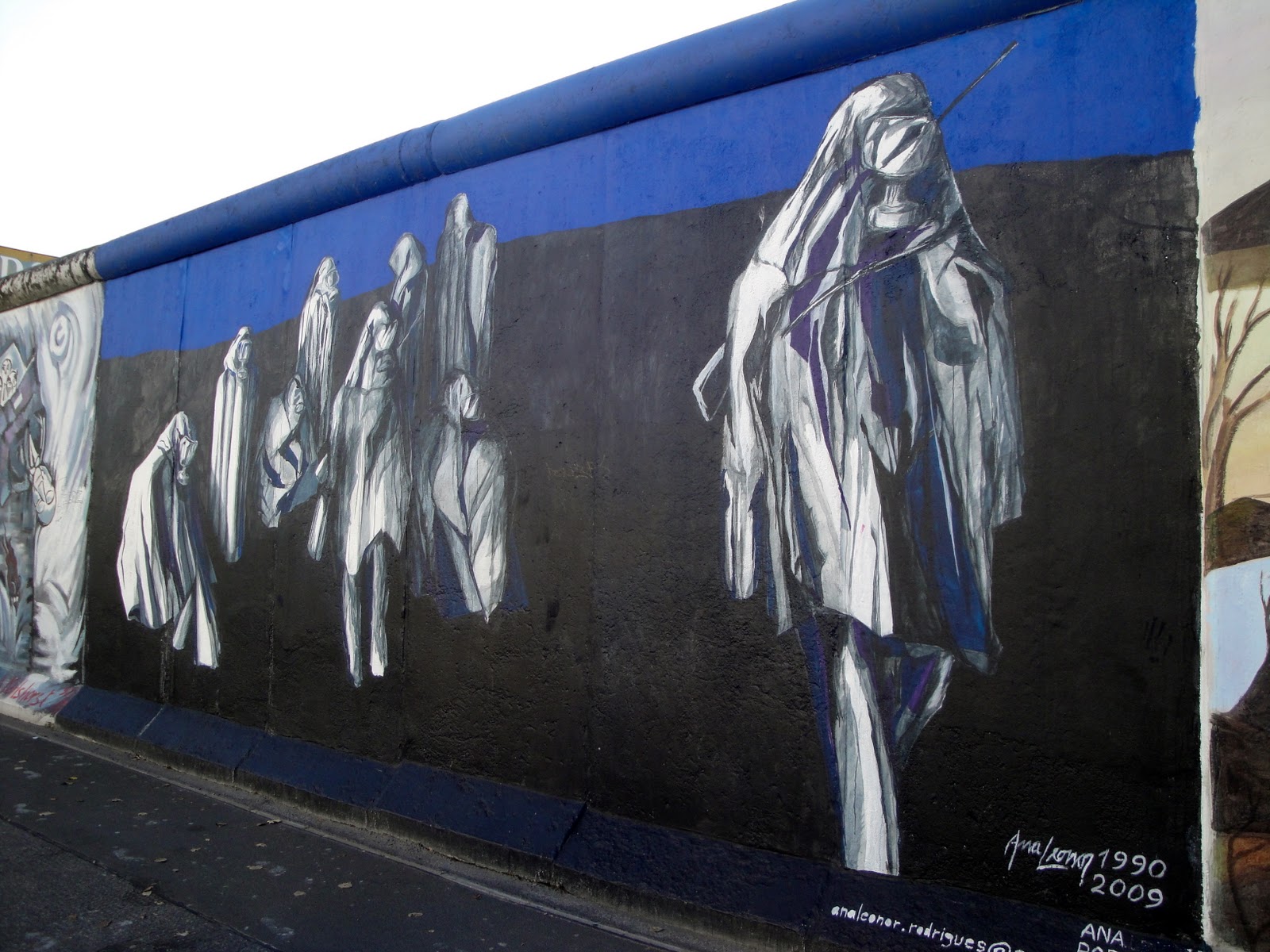
East Side Gallery
(Berlin)


I know, it's far from easy to quit.
Addiction is a phenomenon to ponder.  It is everywhere in many forms.  (We'll talk about sugar in a future episode.)  We tend to see addiction as a personal affair, but it is also-so-social... and in the case of tobacco, so gregarious.

I don't want to romanticize cigarette smoke anymore.  I don't want to feel the inside of my body turning black.

Yes indeed, a behavior reflects a state of mind.  Sometimes I imagine myself as that weightless stream of smoke, going up into the ether, eventually dispersing, free.  Somehow, I associate smoking with freedom; with taking a vacation from the buzz of modern life.  
Sometimes I need to regroup myself, get out of the crowd for a moment, be with my thoughts and feelings for a moment.  I don't need to smoke a cigarette to take that break, but for some reason that's the normal thing to do.  Sitting alone on the curb looking at the stars would raise too many questions on my state of mind.

Finally taking time to write these thoughts down,
(Thanks, perhaps, to rainy Istanbul.)

I've been feeling a bit alarmed, obviously.  I've been dreaming of clean air.  I wonder if there exists a city where it is easy to take care of one's body/self.  I could use their momentum.

Because everything is habit.
Everything is habit.