About this clown

My photo
I often feel that we're all spinning slowly... like a mirror ball. Yes, we are all mirrors to each other. And so, it is the Light between us that I hope to help reveal and celebrate. /// J'ai souvent l'impression que nous sommes une boule disco qui tourne lentement. Nous sommes tous des miroirs pour les uns les autres. C'est donc la lumière qu'il y a entre nous que j'espère contribuer à souligner et à célébrer.
Showing posts with label ecological consciousness. Show all posts

Monday, June 8, 2015

Jungian élan

Pour arrêter de penser
Pour arrêter de penser à la violence, à l'hypocrisie, à l'injustice, à la guerre, à la torture, à la possibilité du Mal.
Aux cata-strophes.
Battante ou moine disciple de l'indicible? indécise.


Pour arrêter de penser.
Et pour rêver. Créer du rêve, et du lien, pour
 interrelier, intelliger, tisser des toiles
à l'envers du décor,

Décorer nos corps,
 qui encore et encore
se fracassent les uns contre les autres,
qui s'érrafles et s'évanouissent, qui s'éradiquent...
des tutsis, des hutus, des tibetains, des chinois, des roms, des palestiniens, des Catalans, des Mohawks, des Québécois, des ... ''nations'' partout qui se partagent... la panète, le territoire, et la tracent de frontières.

Je rêve d'une révolution qui détruirait les murs et les frontières fictives qui nous séparent.
Je rêve à des fois à l'évolution de notre espèce, par l'évolution de la conscience. Une sorte de boost, de reset, de re-synthonisation ou de re-synchronisation. Ou du moins tendre vers une meilleure harmonie. C'est pas une utopie l'harmonie, merde!
Je comprends le rêve collectif d'une Unitié mythique, d'Ur à Monte Albàn en passant par Shambala et Jerusalem. La cité, avant qu'elle ne devienne contaminée par les marchands et les étrangers, par le bazaar des barbares.

Pointée vers l'origines, c'est bien. 
Un tout. Du tout au tout se tourner sur l'origine. L'arché. Le moyeu. La roue.
Psychologie Jungienne.
Revenir vers nos mères, revenir à la Terre. 
Retrouver l'âme des choses, 
anima et animus, 
comme en mythologie.

Conscience collective.

Je veux vous parler de conscience collective, de poésie, et de soirées comme celles-ci
Diseurs de mots, nouveaux griots
Amants de la langue, maîtresse du flots.
À coups de grandes geules, pour dénoncer les failles et les maux, les douleurs, les espoirs,
à coups de grands mots,
aux grands moyens,

En descente vers le plus profond noir hivernal, en chûte libre, de glace, figés là sur la place, publique, voie publique, vois!
Vois! Public.
Public... avisé ou assujetis?
Victimes de la psychologie vampirisée par le capitalisme sauvage?

Sunday, August 4, 2013

''Présence Autochtone'', racines et aspirations


Je songeais à un truc...

Il leur fallait ''la foi'' pour survivre ces hivers, pour défricher et bâtir sur ces terres.  Il leur fallait une enceinte où produire de la chaleur humaine. Combien d'églises ont joué ce rôle rassembleur?  La religion catholique est partie intégrante de notre histoire et j'aimerais qu'on en discute.

Je ne parle pas verser nos économies dans la dîme des prêtres, de se laisser marcher sur la tête, ou de sacrifier nos corps pour la procréation de la race (bien que, comme je tiens toujours à le rappeler, il nous fasse aussi reconnaître que nous ne parlerions peut-être pas français aujourd'hui n'eût été de l'injonction de procréer ). Je ne parle surtout pas de poursuivre dans la voie de la négation de notre élan vital, de baigner dans la culpabilité et la peur. (Car nous devions aussi être ''sauvage'' pour apprendre à vivre ici.)


Je m'adresse au peuple québécois tout en m'adressant à tout le monde.


Cette semaine à Montréal se tenait la vingt-troisième édition du Festival ''Présence Autochtone''. Que dire...

Entre le sentiment malaisant que me procure ''La place des Arts'' et ses odeurs de Panopticon (ou comme si l'art pouvait se restreindre à des espaces choisis, prédeterminés, bétonnés, encerclés, commandités!), et la part de soulagement que je ressens à voir cette présence...
Un teepee moderne, géant, accroché à 40pieds dans les airs par une grue. Malheureusement la photo que j'ai prise est prisonnière de mon appareil photo qui est vraisemblablement kaput (émoticon triste) (Serait-ce le moment de m'offrir la caméra de qualité dont je rêve depuis un long moment?), mais la scène est génératrice de sens... (Quelques photos que je ne peux pas partager - vivement les Creative Commons- et qui vous donneront une idée se trouve sur le site de nul autre que... Loto-Québec, fier commanditaire! (Émoticon ''ironique'')

Je tergiverse tant! Ève, reviens dans le droit chemin.

Bref. J'ai adoré mon expérience de ce ''festival''.
1) Découverte de l'artiste Shauit, musicien et chanteur reggae, natif de Maliotenam sur la Côté-Nord: du rap-reggae en Innu! (Talk about reclaiming a language et prendre la parole!) 

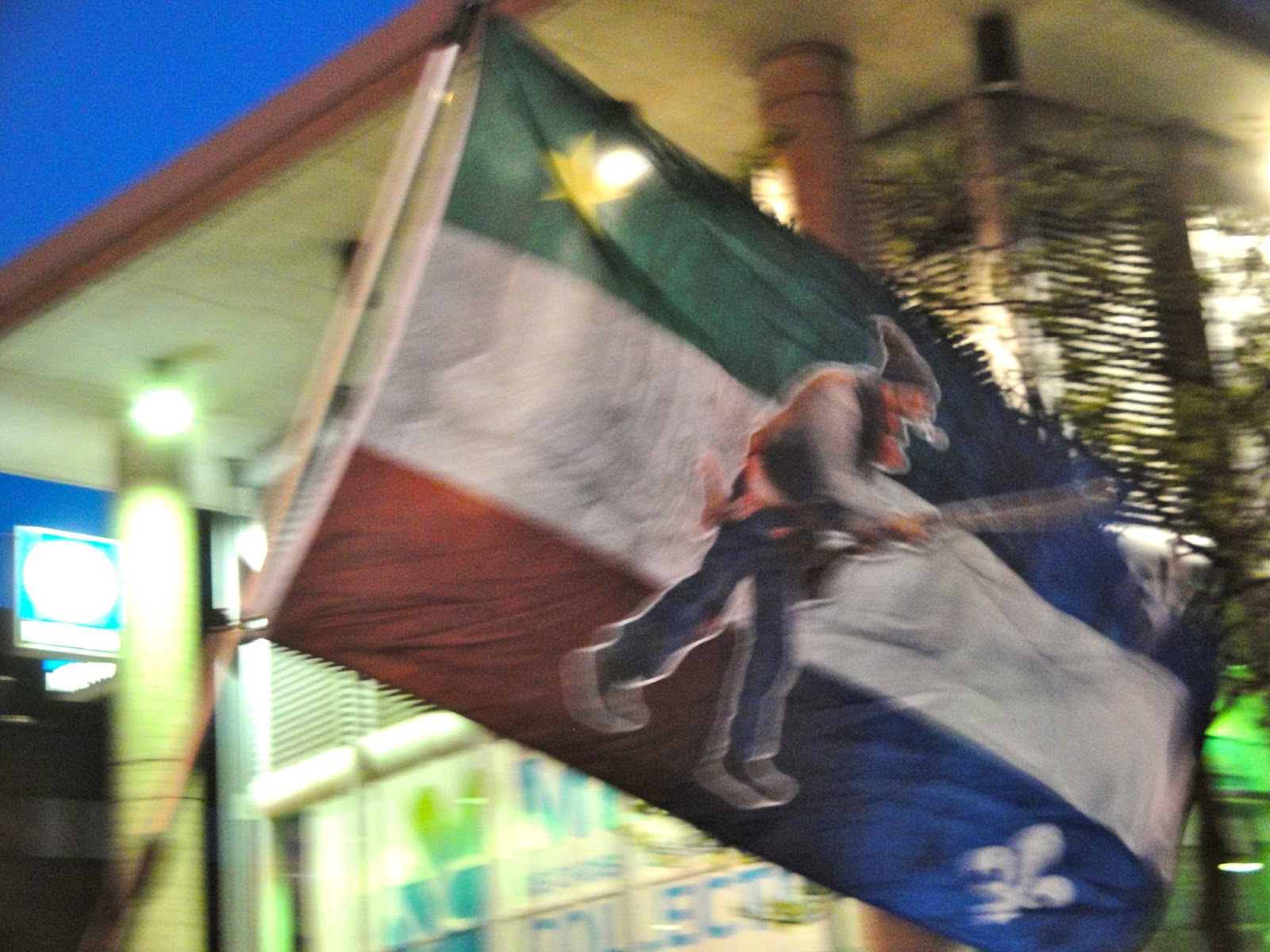
2) Rencontre et conversation avec Yvan.  J'ai vu Yvan pour la première fois mercredi soir dernier, lors de la projection du film ''Ramer d'une seule voie'' ( Cliquez ICI pour le voir: ça vaut le 15minutes.) au Musée McCord.  Il était dans l'audience, tout simplement.  Dans le film, un drapeau que j'aperçois pour la première fois:


Vendredi soir donc, sur la place des Arts, le même drapeau.  Je m'approche pour m'enquérir un peu au sujet du symbole, etc.  Je me faufile dans la foule et me retrouve devant cet homme, Yvan, longs cheveux raides et noirs, yeux pétillants, ceinture fléchée et colliers traditionnels. Dans sa contenance par contre: la vibe d'un ''québécois''. Son accent, son nom, son aura.  Bref, j'apprends que le signe d'infini a été adopté par la communauté Métis.
'' On est tous issus du métissage.''
''Nos ancêtres se sont alliés. Les colons étaient des hommes et des femmes courageuses, notre culture est une culture de la terre d'ici, des conditions et des besoins d'ici.  Notre culture est remplie de la présence autochtone: nos canots, nos raquettes, nos textiles, notre courge et notre maïs, notre langue...  Notre emphase tend à porter sur l'inimité, sur la blessure et les autres facettes souffrantes de la colonisation.  Certes, il est essentiel qu'on se fasse ce devoir de mémoire.  Mais serait-ce possible que le temps soit venu pour outrepasser la grande blessure et pour entreprendre un dialogue qui continue d'aller de l'avant?

Un autre drapeau déjà aperçu: blanc avec un arbre dessiné dessus: La famille. ''Et ce drapeau-là, tu peux m'en parler un peu?'' ai-je demandé à Yvan.
''Ça c'est La famille. Ça veut dire qu'on est tous une famille et qu'on doit se rappeler ça, des racines vers le tronc, puis les branches, nos parents, d'autres branches, nous-mêmes, et nos enfants...''
''Et notre connexion avec la terre'' je rajoute.
Il me sourit. ''Oui'' ''Et y'a les racines surtout, parce que si on coupe les racines, l'arbre meurt.''
''Nos aînés, nos ancêtres...''

Euh...
Partage d'un ''pregnant silence'' (une belle expression que les anglophones utilisent). Et je lui confie, ''sauf que c'est justement quelque chose qui me fait peur; au Québec, cette relation défectueuse avec nos aînés, notre incapacité à conjuguer la ''vie moderne'' et le prendre soins de nos parents. (À ce sujet, un l'Institut du Nouveau monde entretient un dossier TRÈS intéressant: http://www.inm.qc.ca/a-propos/paroles-de-linm/la-declaration-des-generations-2011) Ça ne me donne pas beaucoup d'espoir.''

Yvan me regarde et me dit, d'un ton scintillant:  ''C'est pour ça qu'il faut qu'on regardes dans les yeux des enfants. C'est eux qui nous montre la Vie.''

Une conversation de quinze minutes, droit au fond des choses. Amen

Je n'ai pas fini ma tirade sur l'Église et la spiritualité au Québec.  C'est évidemment un travail en cours/ work in progress.  But you get the point...
J'ai dis qu'il fallait la foi.  J'aimerais qu'on parle du mot.

Église sur une réserve près de New Richmond, dans la Baie des Chaleurs.


Tuesday, July 23, 2013

Puisque tout est politique.

Un texte pouvant peut-être sembler un peu décousu.
C'est que le fil est transparent.
N'hésitez pas à commenter!


Une amie me racontait: ''Pour moi tout est politique.  Des fois... ça devient un peu fatiguant.''

Je me dis, en effet:
J'aimerais, par exemple, savoir comment prendre le temps
de prendre soins de jeunes plantes

Parce que 1) prendre le temps est un geste radical, à contre-courant du mode compétitif effréné dans lequel se vautre notre culture économique; et parce que  2) prendre soins est un geste radical et trop peu valorisé: ça ne fait pas partie du PIB!
S'appliquer, s'engager, s'efforcer à faire émerger la vie, à fournir la juste dose de tout ce qu'il faut pour que prennent racines: c'est radical. Imaginer une production alimentaire significative à même nos milieux urbain, faire respirer la cité-bitume, semer sur les toits de nos appartements, dans les craques des trottoirs, dans nos bacs à double-fond et nos jardins grimpants...
Ça requiert tout un engagement.

Cultiver.

Naturer.

Arrêtons de prétendre que nous ne comprenons pas ce qui nous arrive. Certes, encore aujourd'hui, tous les angles ne sont pas visibles.  Mais ne pourraient-on pas rendre compte de ce qu'on a appris et de ce qu'on continue d'apprendre? Je continue de croire qu'il nous faut créer des espaces dans lesquels on se permettrait d'explorer, c'est-à-dire de ressentir, les sentiments qui se rattachent à l'Histoire.

Reconnaître notre ignorance et notre vulnérabilité en tant qu'espèce. Intégrer ce que nous avons appris depuis Nietzsche, Freud, Fromm, etc. Célébrer le chemin parcouru. Considérer les motivations psychologiques derrière la tendance réactionnaire et la puissance grégaire. Expliciter le phénomène et se donner les outils pour ne plus commettre de telles violences.  Car c'est nous-même qu'on continue de mutiler.


Des outils comme le discours critique, ou comme la compassion! Nous sommes en train d'apprendre à nous émanciper.  Nous y oeuvrons maladroitement depuis 2500 ans (avénement de la philosophie occidentale. Le processus émancipatoire tient sans doute de bien plus loin...) L'apprentissage est là, étape par étape.

Ce qui me fait penser... aux Lumières!


Par exemple, pourquoi ne pas outrepasser la philosophie des Lumières? Questionner le libéralisme, la science moderne, le capitalisme industriel... l'État!  La philosophie des Lumières, ce n'était pas l'aboutissement de l'histoire, la ligne d'arrivée!  Pourquoi ais-je l'impression que ''la société en générale'' en est demeurée avec les idôles de ce temps? ''Liberté, raison, ... égalité''.  Le culte de l'individu et de sa supposée raison!  Démocratie?  ''Droit fondamental''?  Pourrait-on seulement continuer de porter une pensée critique sur ces Idées ?

Je ne suis pas la première à dire vouloir rappeler le lien qu'il existe entre l'État moderne et nos pires cauchemars: holocauste, hiroshima, génocide au Rwanda, corruption, violence policière, etc.  La justice et la liberté n'existent qu'en Idée. C'est autre chose qu'on choisit, il faut arrêter de se leurrer.  J'appellerais ça le Sentiment de Sécurité?

On le voit bien qu'il faut questionner!  On le sent, et c'est pour ça qu'on s'entre-mêle dans des tirades émotives et des rassemblements de peuple - tant de phénomènes que nous le savons voués à nous faire perdre la raison.

Rassemblons-nous alors!  Je sais que plusieurs philosophes contemporains sont derrière moi, entre autre parce pour ce qu'ils ont influencé ma vision du monde : Le sauvage, le non-ordre, le courant libre et créatif.. tout ça se doit d'avoir une place dans nos vies!
C'est dommage que la société québécoise du spectacle ait co-opté tout ça.


Le carnaval existait bien longtemps avant le cirque du soleil, le festival de Jazz de Montréal. Le carnaval existait avant Jésus-Christ, avant les Romains, avant Gilgamesh! Peut-être parce que l'être humain a bel et bien besoin de ces rites (de purification?), de cette intoxications, de cet ex-stasie (hors d'état).  C'est nécessaire, pour l'équilibre des choses.

Il y a une charge, une énergie, qui coure et constitue le flot des choses.  On ne perçoit que les presq'équilibres; on n'en sent que la tension, que la réverbération d'un mouvement minuscule qui devient séisme dès qu'on arrête de se tenir occupé.

Pourquoi, à quoi résister?
Quand on s'arrête de bouger, le cosmos lui tourne encore.
Résister au changement? Résister au status quo?
Les deux forment un tout.
(Y aurait-il un tierce élément à considérer?)

Bref.


Notre sensibilité est palpable.

Alors pourquoi nier?  Pourquoi tout enfouir?  Nos déchets et nos échecs, notre incapacité à gérer l'affaire. Les dépotoirs comme l'ombre de nos Lumières. Du matériel inconfortable à gérer, dont on préfère rester inconscient. Un barrage mental - qui a servi sa fonction - prêt à exploser.


''Je ne pense pas que je sois si politisée que ça''.
Mon amie était surprise.
 - ''Toi? Une fille qui étudie et qui va enseigner la science politique... et qui n'est pas politique!...Ah!''
On a bien rit.

Les cégeps existent depuis 46 ans.
Avant, la grande majorité des francophones du Québec
ne poursuivaient pas d'études au-delà du secondaire. Qu'est-ce qu'on a appris ?
Bien sûr que je suis politique.  Comme toi, je vois un système et je suis curieuse de le comprendre. C'est seulement qu'il y a quelques années j'ai aussi compris que mon intellect et mes efforts de logique servent d'abord à apaiser un feeling.  Je ne suis pas la seule.  Il faut en parler.

Tout est politique.

Alors je choisis de vivre en communauté et de chercher à définir le sens du terme, de créer des espaces de croissance et d'émancipation, d'enrichissement et de résilience.


Qu'il est sublime de voir un plant de haricots spiralé son chemin vers la lumière!


Wednesday, September 26, 2012

cueillette de apples et ecopsychological projections

Une nouvelle saison s'est amorcée ici.
Ici, maintenant, je m'assieds finalement.
Et aussi bien sûr, je danse.

L'automne vient de nous tomber dessus, tout d'un coup.  (Est-ce la tempête de la semaine dernière qui nous a laissés comme ça, sans chaleur?) La transition est un peu brutale.  L'été fût si délectable.  Si chaud, si court.
Mais qu'il est bon de pouvoir voir s'étioler les quatre saisons! (Le penchant de ce beau temps éternel dont jouit la Californie, et qui me plaisait tout autant.)  Ces nuages qui s'amoncèlent, se chargent, et passent sur nos têtes... Ces pluies et ces après-midi de soleil ardent.  Tant de vélos défilent dans les rues métropolitaines...

Des pommes et des hommes.  
La semaine dernière, je me suis ''taper'' un roadtrip qui se mériterait certainement quelques lignes, peut-être à venir...)
De nouveau sur la route hier: quelle bénédiction.  Cette fois-ci, non pas en direction de New York, mais plutôt vers St-Jean-sur-Richelieu, à 45 minutes de Montréal.  Le temps était parfaitement capricieux; passant, dans l'espace de quelques minutes, d'un ensoleillement quasi absolu à l'ennuagement sournois.  Puis, à nouveau le soleil.  Bref, une merveilleuse journée d'automne... et en bonne compagnie par dessus le marché.
Détours, chantiers de constructions.. puis le décor devient bucolique à souhaits: voilà la rivière Richelieu, étincelante.  Nous voici sur le chemin des Patriotes.  L'architecture du village m'apparaît étrangement hétéroclite.  J'aimerais bien connaître les différents styles d'habitations et leur histoire.

Comment dit-on ''patrimoine'' en anglais?
(Heritage)


Soon my friend and I are walking towards the orchard, bucket in hand... elated...

(Ouais, je switch en anglais tout bonnement comme ça.  Pourquoi?  Parce que j'en ai envie, et parce que j'imagine sue plusieurs lecteurs ne parlent pas français. ?)

We are elated by the smell of sunshine, by those infinite rows of grass.  Rural, fresh(er) air.
We marvel: those trees are so crooked and so heavy!  They are actually bent by the weight of their own fruits!

I get emotional, of course.
What can I say?  To witness a phenomena like this fills me with such intense images and emotions..

And emotions naturally lead to thoughts...

There are somethings that make apples 'an Apple', yet each one is different.  They grow according to the conditions they are given.  Some have the top branches, others grow in the shade...
How are humans similar to apples?

As usual, I quickly find myself thinking in ''eco-psychological'' terms.

I strongly believe that everything we experience is at least partly projection - and a potential teaching.  It applies to all our relationships, humans and non-human.
So then what can we learn from observing the feelings and the thoughts that come up?

In this case it is obviously projection, simply because this tree is not feeling what I am feeling - the lightness, the heart expanding, the teary eyes.   It doesn't feel the burden.  It isn't sad or weary.  This tree doesn't ''know'' that its fruits are weighting it down.  It cannot talk about the laws of gravity.  It only is.


'' Isn't it amazing how apples return to the earth and help fertilize the very tree that produced them?'' muses my friend.
''Indeed.''  I hadn't thought of that.
And I wonder, just for fun: How can this be analogous to human experience?
What are our fruits?  What are my fruits?  Do we know when they mature and when they fall?  Sometimes we do.  Sometimes we don't.
We do experience phases in our lives:  seeds we plant, fruits we taste, losses and cycles that never quite end... (The I is what remains as the thread.)

Oh! I can see how we might be like those apple trees... sociologically speaking.  Easy!  Hum.

I like to imagine that here nature is showing us how to remain faithful to our ancestors, and how that principle can strengthen and sustain Life.  And I don't mean only physically - taking care of the lands our grand-parents have toiled and lived on, or taking care of our elders.   I also mean culturally.
For, while acknowledging (and accepting?) our fateful place as one in the bunch, we also each have a chance to bring a unique contribution - our fruit - to the Great Narrative.
By creating new stories, new narratives, we keep fertilizing the cultural soil of our ancestors.

Our parents have done they best, reaching for the light and in the process feeding us and filling us with their hopes and their stories.  They raise us and when we are ripe enough, they let us fall off their branches.  It is now our turn, little seeds, to strive and to thrive, to send down our roots and reach up, feeding from the ground beneath, so as to bring more generations of light-filled fruits.

Voilà.  Désolée pour le switch vers l'anglais.  Mes ancêtres parlaient tous français.  Mon histoire aujourd'hui se raconte dans les deux langues.  Et si je tends à choisir l'anglais, c'est parce que j'ai toute une planète avec laquelle interagir...
Néanmoins, le dilemme demeure.  La saga continue...


Tuesday, June 12, 2012

Of minds and men (Mtl, Moscow, Mind)

Création d'espaces créatifs
All things are well in the midst of the Squirrel's Spire.

  Beautiful encounters over the past few das, the past few weeks.  I am trying not to make sense of it all but rather to experience it, with trust.  With breath.  
If the results of this experiment in abundance have been positive so far, I simultaneously feel another strong emotion... The depth of the Unknown, the compulsive fears and reactions, the anxieties of eminent change, of a potentially profound transformation.

Power to the Neighborhoods!
(Oui!)
As the Second Quiet revolution is starting to take place, we, the people, and I, actually, are starting to wonder... what's the point again?
''Le tintamarre des Casseroles'' is still happening, every night, though in reduced numbers now.  It has been going on since May 18th.  That's almost one month!  Every night, some... citizens get out and start following sidewalks and banging on their pots and pans.  Neighborhoods concentrate and relate, in this demonstration against the undemocratic absurdity of Loi 78.  Oh yeah, that's why!

But people also go to work everyday.  They also eat and so they cook or buy food.  They go for a drink or two, they see their friends.  We want the revolution AND life as usual.  We want to eat well and to be surrounded by people we love.  And why not?  You can't be on the battlefront at all times; because then, what are you fighting for?
Is the movement losing its breath?  I don't know, 'cuz I haven't been to the protests!

I am fighting for the Beauty and the interconnection in All things.  I am fighting for the Mystery of Life.
But sometimes I find it hard to sustain the fight.


Thoughts?  If the human species disappeared, it would take no more than a hundred years for planet Gaïa to rejuvenate Herself.
We are not indispensable.

 By now, we have to acknowledge that, since our arrival, we have been the most destructive species on Earth.  We need to acknowledge this reality, our reality, if we want to move forward.

And so once more it seems it comes down to some primary Guilt.  Damn guilt.
When you mama gave birth to you, it was the most painful and mystical experience... and yet.
 It's just how it is.

(Plus we now have epidurals anyway.  Not that I'm against it, just that we have adapted to make birth less painful and less dangerous.  Less mothers die I suppose.  That's a good thing!  But we get born in these conditions now, shielded and numbed from the pain of birth, and so we carry this on later in life, using more drugs, which I am not saying I am against either... given that it's all interconnected, and that the Earth also gives us these plants...)
(I could go on and one with musings on sacred medicine, but that'll have to be for another time.)


In short, all in all, consciousness is quite a phenomenon...

What are they trying to sell to us?


Une affiche, un manifeste non-signée. (Centre-Sud.)
 Of course I am trying to make sense of what's going on.  Why wouldn't I?  Why wouldn't a tree drink from its roots and tend toward the Sun?


 I don't need a lot of money.  What would be nice, however, is a good camera...


P.S. Remember !  The whole world is going through its revolutions.  One hundred thousand people gathered yesterday in Moscow, to overtly protest Putin's government and ask for new elections.  

Since embarking on his third presidential term, Putin has taken a stern stance toward the opposition, including signing a repressive new bill last week introducing heavy penalties for taking part in unauthorized rallies

Read more: http://www.canada.com/news/Tens+thousands+flock+anti+Putin+protest+Moscow/6768552/story.html#ixzz1xbCWp9cE
Yep.  It's happening in Russia right now.  Same thing!


A famous photo from Germany.  Cops suddenly take off their helmets and escort the anti-capitalist protests taking place in Frankfurt...  May 19, 2012.   (That was about two weeks ago.)


And in Poland, also yesterday!  :D  This is in parliament.

Tuesday, May 15, 2012

De-Growth and Re-ligare

Most days are made of labour and wonder, boredom and anxieties, delights, communions, and questions.
Most days I pray, not in the form of penitences but in giving thanks, and praise.
Every day, I wake up with the knowledge of one world,
one planet, cast in a spiraling dance,
since hundreds of thousands of years,
and I, descendant of an exploding star
pondering
the feeling, of wind on my skin
this phenomenological presence
in the midst of an ''ecological crisis''

not only am I anthropocentric
I am also ego-centric
for I am trapped within the confines of my body
craving for an umbilical connection with All there is
an embrace
not as a hope that my thirst be quenched
but as a celebration, of the dance
pushing and pulling
sinking and soaring
between Mother Earth and Father Sky
a child, a navel and a star gazer
knowing myself, as the Self,
as one concentric being of possible becomings
amongst infinite networks, of centers also unfolding
amongst patterns, of a Life,
Self-organizing


Today I attended a conference that's taking place on the Concordia campus.  I hadn't planned on going.  It got decided over breakfast and freshly baked banana bread.

My roommate was looking at the program trying to decide which panels and activities to go to.  I had heard about she and A. signing up to volunteer and attend that De-growth conference, all week.  I was curious, but I also thought to myself: ''Well, here's another wonderful thing happening in Montreal and I won't get to be part of it... because it's expensive and overwhelming, for it's attracting all those wonderful people who are involved in the gardening movement... and blablabla... how come I can feel so close to this intellectually and yet not get more involved?  What's keeping me from getting my hands dirty?  blablabla...''

In short, I hadn't planned this day.
But there I was, 9 in the morning, biking down Rue Sherbrooke along with two of my friends.  Sunshine in and out.
How did it happen?  She said there was a film being presented this morning, and she wasn't sure she wanted to go because it was so nice outside.  I asked about the title of the movie, and she answered: ''Journey of... ''
'' ... of the Universe!?'' I interrupted with a big smile.
''Yeah''.
''Oh my God!  That's my professor!', I explained with overflowing enthusiasm.  ''I totally want to see that movie!''
''I bet you could just get in like that,'' she said, ''they don't really monitor.''

And so I walked into Concordia University's auditorium.  And there he was on big screen: Brian Swimme, one of my dear professors from the California Institute of Integral Studies.

Invited for this projection were three imminent panelists: two professors from Yale - creators of the Yale Forum on Religion and Ecology - and the producers of the film: Marie-Evelyn Tucker and John Grim, whose names I have heard so much about during my time at CIIS, as well as William Rees,
professor of public policy at the University of British Columbia... and the originator of the ''ecological footprint'' idea and co-developper of the method.


Listening to Brian Swimme reiterate his wonder about the unique circumstances that made human consciousness possible in the Universe, hearing talk about that 14 billion years old journey to this new scientific narrative, witnessing his praise of play and wonder being communicated to people gathered right here, in the province of Québec... I personally experienced the bridging of what often comes off as two worlds...
San Francisco meets Montréal!  My mind: hyper stimulated, the way it gets when I attend those ''academic conferences''.
(''In my days'' while I worked both at UMaine and for CIIS Public Programs, I attended a hella those lectures and conferences, and I've been reflecting on that recently as I went through the résumé process.)

But it wasn't only CIIS and Montréal, it was my bachelors at UMaine also, the environmental and political philosophy papers, the thought process...
I was inundated with flashbacks from my trajectory, hearing my own personal worldview and conclusions being investigated.
Part of an important conversation.

So I guess that the International Conference on Degrowth in the Americas is right along the lines of my work.  I might not know exactly what this work is, I suspect it is going to play out in several aspects, but I cannot deny that I am strongly tied with this community of thinkers and ecologists.

I regularly get down on myself, for I find it difficult to see that even though my understanding points to the necessity of re-learning re-lating with the natural world, of re-incorporating and re-localizing the process of food production, even though I know and praise the importance of urban agriculture, I still haven't planted a seed this year!
I'm surrounded with people who do, though.
I tell myself it'll unfold in due time, when I have landed a bit more in my new reality (Is six months long enough?).  I tell myself that it's good I am surrounding myself with all these community and guerrilla gardeners while I'm attending to whatever needs to happen in my own life at the moment.  I am learning by osmosis, through conversations and observations mostly.  I am cultivating kefir.

I did dig up rocks in my friends' gardens last week, when I went to St-Élie-de-Caxton to spend a Monday afternoon with the ground, massaging the Earth's body, turning mama's soil and giving her oxygen so that seeds can grow.

Little by little... I am grounding into something... and that's something is changing, evolving, at a pace unprecedented.

I have physical theater plays flashing in my head, doctoral theses waiting to get delivered, and dance phrases burning to get drawn in space and time...

I have visions, and Professor Tucker said that's exactly what we need right now: visions to guide us.

I have visions.


Tuesday, May 1, 2012

Political ecology: we're relating


I had diner with about 14 roommates tonight. It was the Shire family from downstairs, and us all squirrels from the spire; a last supper before many leave us for the summer, to plant trees in British Columbia, to go back home to Barbados, or to move forward to new adventures as new parents! Next week, things will be so different.

We can all feel it. Something is changing. ''What's next?'', we ask.
The conversation some of us are having is the whole point.
Citizens engaging in endless debates, exposing their opinions, and thus exploring and exposing their values. Citizens finally having a conversation, so at least, there is finally some kind of communication happening. We are mobilizing, organizing, and talking about our pains and our visions.
Not everyone, but many are starting to consider the puppeteers casting shadows on the cave wall, we are naming it: the illusions propagated by the media. The veil.


Apocalypse:
Emprunté au latin apocalypsis (« révélation »), lui même emprunté au grec ancien ἀποκάλυψιςapokálupsis (« découvert »), et non pas « révélation de Dieu » comme cela est communément admis. Provenant du verbe grec καλύπτωkalúptô (« cacher »), précédé du préfixe de privation ἀπό ápó. Littéralement donc « dé-caché », et donc par extrapolation, « dévoilé au yeux », « retrait du voile », « le voile est levé ». Ce n’est que bien plus tard que les écritures religieuses assimileront le mot pour l'associer au jugement dernier et donc à la découverte de la vérité de Dieu.

In Le Devoir online, a reader started a debate about strikers being constituted of a great majority of students of what she called the ''soft sciences'', i.e. human, social, literary sciences. Oh my friend, you should have read what other people responded! (You can click on the link above). This sort of debate is happening anonymously, which creates a certain distance, but I find it wonderful, that citizens be sharing their point of view.


Someone recently told me: ''We shouln't talk about politics when we're in family.''

Well, I think we should. It's hard to come face to face with disagreements. Discussions get heated. It's easier to shy away from conflict and mute the tensions that exist. It's also dangerous, as a collective, to deny the issues that concern us all.
We should gather around, people of Montreal. What we have is something so special: French, English, and a dozen more ''nationalities''.. we should open up that discussion about what ''nationality'' means, to acknowledge the inescability of ''politics'', and to generate thoughts and actions that will contribute to a better tomorrow.


We should share in the excitement of not knowing what tomorrow is going to look like, and share in the fears that come up for us too. We should see the web we have been waving, and use it for Good.
(So far, in my book, Good = sustainable.)


--------

I can't believe that I'm living in this city, at this time. i can't believe that I do live in the co-op I have been talking about for years! Yes it's hectic and it's sometimes crowded, but so is the world out there. We are social researchers, organizational revolutionaries, even though we're still so much working at what it all means.

Yes I live with ''a bunch of students'', and somehow I sometimes struggle with that thought. As if it was a pejorative classification. As if it was "better'' to have already found your place (read: a career) in society. But tonight as we were talking about politics and ecology, I smiled to myself and realized that it is a privilege and a huge responsibility, to be studying this society and this world we are about to ''enter'' and take part in.


students digging for books!


In other words: this is the way we take part in it. This is our way of showing maturity. We are rebelling, taking to the streets, as an existential response and a duty, as citizens of tomorrow.
Are we complaining with our mouths full? Sure. (Is it better to complain after you've gone hungry?) Our mouths are full of genetically modified food, soaked in pesticides and chemicals meant to kill other creatures. Our mouths are full of foods that are being produced by underpaid farmers and sent halfway across the world, in gas guzzling trucks, on highways that are built on the lands of indigenous people. 

We want to do politics with what we're learning through ecology. Everything is interrelated.
Seems to be the new cosmology. It would seem that humans have always organized according to the myths that underlie their understanding of the universe.

Friday, February 24, 2012

Situating the Species

Someone recently told me, ''Humans are animals, and as such we are meant to relate with our immediate environment through our senses, through our body.'' (So far, so good.)  Then she added, ''It's not normal, it's not healthy, for us to be bombarded with information about the state of the global economy, etc.  It's too much stress, and it brings us way up in the mind...''

This was a response to me bringing up that I would like to create space for people, to really feel the depth of emotion they feel when they ponder the current crisis.  It's an economical and ecological crisis.  (It is an ecocrisis.)  I partially agree with that comment, although from an evolutionary perspective, I am resistant to this idea that ''we were not supposed to''.

I think it was meant to be this way... and that we're coming full circle in order to embark on a new leg of our journey.

Consciousness has morphed tremendously since the advent of our homo sapiens ancestors.  The evolution of consciousness is a reality.  Look carefully and you'll see the parallels between developmental psychology and the growth of humans society!  From undifferentiation to rebellion to integration, it's a never ending process that everyone experiences.

One aspect of this is how humans have pushed technological innovations (through their imagination first, which is beyond the five sense), from the mastery of fire and the creation of the wheel, to the building of steam engines, nuclear reactors, and global positioning systems.  Each new discovery has transformed the fabric of society.  Each new invention has transformed the relationship of humans within time and space and amongst themselves.  Today we are finally remembering the fundamental fact of our interconnectedness with the entire world.  Today, we can experience more empathy for the Other. A marvelous book on the connection between the advances of technology and the grown of empathy is called The Empathic Civilization (2009), by Jeremy Rifkin.

It couldn't have been any other way.  We are social animals, who have created beyond themselves, projected ahead of time through our minds eyes.  We have imagined.  We have dreamed.  We have created.

And we've migrated and colonized, and relocalized.  Today we urbanites find ourselves uprooted, piled up in offices and lined up in subterranean mazes.
We get to see the insides of the matrix we live in.  Roads, tubes, neurotransmitters and all.
EarthRise

Complex systems are difficult to behold and comprehend.  That's why our species had to compartmentalize, first, throughout the ''mental'' (to use Jean Gebser's terminology) era.  We had to analyze, to understand, to control... to divide and conquer.  The prerogative of a great deal of ''methodological'' thinking, especially since the Enlightenment.
But the problem is that we can't and should not conquer nature, because wildness is the source of our creativity.  Wildness is necessary to our survival.


Yet it's true; beholding the present situation is overwhelming.  What can I do, now that I know the statistics: in 2010, it's an estimate of 925 million people that were undernourished, and this  in spite of the fact that, ''World agriculture produces 17 percent more calories per person today than it did 30 years ago, despite a 70 percent population increase''?   

What am I to do?

I think about... ecology, because that's how I've come to look at politics, spirituality, psychology... even the arts.  It's all interconnected.

Witnessing this incredible web of connections and relations... It humbles me, and it makes me so much greater than myself, all at the same time!

This being said, the systematic study of ecology, as a science, is a relatively new :
Ecology is a sub-discipline of biology, the study of life. The word "ecology" ("Ökologie") was coined in 1866 by the German scientist Ernst Haeckel (1834–1919). (wikipedia)
The greek word ''Öko'' means ''house, which means that ecology is the ''science of the house''.


It was 1968 - only 44 years ago - when the astronauts of Apollo 8 took the famous Earth Rise photograph (above) and for the first time gifted humankind with a new perspective of our home, as seen from outside.
Two generations ago, they'd never seen a picture of the Earth taken from space!  Just ponder that.

Ecology is a new field.  It's an ongoing observation of the all the complex and intertwined relationships that make up this web we call Life.  Am I to be derogatorily labelled ''hippie'' for the simple fact that I actually understand the significance of all of this? 

Yes, I care about the environment I live in.  Yes, I get emotional when I look at this mess we've created for ourselves.  It makes me wanna know the next room's occupants, my neighbors.  It makes me wanna learn their language so I can have a conversation with them around the table.

And it makes me want to localize myself and re-awaken to my five senses and my body's wisdom.  It makes me want to grow and prepare the food I eat, instead of relying on chemical fertilizers and gas guzzling transportation and plastic wrappings.  

I want to hold and celebrate the sublime immensity and of the matrix.  I want to send my roots down so that I can bear my fruits, in time.  That's what I mean by coming full circle.  We don't need to roam anymore.  We don't need to hurry either.  We have each other plus myriads of other living friends to get to know better.  Here, now.

Thursday, February 16, 2012

Bios-que-faire?

Psychic tension.  Tension psychique.
I've been offered a job... in a wonderful independent bookstore!  Biosfaire offers books on everything from permaculture to Buddhism, to anthroposophy, holistic health, and transpersonal psychology, to community living, consciousness studies, and super foods...

I had walked in there out of curiosity, and did something I never quite dare to do by asking, ''Do you guys happen to have a job opening?''
''Well yes, actually, in March.  You can give us your résumé.''
So I did.  I printed the appropriate version and walked over there (It's 10 minutes from where I live right now, and it'll be a ten minute bike ride once I move to my new place ... and get a bike) to find the owner doing her inventories.
''I studied Philosophy, Cosmology, and Consciousness'', I said, handing my résumé.  ''So your place pretty much feels like home!''
''Where did you study that?'' she asked.
''In San Francisco.  I just returned.''

She called me about a week later, that is, a few days ago.  ''Honestly,'' she told me, ''you are over qualified for this retail and service job... However, I do think you would have a good time working with us.''
I do too.  The problem is that it doesn't pay anything.  I mean, 16$/hour at a community center is already quite basic... But this.. is not even close to that.

I don't know what to do.
I just turned in an application for a position with the most amazing Non-Profit organization, called Exeko.  There, I'd get to use words, and symbols, as well as my social skills (I'd work in communications), in order to represent and promote artistic, cultural, and educational programs which are taking place with indigenous, incarcerated, and mentally disabled populations!  I mean, talk about an integration of my interests!
But what if I don't get it?

Maybe working in the hub of holistic health would be just as perfect...
I'd get to smell everything that's being published (oh! the scent of a freshly-printed book!), I'd certainly get to discuss eco-psychology, power of intention, and planetary wisdom with clients; I'd be able to speak that language on a day-to-day basis.  I'd be surrounded by the work of those I emulate.  I'd be inspired... and-or overwhelmed.
I was just telling a friend about feeling overwhelmed when I'm in a bookstore sometimes.  I want to read them all, and comment on them all.      I want to write them.  (But not all).

I was just telling another friend, that regardless of my stance against capitalism and consumerism I actually want to be financially comfortable.  I don't know exactly how that's done.  I guess the more you have and the more you fear of losing it anyway.  And what's being ''comfortable'' ?  I've lived with the premise that keeping my needs in check is a good start.  Do not succumb to the consumerisssss serpent.  Do not get fooled by advertisement.  So many get into debt trying to fulfill an emotional gap with stuff.  I just have to make sure I don't do that.  I just have to make sure I spend my money on what really matters...

But. 9, 75$ for an hour?

Acting out of fear? (of not finding something else)
Or acting out of love? (I've always dreamed of working in a library... and this is the best independent library in town!)

What do to?

Sunday, February 5, 2012

Ecovillage.. in the name of ?

The revolution is happening.
Well, it has the potential of happening.
And I feel a bit scared.

I am facing an opportunity to step into what I have been professing to be my dream!  (Careful what you wish for, hehe).  Less than two months after my return to the native land, and I have already found and met a group of people who speak the language of permaculture, who share visions of organizing into ecovillages.  They speak the language of permaculture and they agree that it is essential that we begin to learn, how to grow our food, and how to grow... socially, together.
I've been thinking about socio-political organization for at least ten years now.  I've been talking about egalitarianism, and community-living for almost as long.  Yesterday, as I sat in the living room of a fellow visionary and discussed the potential of the ''Institut de desurbanisation'', I gradually came to feel the significance of my conclusions.

The idea would be to live communally, in the city, while preparing for a transition to the ecovillage.  We'd be learning several skills to regain some autonomy, like sewing, knitting, canning, brewing, fixing and renovating the house, etc.  That's exactly what I've been ranting about for the past six months!
But the thought of actually doing it: living and working together, makes me a bit dizzy.  Have I grown to comfortable in my individualistic modern ego?
The truth is, I don't know these people as well as I know the friends I have had over the past fifteen years.  With my old friends I have sweated and fought (most of us played soccer together), won and lost, cried and laughed.  We have witnessed and supported each other through idyllic and horrendous love stories, through break-ups, confusions, joy and dreams... We have been through so many changes together...
Now there is a brand new group of people I could be moving forward with.  We could be entering a new phase of change together.  We could create change!
But we don't know each other yet.
And is that even what scares me the most?

Or is it the thought of eventually leaving the city?  No more world-music parties, no more impromptu meeting at the pub for a drink, no more sitting in a café with my laptop, no more dance classes, no more théâtre, no more daily multiculturalism.
Do I want to retreat from all of that?

In the name of energetic autonomy, in the name of food security, in the name of building an example of what could be...

In the name of every human being who is being oppressed, beaten, starved, raped, and forgotten... just because they live on a land where natural resources are being extracted...  In the name of voluntary simplicity... of anti-consummerism... In the name of indigenous people in Northern Canada, who are watching their last frontier getting drilled and destroyed by the oil industry...
In the name of fresh water and the hundred of animal species who have gone extinct over the last fifty years... In the name of heavenly Pacific islands, which are now slowly sinking under raising levels of ocean waters... In the name of ghettoized populations being plagued with pollution emanating from irresponsible industries and the spread of landfills (it's called 'environmental racism, look it up)...
In the name of my Cuban, Mexican, and Salvadorean amigos, of Palestinians and Israelites, of Syrians, Russians, Tibetans... in the name of my neighbors in Hochelaga-Maisonneuve... In the name of PEACE, in the name of Love for this planet and all the wonders it has gifted us with...

In the name of Life, simply.
Out of fear that we'll end up blowing each other up for fear of scarcity?

I am trying to re-trace the line of thought that brought me here today.

In the course of my political, environmental and philosophical studies I have come to consider most wars and injustice as symptoms of deep-seated unconscious fears (that stem from the illusion of separation).  Fear of lacking.  And from that fear, the sprouting of greed, lies, violence.
Peace doesn't mean the absence of struggle or dialectic.  But it does mean the end of violence.

In the course of my study I have come to value egalitarianism as an ideal to strive for, if we are to develop a sustainable peace.  And I have come to value wildness as the necessary source for creativity to keep flowing.

I'd like to eat food that is wholesome.  I'd like not to depend on the industry for my sustenance.  I'd like solar and wind power to replace the nuclear.
We're not mature enough, as a species, to make use of such powerful a tool.
We must learn how to live together.

Sunday, January 29, 2012

Dreams are bubbling

I am tired, but I'm happy.  Life is good and full of new connections.
And I like connections.  They mean more mirrors, more reflections, more truth.
There is so much I want to convey that I run the risk of going abstract.  It happens like that a lot.
But the theme of today was Grounding, so in that spirit I will make an effort to focus my entry a bit.
And besides, I am extenuated.
I just got back from an important meeting.  No, it wasn't a job interview.  It was a preview of a possible future though, a taste in what my life's work could be... of what life could be.

There were 37 of us and we came from many different regions of the province of Québec.  (In case you wonder: that's 1,667,926 square kilometers, which is three times the size of France, and a big 20 percent of the USA.  In short: the province of Québec is LARGE.)

Some of the people there already knew each other through the Occupy Montreal movement, others came form small villages that are 5 hours away from the big city.  Some were veterans of the 70s and the 80s commune experiments, some of us don't remember a life before the advent of the internet.
I didn't know anyone; I had only had a few cyber exchanges with one of two of the organizers.  We came from the four corners and spanned at least two generations, but we all shared one basic intention:  the creation of a self-sufficient and healthy eco-community, according to the principles and philosophy of permaculture.
37 strangers, one utopia.
For where is this place going to be?  Are we talking about one, or more communities?  What land(s) do we have available?  What does the process involve?  What resources do we already have?
Do we mean the same things?

Permaculture means that we recognize how fundamentally interconnected and interdependent we are.  It means we are ready to see, observe, and learn from what's before our eyes: the Earth is wise and she is teaching us about diversity, complexity, and unity.  She's teaching us about relationships, cycles, and change.  She's teaching us about equilibrium.

We have had enough of buying into the false promises of the capitalist system.  We don't want to waste anymore resources and time: we'll create the alternatives.  We'll build new models, propose new ways.

Changes happen at the periphery.  If Darwin was right, the fittest organisms will be the ones living on.

There is so much I would like to revel into while reflecting back on today's experience.  But I want to go sleep for now.  It is only the beginning...

A wonderful experience is in the works...

Sunday, December 18, 2011

Catalonia throughout His-story

Processing a visit at the Museu d'Història de Catalunya...

I finally shook myself up after two strange days of energetic and emotional tumult (more on this in another post), to take myself to one of the museums I had intended to visit during my week in Barcelona.
It has been a most unsettled kind of week through which I have learned A LOT.  But I'd like to attempts not to disgress into the personnal sphere quite yet and focus my writing on the experience I just had at the museum.
Of course, it is all related.  We call it Life.

We call it History.  Mainly indeed: his-story.  Words upon words, artifacts and media of all sorts, exhibitions to trace the line of a place.
I wanted to see this particular museum because I don't know anything about Catalonian nationalism and its roots and aspirations.  There is a conception, an assumption, of a connection between Quebec and Catalonia.  It´s true, we are minority languages (and thus cultures) with long standing struggles for recognition and independence.
But I think it's actually much more complicated and nuanced than that.  Nothing can be isolated or singled-out so easily anymore.  We have learned that much.

This was yet another journey down the ages... (How many museums have I visited in the past three months?) This one starts in the lower paleolithic era.  Fossils from some long gone homo erectus ancestors were unearthed around here.  Four hundred fifty thousand years that is. 450,000 years - most of which were not conceived on a Roman calendar.
So I'm walking around trying to imagine that concept, trying to imagine the most primitive conditions and technologies, the most ancient modes of human lifestyles.  Nomads.  Cave dwellers.  Very small carbon footprint.  Yet so many other short-comings I'm sure.

It's precisely that phenomenon that blows my mind.  I cannot help myself, I look at everything through utopian lenses!  I'm there, studying, reading, pondering images and objects, while some part of my consciousness is always searching for connections, for clues if not examples, of "good" living.
Meanwhile another part of my brains smiles like a buddha, asking gently and humbly: "what is good?  justice?  what is justice?"  The Buddha would have more than evidence from this exhibition: life is suffering.

O such [beautiful] complexity!  Complexity of power structures, of misery and labor, of blood and soil and migrations and multiculturalism, and occupations and wars and political and religious systems, and technological discoveries and developments, and social classes, and power structures.... and power structures.
Another part of my mind is gathering information with what appears to be a attempt to situation myself and find answers to my current quest.  What is my role in society, at this time, in this body, with this conditioned reality?

I'm a young woman, from a middle class family.  One of my grand-fathers worked in a paper mill, the other one on his family farm.  My parents moved to the city as soon as they could; they bought a freshly-built house in a pleasant suburb.  Quebec has [only] been colonized for 400 hundred years.  What did my ancestors do, back in Normandy and Brittany?  What social class did they belong too?  I'm a global citizen, fruit of a cultural globalization movement that began... well... over 450,000 years ago.  I'm educated, out of touch with industrial and agricultural means of production.  I'm a mind, a spirit, a body, a heart.  I'm a philosopher, a spiritual being, a political thinker, an artist.  All these used to be the domain of men.  All these, used to be (and to some extent, they still very much are) valued, and as such they were sponsored by those with money, with ranks, with land.

I want land.  I think I'd be able to learn how to keep it alive.  But I'm a lazy-ass generation Y kid (why!?), living off the historical struggles of peasants and syndicalists, who toiled and fought with their lives for some minimal changes in labor conditions.
And I'm here, in Barcelona, typing on a macbook Air in an Irish Pub, pondering the state of the planet and the next steps to take in order to... in order to what?
To fight for Liberty, Fraternity, and Equality?  It's such a relatively recent concept, though we can obviously trace it back to Jesus Christ, (and most likely, to other people before him.)  But they killed Jesus!  And they still have the power and the weapons and the capacity to blow it all up if they feel like it!  They still have the power to kill anyone they choose, to occupy the land.  Do they know how to make food grow?  I'm not sure.  But they have gunpowder, and satellites.
So what's the point if there's no spiritual realm in which to find redemption?  I'm not talking about another life in the Kingdom of Heaven.  I'm only thinking dignity, in promoting love and wholeness, and dying when the time comes, even if it's at their hands.

History is a strange and wonderful thing.  Wholeness, for instance, takes a whole new meaning in today's world!  Wholeness is a scientific fact!  We can see it on one of the greatest photos ever taken: Earth Rise.

NASA, Apollo 8. December 24, 1968.

The world is one.  No denying.  Physically at least, so economically too.  For eco-logy is eco-nomy is oikos: home.
I wouldn't mind a peaceful home where I can age with some kind of security, within a community, which to me, is Spirit.

Wow.  Who said museums were boring?
;)

Oh.  I remember now... Catalonia.  Well I learned it's a national identity that emerged out of several many a lot of geopolitical dynamics and fluctuations.  But what's new with that?  It's always the case.  In the case of Catalonia, we're talking NorthEastern part of today's Spain, which was inhabited by Iberian people prior to conquests and settlements by Greeks, Carthaginians, and then Romans.  (A pattern very similar to that of most of the Mediterranean coast).  Here the Visigoth kingdom then took over and briefly ruled until the Moorish empire spread its Al-Andalus territory (8th cent.) to include the Iberian Peninsula.  The Franks coming from the North eventually made their presence known, and somehow in 795 Charlemagne created a buffer zone - called Marca Hispanica - between his empire and that of Al-Andalus.
I think this buffer zone thing is very interesting.  I don't know enough of the details and the history, but it looks like that zone included those parts of country where nations would later demand cultural recognition and autonomy.  It's the Pyrennes; and it's the Basques and the Catalans, etc.

Anyway.  The catalans became stuck between the French (Franks) and Spanish (Aragon) kingdoms at some point.  It was ruled by a bunch of counts who ended up not buying into French nor Spanish feudalism.  They had a different system, a more democratic, decentralized one.  They worked some sort of consensus organization between the different ruling groups (priests, counts, merchants? Don't remember.  But certainly no peasants nor women!)

Then it was the maritime age of commerce, and cities popped up and the plague came through and the peasants rebelled against tyrannical kings and the Americas were conquered and Catholic authorities came in and then brought the Inquisition, and more commerce happened and soon the first phase of industrialization with its capitalism and the formation of new social classes and the ebullient anarchist-syndicalist movement and a civil war and a bloody dictatorship...

And today.  A neoliberal, global economical crisis is affecting Spain quite badly, with about 24% unemployment.  Cell phones, immigrants, political apathy and young adults spraying graffitis...

It has changed so much and it is so much the same.