About this clown

My photo
I often feel that we're all spinning slowly... like a mirror ball. Yes, we are all mirrors to each other. And so, it is the Light between us that I hope to help reveal and celebrate. /// J'ai souvent l'impression que nous sommes une boule disco qui tourne lentement. Nous sommes tous des miroirs pour les uns les autres. C'est donc la lumière qu'il y a entre nous que j'espère contribuer à souligner et à célébrer.
Showing posts with label change. Show all posts

Thursday, July 31, 2014

Rick Tarnas and Stan Grof

This is an article from RealitySandwich.com. I wanted to copy it here as a memo to myself, and as as way to expose you to this unusual yet absolutely compelling work. Stan Grof and Rick Tarnas were two teachers of mine at the California Institute of Integral Studies, in SF. 
I've been renewing with astrology lately. These were the people that introduced me to it.
Thank you teachers. 

Stanislav Grof and Richard Tarnas: The Birth of a New Worldview


The following is excerpted from Pathways to Wholness: Archetypal Astrology and the Transpersonal Journey, published by Muswell Hill Press. 
Breakthrough in Europe
In the mid-1960s, Stanislav Grof, a young Czechoslovakian psychiatrist working at the Psychiatric Research Institute in Prague, made some extraordinary discoveries concerning the fundamental structures of the human psyche. Conducting sessions with a wide range of individuals in a program of systematic LSD psychotherapy, Grof and his clients encountered experiences that gradually and then irrevocably challenged the orthodox Freudian model in which he and his colleagues were working.
The experiences that emerged during these sessions suggested a far deeper understanding of the human psyche and the cosmos itself than had been previously imagined in any existing psychological theory. After supervising over 3000 sessions and studying the records of another 2000 from colleagues around the world, Grof eventually introduced a far-reaching new model that accounted for the observations of his clients’ sessions, integrated a number of other psychological theories, and reached into areas of human spirituality described by the great mystical traditions of the world.
Grof’s research, although representing a dramatic breakthrough in Western psychiatry and psychology, is supported by many precedents in non-Western and preindustrial societies. Since the dawn of history, guided non-ordinary states of consciousness have played a central role in the spiritual and ritual life of humanity. Stretching back more than 30,000 years, the shamans of ancient cultures began their healing professions through a spontaneous or induced experience of death and rebirth. In a firsthand way, they explored territories of the psyche that transcend the boundaries of normal individual awareness. Similarly, in the rites of passage, initiates were guided into non-ordinary—or what Grof has termed holotropic (from holos, meaning “wholeness”; and trepein, meaning “moving toward”)— states of consciousness and had a personal experience of higher realms that transcend the physical world.

In the ancient mystery religions of the Mediterranean, neophytes participated in various mind-expanding processes in order to move beyond the limits of individual awareness and experience directly the sacred or numinous dimensions of existence. The celebrated Mother Goddess mysteries of Eleusis, for example, which were held near Athens for almost two thousand years, we are now virtually certain used ergot, a naturally occurring form of LSD.1 Many of the creative and intellectual giants of Western culture, including figures such as Pythagoras, Plato, Aristotle, Epictetus, Euripedes, Sophocles, Plutarch, Pindar, Marcus Aurelius, and Cicero, all attest to the life-changing power of their experiences at Eleusis or one of the other mystery sites.
As well as the ritual use of psychedelic substances, many cultures have used methods such as trance dancing, rhythmic drumming, sensory overload and sensory deprivation, sleep deprivation, breathing maneuvers, fasting, meditation, and other techniques to enter holotropic states. Preindustrial cultures around the world understood an important fact of human nature that we in the modern West have forgotten—that exploring the psyche can mediate a profound reconnection with the cosmic creative principle, helping people to heal a range of emotional and physical problems, transcend their fear of death, and reach a more integrated level of functioning in everyday life.
Modern consciousness research, such as that conducted by Grof, has found that individuals who undergo these transformative processes automatically develop an interest in spirituality of a universal, non-sectarian, and all-encompassing nature. They also discover within themselves a sense of planetary citizenship, a high importance given to warm human relationships, and the desire to live a more simple and satisfying life in harmony with nature and ecological values.
The considerable time and resources that other cultures devoted to finding effective techniques for exploring the inner terrains of the psyche is in marked contrast to the values in our modern industrial society. The dominant world view in Western civilization is concerned primarily with the external and physical layers of reality. In many ways it denies the existence of the human psyche altogether, and especially of higher spiritual or transpersonal states.
Grof’s research thus provides an unexpected gateway to a deeper knowledge of the long-neglected inner world. As we will see, the systematic exploration of the unconscious in holotropic states can initiate a profound transformation of awareness—a transformation that many now believe is urgently needed if we are to face and successfully overcome the great problems of our time. However, the journey into the heart of the psyche can be an immensely challenging process, exposing individuals to the depths and heights of human emotional experience. A map of the inner terrain, a way of understanding and predicting what might take place during holotropic-exploration sessions, would therefore be of invaluable benefit.

An Unexpected Rosetta Stone
For years, Grof and his colleagues had looked unsuccessfully for some kind of diagnostic system—such as the Minnesota Multiphasic Personality Inventory test (MMPI), Shostrom’s Personal Orientation Inventory (POI), the Rorschach Inkblot Test, and others—to predict the experiences of their clients in deep self-exploration. Decades later, when the cultural historian Richard Tarnas discovered and systematically applied what Grof would later call the “Rosetta Stone” of archetypal astrology to this problem, Grof had to ironically concede that the one successful predictive technique turned out to be a system that was even more controversial and beyond the range of conventional science than his research in psychedelic therapy. Despite their deep initial skepticism toward astrology, however, the correlations that he and Tarnas observed were striking and consistent over time. Whether the catalyst was Holotropic Breathwork, a psychoactive substance, or a spontaneous eruption of unconscious contents during a psychospiritual crisis, archetypal astrology provides, in Grof’s words, “the only system that can successfully predict both the content and timing of experiences encountered in non-ordinary states of consciousness in experiential psychotherapy.”2

Given the widespread misunderstanding of and skepticism toward astrology in the modern era, a brief preface is required before we proceed. Although many of the founders of modern science—notably Johannes Kepler and Galileo Galilei—retained a deep belief in the principles as well as the practice of astrology, and of a higher cosmic intelligence or God, subsequent generations would later discard this understanding as the relic of an older time. Although the astrological vision became deeply discredited in the modern scientific West, the world view underlying it maintained credibility and continued to flourish in the philosophical movements of late Neoplatonism, Idealism, and Romanticism, in a direct lineage from Socrates and Plato.
This situation began to change in the mid-twentieth century, however, with the work of the pioneering psychiatrist C. G. Jung. Jung’s discovery of the archetypes of the collective unconscious, his formulation of synchronicity (“an acausal connecting principle”), and his speculations concerning the anima mundi (world soul) provided a conceptual framework for the mature rebirth of a more psychologically oriented and nuanced form of astrology. Brought to fruition through the writing of figures such as Dane Rudhyar, Robert Hand, and Liz Greene, this new approach drew on the insights of Jungian depth psychology while leaving behind many of the fatalistic dogmas of the old astrological tradition. Hand’s work also set the stage for a much more rigorously self-critical and self-questioning discipline.
Then Grof’s friendship and collaboration with Tarnas was to initiate another major leap in the field. A highly respected philosopher and psychologist, as well as historian, Tarnas gained international acclaim with his best-selling The Passion of the Western Mind (1991), which went on to become required reading in a number of university courses around the world. He followed this in 2006 with Cosmos and Psyche, in which he presented over five-hundred pages of systematic and compelling evidence to support his groundbreaking theory.
Tarnas begins by introducing the concept of archetypes that has played such an important role in the Western philosophical tradition. For now, we can describe the archetypes simply as primordial patterns of experience, which influence all people and cultures in the form of basic habit patterns, instincts and emotions. In Cosmos and Psyche’s bold hypothesis, Tarnas suggests that the dynamic interplay of these timeless universals that have shaped our history occurs in coincidence with geometric alignments between the planets and the Earth, intelligible through an emerging epistemology and method of analysis which he calls archetypal astrology.
In contrast with traditional astrological belief and practice, the archetypal approach that Tarnas introduces is non-fatalistic and non-deterministic. The archetypes are recognized at all times as being complexly multivalent and multidimensional—taking different forms in different situations and at different times in people’s lives. Each archetypal complex can manifest in a wide range of possible expressions, while still being true to its basic thematic character. Tarnas carefully demonstrates that the methodology he presents is archetypally predictive rather than concretely predictive. Although planetary alignments can illuminate many essential characteristics of an historical epoch or individual life experience, and even suggest basic expected characteristics of an upcoming period, he emphasizes that the specific concrete expression the archetypes will take at any time remains indeterminate—contingent on additional factors such as cultural context, free will, co-creative participation, and perhaps unmeasurables such as karma, grace, and chance.
It should be acknowledged that many of the fundamental tenets of the emerging archetypal world view concerning the nature of the human psyche and of the universe itself are compatible with the most recent branches of modern science, including quantum-relativistic physics, Pribram’s holographic model of the brain, Sheldrake’s study of morphogenetic fields and morphic resonance in biology, Prigogine’s study of dissipative structures, systems theory, chaos theory, cybernetics and information theory, the anthropic principle in astrophysics, and others.
Grof also mentions the pioneering attempts of Ken Wilber and the successful accomplishment of Ervin Laszlo in integrating transpersonal psychology into a new comprehensive paradigm.6 I would further note Keiron Le Grice’s work in The Archetypal Cosmos, which draws on the implications of Tarnas’ research and integrates many of the new scientific theories in direct support of an archetypal or holotropic world view.7 Perhaps the most concise way to describe this emerging paradigm in science is the realization that consciousness, rather than being an accidental by-product of neurophysiological and biochemical processes in the brain, is an integral component of the universe itself.
The most well-known area of Tarnas’ study to most readers has been his exploration of cyclically unfolding archetypal dynamics in human history and culture, deeply informed by the principles of Jungian and transpersonal depth psychology. A less widely known aspect of his inquiry, and the area on which this book concentrates, is based on his research with Grof into holotropic states of consciousness. In 1990, I proposed the term holotropic astrology to describe this facet of Tarnas’ research that is specifically concerned with holotropic states.
Tarnas refers to astrology as a kind of “archetypal telescope” directed on the psyche, a way of understanding and contextualizing the material that emerges in deep self-exploration. Grof similarly concludes that the role of holotropic and psychedelic states of consciousness in psychology is comparable to that of the microscope in biology and the telescope in astronomy. When responsibly combined, the therapeutic effectiveness of these powerful magnifying processes of the psyche cannot be overstated. During my own three decades of research with workshops, consultations and personal experience, I have come to believe that archetypal astrology and holotropic exploration have the potential to revolutionize humanity’s relationship with its deeper nature and help us to rediscover a more harmonious relationship with each other, the natural world, and the larger cosmos.

Tuesday, July 23, 2013

Puisque tout est politique.

Un texte pouvant peut-être sembler un peu décousu.
C'est que le fil est transparent.
N'hésitez pas à commenter!


Une amie me racontait: ''Pour moi tout est politique.  Des fois... ça devient un peu fatiguant.''

Je me dis, en effet:
J'aimerais, par exemple, savoir comment prendre le temps
de prendre soins de jeunes plantes

Parce que 1) prendre le temps est un geste radical, à contre-courant du mode compétitif effréné dans lequel se vautre notre culture économique; et parce que  2) prendre soins est un geste radical et trop peu valorisé: ça ne fait pas partie du PIB!
S'appliquer, s'engager, s'efforcer à faire émerger la vie, à fournir la juste dose de tout ce qu'il faut pour que prennent racines: c'est radical. Imaginer une production alimentaire significative à même nos milieux urbain, faire respirer la cité-bitume, semer sur les toits de nos appartements, dans les craques des trottoirs, dans nos bacs à double-fond et nos jardins grimpants...
Ça requiert tout un engagement.

Cultiver.

Naturer.

Arrêtons de prétendre que nous ne comprenons pas ce qui nous arrive. Certes, encore aujourd'hui, tous les angles ne sont pas visibles.  Mais ne pourraient-on pas rendre compte de ce qu'on a appris et de ce qu'on continue d'apprendre? Je continue de croire qu'il nous faut créer des espaces dans lesquels on se permettrait d'explorer, c'est-à-dire de ressentir, les sentiments qui se rattachent à l'Histoire.

Reconnaître notre ignorance et notre vulnérabilité en tant qu'espèce. Intégrer ce que nous avons appris depuis Nietzsche, Freud, Fromm, etc. Célébrer le chemin parcouru. Considérer les motivations psychologiques derrière la tendance réactionnaire et la puissance grégaire. Expliciter le phénomène et se donner les outils pour ne plus commettre de telles violences.  Car c'est nous-même qu'on continue de mutiler.


Des outils comme le discours critique, ou comme la compassion! Nous sommes en train d'apprendre à nous émanciper.  Nous y oeuvrons maladroitement depuis 2500 ans (avénement de la philosophie occidentale. Le processus émancipatoire tient sans doute de bien plus loin...) L'apprentissage est là, étape par étape.

Ce qui me fait penser... aux Lumières!


Par exemple, pourquoi ne pas outrepasser la philosophie des Lumières? Questionner le libéralisme, la science moderne, le capitalisme industriel... l'État!  La philosophie des Lumières, ce n'était pas l'aboutissement de l'histoire, la ligne d'arrivée!  Pourquoi ais-je l'impression que ''la société en générale'' en est demeurée avec les idôles de ce temps? ''Liberté, raison, ... égalité''.  Le culte de l'individu et de sa supposée raison!  Démocratie?  ''Droit fondamental''?  Pourrait-on seulement continuer de porter une pensée critique sur ces Idées ?

Je ne suis pas la première à dire vouloir rappeler le lien qu'il existe entre l'État moderne et nos pires cauchemars: holocauste, hiroshima, génocide au Rwanda, corruption, violence policière, etc.  La justice et la liberté n'existent qu'en Idée. C'est autre chose qu'on choisit, il faut arrêter de se leurrer.  J'appellerais ça le Sentiment de Sécurité?

On le voit bien qu'il faut questionner!  On le sent, et c'est pour ça qu'on s'entre-mêle dans des tirades émotives et des rassemblements de peuple - tant de phénomènes que nous le savons voués à nous faire perdre la raison.

Rassemblons-nous alors!  Je sais que plusieurs philosophes contemporains sont derrière moi, entre autre parce pour ce qu'ils ont influencé ma vision du monde : Le sauvage, le non-ordre, le courant libre et créatif.. tout ça se doit d'avoir une place dans nos vies!
C'est dommage que la société québécoise du spectacle ait co-opté tout ça.


Le carnaval existait bien longtemps avant le cirque du soleil, le festival de Jazz de Montréal. Le carnaval existait avant Jésus-Christ, avant les Romains, avant Gilgamesh! Peut-être parce que l'être humain a bel et bien besoin de ces rites (de purification?), de cette intoxications, de cet ex-stasie (hors d'état).  C'est nécessaire, pour l'équilibre des choses.

Il y a une charge, une énergie, qui coure et constitue le flot des choses.  On ne perçoit que les presq'équilibres; on n'en sent que la tension, que la réverbération d'un mouvement minuscule qui devient séisme dès qu'on arrête de se tenir occupé.

Pourquoi, à quoi résister?
Quand on s'arrête de bouger, le cosmos lui tourne encore.
Résister au changement? Résister au status quo?
Les deux forment un tout.
(Y aurait-il un tierce élément à considérer?)

Bref.


Notre sensibilité est palpable.

Alors pourquoi nier?  Pourquoi tout enfouir?  Nos déchets et nos échecs, notre incapacité à gérer l'affaire. Les dépotoirs comme l'ombre de nos Lumières. Du matériel inconfortable à gérer, dont on préfère rester inconscient. Un barrage mental - qui a servi sa fonction - prêt à exploser.


''Je ne pense pas que je sois si politisée que ça''.
Mon amie était surprise.
 - ''Toi? Une fille qui étudie et qui va enseigner la science politique... et qui n'est pas politique!...Ah!''
On a bien rit.

Les cégeps existent depuis 46 ans.
Avant, la grande majorité des francophones du Québec
ne poursuivaient pas d'études au-delà du secondaire. Qu'est-ce qu'on a appris ?
Bien sûr que je suis politique.  Comme toi, je vois un système et je suis curieuse de le comprendre. C'est seulement qu'il y a quelques années j'ai aussi compris que mon intellect et mes efforts de logique servent d'abord à apaiser un feeling.  Je ne suis pas la seule.  Il faut en parler.

Tout est politique.

Alors je choisis de vivre en communauté et de chercher à définir le sens du terme, de créer des espaces de croissance et d'émancipation, d'enrichissement et de résilience.


Qu'il est sublime de voir un plant de haricots spiralé son chemin vers la lumière!


Friday, December 21, 2012

La fin d'un Monde

C'est la veille de la fin du monde et je me sens bien.  J'habite dans un coeur battant.
Un nouveau monde commence demain.  À travers les tueries, la souffrance, les guerres, l'esclavage... en chute libre au creux d'un futur qu'on dit ne pas pouvoir connaître d'avance.
Sauf que le problème, c'est que le futur n'existe pas.  Et en même temps, il existe aussi: c'est nous qui le créons.  Le future, le telos, c'est une projection de l'esprit humain.

C'est la veille de la fin d'une histoire.  La veille du solstice de 2012.  Le temps et l'espace s'apprêtent à prendre une nouvelle dimension.

Mon présent est vraiment merveilleux, because I come home to an open heart: a open home.   Parce que c'est pratiquement ''un open house'' ici, for our friends, visitors, family, friends of friends, etc.  We are seven and satellites, a kind of nucleus for nomads particles to find a home, for an instant.
We leave or heart open, so we learn from each other.
Three languages, four including music.  Cooking.  Building.  Sharing.  Growing seeds and sprouts and picking up the excesses from the capitalists' dumpsters.  Trying to live radically: trying to live from our roots.  Though we all come from elsewhere, from another part of the world.

Moi, fille d'ancêtres quelconques, de colons Français immigrant dans un nouveau Pays.  Et je me demande: Qu'elle était leur relation avec ceux qui habitaient sur ces terres?
Ils sont venu s'y établir, les Européens; ils sont chercher des richesses, développer des marchés, puis coloniser, cultiver, et évangéliser... Ils sont venus raconter leurs histoires d'un futur meilleur...

Meilleur que quoi?  Meilleur pour qui?

Eux qui perdirent leurs mythologies d'éternel retour des choses se mirent éventuellement à adopter de nouveaux mythes... des mythes de: progrès.  Une ouverture est créée.  C'est demain qu'il faut viser.  Demain, il y aura plus, plus de grain, plus de surplus, plus de sécurité ...

Nous avons si peur de la disette, de la pénurie.
Nous avons appris à focaliser un supposé état de manque.
Ceux qui détiennent les moyens d'exploitation, de transformation, et de distribution de nos ressources se rient bien de nous voir perdre nos moyens, de travailler comme des imbéciles et de courir contre la montre pendant qu'eux amassent les richesses en évitant de mettre l'épaule à la Roue (de la Vie)...
(Nous produisons beaucoup désormais.  Il y en aurait surement pour tout le monde.)

Au fond,
La Vie et la Mort son comme le pouls d'un temps infiniment profond.  Nos petits ''je'' ne font que passer dans la grande parade de l'Histoire, et encore plus dans celle du Temps...

Considérons...

- 408 million years ago, the first amphibians ''appear'' on Earth - planet Earth, that is; where we live today - the first insects, and the first spiders from the Silurian period and bring about what we apparently label the ''Devonian period", which is of course part of the Canbraic Era.

Then, 
All through this time the earth was changing. 
In the Triassic period, all the continents were joined together in one huge landmass. Climate was hot and dry but with rain seasons. The first tree ferns and coniferous trees were starting to appear. 

In the Jurassic period the climate changed as the huge continent was breaking up. There were now forests of cycads, conifers and gingko, all plants that still exist today. 

In the Cretaceous period (that's: 144 million years ago), the continents had separated and each had its own flora and fauna. However, Australia and Antarctica were still joined together. There were now flowering plants such as magnolias and waterlilies.

The first cell with a nucleus?  2.100.000.000 years ago.
Homo Erectus: 2, 500, 000 years ago.  

And then, barely two million years later, two MILLION years, homo sapiens emerges and begins to sapiens itself: a new form of self-consciousness develops...

Neolithic humans developed agriculture 8,000 years ago.

Two millennia ago, a Son of Man claimed himself Son of God.  King of a non-Earthly Kingdom, where there would be no wars, no slavery, no injustice.  Jesus was the awaited savior a of people without land, the one who would die and live again to purge the world of its darkness.  The Sun of God, the one who would live and die to bring us Light, just like old god Dionysos. 

Before that, at about 2,500 years ago, it was the son of an aristocratic man from the metropolis of Athens, a man named Plato,who laid the foundation of Western Philosophy and Ethics.  He told us of the man Socrates, who taught citizens how and why to think for themselves...

In this geological perspective, what is 2013?

What is December 21, 2012?
The astronomical calculations of the indigenous people of Mesoamerica.  A long cycle is ending: one Baktun of some 394.26 years, a cycle which is itself but a fraction of a bigger cycle that is also ending...
I heard about special cosmic phenomena that would apparently be taking place, like:
The supposed prediction of an astronomical conjunction of the black hole at the center of the Milky Way galaxy with the winter solstice Sun on December 21, 2012, referred to by Jenkins in Maya Cosmogenesis 2012: The True Meaning of the Maya Calendar End-Date (1998)
Is there really a black hole at the center of the Milky Way !!?

The Milky Way?  Can we really see that far outside of ourselves !?  Historically as well as cosmically, why deny it: we are so small.  Are we thus also insignificant?
Peut-on vraiment voir aussi loin à extérieur de nous-même?  Historiquement et astronomiquement parlant, pourquoi le nier: nous sommes tellement petits.  Mais alors, sommes nous pour autant insignifiants?

Voilà ce que j'en comprends.
Demain, je prendrai le temps d'écouter la souffrance de mes contemporains.  Je sais que je vais aussi ressentir la souffrance de notre Terre Mère, les guerres de nos pères, les peurs de nos frères et soeurs.  Je ressentirai l'Histoire, la pre-Histoire, le Temps Profond.  Je m'émerveillerai aussi certainement avec une dose d'ambivalence et une fascination intarissable, de voir nos constructions, notre architectures, nos organisations, si imparfaites.  Je m'émerveillerai d'être sapiens sapiens, de pouvoir être témoin de tout ça: le temps, l'espace.  Je serai reconnaissante, de pouvoir ressentir un flocon de neige sur ma peau, de pouvoir concevoir et admirer son unicité, son éphémérité...


Monday, December 3, 2012

Apoca-postmod-idiosyncratisme... et Jean Gebser

Just do it.
Write it down.  It doesn't matter if it makes no sense at first.  Eventually, it will.
Because I feel it in my being.
Visions that come from instincts.  Now I want to use conscious projection, now that I have come to see it clearly: The world is made up of psychic projections.  Call it Maya, or the Veil.  And that's what I mean when I say I want to talk about: the Apocalypse.  (Okay I admit, I don't actually say that often. But in my head I do.)  For,
An apocalypse (Ancient Greekἀποκάλυψις apocálypsis, from ἀπό and καλύπτω meaning 'un-covering'), translated literally from Greek refers to a revelation of something hidden, although this sense did not enter English until the 14th century.[1] In religious contexts it is usually a revelation of hidden meaning - hidden from human knowledge in an era dominated by falsehood and misconception.
Isn't it time we lift the Veil of ignorance, together, so as to acknowledge how we've been going down a path of falsehood and lies, which seems to be leading us towards catastrophic times?  Isn't time we dare to recognize the impact of our behaviors?  Modern man has prided himself on the capacity to use logic and lay out the laws of cause and effect.  Modern man has gone too far in wanting to use these sciences in order to control the world, for his own ends.  Modern man doesn't have control...

But do not despair!  For ''post-modernity'' has been formulating responses!  Tadam!  Thanks to Nietzsche, Freud, Jung, Einstein, Derrida, Heisenberg, etc.  (Some womyn in there ??)

If all that is human is projection, if God is finally dead (thank God!) and humanistic morality has showed itself to be but another unsatisfying panacea against the depth of our existential guilt and anxiety,  if relativism today gets thrown around by social and natural scientists alike... what can postmodernism give us?


I have picked up Jean Gebser's book ''The Ever-Present Origin'' again.  I'd started reading it two or three years ago but had lost momentum (this is one thick and dense piece of philosophical work!); today, the timing feels just right...

Structures of consciousness: archaic, magic, mythical, mental... integral.
I won't get into all of this right now, but my idea was to try and put some of the myriad of concepts and intuitions in ''order''.  (How faithful to the mental's obsession with ''dividing and conquering''!)

So as a point of departure, let's sample a few quotes:
It is of fundamental importance that we clearly distinguish between ''irrational'' and ''arational,'' for this distinction lies at the very heart of our deliberations.  Arationality has nothing to do with irrationality; their only connection exists in the fact that a rationality is not possible without irrationality, or far that matter without the pre-rational or the rational.
Wow.  I was just thinking about this recently!! Well, that's what I was coming closer to express, though my thinking was incomplete.  I was pondering the anti-rationalist stance I seem to have gradually adopted over the last decade.  How can I become a CÉGEP philosophy teacher (I'm about to go back to school and get some teaching tools and credentials) when I can also picture myself writing a Ph.D dissertation on the topic of wildness and the necessity to overcome and transcend rational thinking?!  Would that make me a hypocrite?

Gebser says it so well.  It's time we integrate all structures of consciousness.

Furthermore addressing my conundrum and the fear I have about teaching, he writes:
Two difficulties present themselves in these deliberations with which we must contend.  The first is inherent in the demand of any treatise for a sequential presentation, which is necessarily contrary to the simultaneity of an integral mode.
Believe it or not, this actually speaks to what I was telling my mom, just last week!
''I don't know if I can be a good teacher,'' I was admitting to her, ''because I don't consider myself very eloquent when it comes down to conveying the knowledge I'd like to share.''  She said she thought I'd be a great teacher, on the contrary.  ''I don't know.  I feel disillusioned and borderline resentful towards half the curriculum, and whatever I am passionate about, I have such a hard time verbalizing in a clear, concise, and linear fashion!  I feel like a webpage with dozens of hyperlinks: I want to open them all, enter in every concept, explore all angles and all directions so as to really get the whole picture!''

My mother laughed.  I felt that she understood and it felt good.

No doubt I could keep this blog entry unfold to great lengths.  I mean, I didn't even get to explore my first idea in sitting down to write a blog today!  I wanted to reflect a bit on Gebser, but I also wanted to explore the intuition I've been having, that my addiction to food (it's so intense these days!! Compulsion galore!) could have something to do with the shift we-I are going through.

Making loose parallels between the fast burning, highly concentrated energy which is characteristics of fossil-fuels consumption (along with their long-term consequences), and the energy resources I am fueling my own body with: carbohydrates and simple sugars.  Isn't there a parallel there?

Immediate gratification versus health.  Why can't I stop reaching for breads and sugars, when I am perfectly well aware that it is not good for me?!  I call this an addiction.

The good thing about this is that I get to belong and remain part of the collective.  (Belonging is a vital and primary need.)  Observing my addictive behavior fills me with empathy for all the addictive behaviors everyone is grappling with.
The ecological crisis is a question of addiction.

Oh! There's got to be a thread linking the contents of this entry... the apocalypse, postmodernism, Jean Gebser's genius work, and my idiosyncratic challenges and ways of making sense of them...

The thread?  Consciousness.


Wednesday, August 1, 2012

politics and the phenomenology of paradox

Sitting in my former school, the California Institute for Integral Studies. Soaking in. Reading and meditating on the different objects of my attraction.  On the one hand, mysticism and the taste for a free, unconditioned experience of Life.  On the other hand, visions and fears concerning the condition of matter, humankind, society, and Mother Earth.
I've been reading Mircea Eliade on Yoga.  I've also been seeking those with explicit inclinations towards consciousness studies... taking full advantage of this special Bay Area spirit.  It's clear to me, a region produced by the frontier mentality had to be permeated by idealism.  This place was born out of the necessity and capacity to see further, to open up paths into the unknown, to envision riches and dig for it.  The gold rush is of the past, but furher riches are being unearthed here. 
We've colonized land to the very edge of the new continent, and so came facing the unchartered territories of the mind, aided by the wisdom of Indigenous (behind) and Asian (ahead) cultures... This to me is one of the greatest gifts of San Francisco.

I am re-membering the pieces of my own journey.
I am considering the nature of time, and space.
I miss Montreal and the nation of my ancestors.  And in the material plane I wonder, I feel, that I can contribute something of what I've been learning...

Back in Quebec, the elections have been officially announced by the prime sinister - uh, minister.  Given what has sprung out of the "Printemps Erable", Charest might be right on one point: these could be the most important elections in the history of the province.  Or not.

It's 2012.  How many are able to dare and be visionaries?  How many would agree with my intuition; that we too are of a certain frontier mentality?  We are made up of pioneers (though we were first enslaved to the Catholic Church, and since then, to our fears and victim mentality.), ingeneers (for we had to keep ourselves warm and sufficiently fed) and hard-working families.  We were multicultural from the start, all immigrants on indigenous territory.  We have wide spaces and tons of ressources; water, minerals, wood.  We have circumstances, which point to warmer climates and future population growth.

We have so much potential.  If we acknowledge it.
If we can truthfully consider the power structure and the dynamics that are making up our society.  If we can keep talking amongst neighbours to revitalize the connections we have with one another; if we can let this be a strength that helps us out of fear and stagnation.  If we can imagine what is possible through emancipation and cooperation.

I cannot deny my vocation for political philosophy.  I also cannot deny my understanding that there is an Ultimate reality, beyond the illusion of separation and the fear of ego death.
I wonder how to honor both.
I am sitting at the California Institute of Integral Studies.

Sunday, June 17, 2012

solstice on the island...

We're getting closer to the solstice here.

A people of festivals.  A people that used to go to Church every Sunday... ?

I see many movements... There's a huge movement, to create spaces for neighbors to meet one another and talk about common realities.  I see organizers.  Leaders.

I had an idea for a new creative ''manif'' ...
I see hundreds of people dancing... une gigue!  (a jig)

Imagine everyone crossing arms and spinning, meeting one another with a laughter, a face, a look in the eyes... skipping around and switching partners, until we meet everyone and make 'them' dizzy watching us from their glass towers and helicopters!

It would be such a gesture, to dance... Emma Goldman's revolution.

Or Nietzsche's revolution - as far as my exegesis goes - for it is an unleashing of our greater potential as creators.

We don't go to Church anymore.
In the summer time, we sit on our front stoops and our balconies.  In the winter, however, we sit facing the television, still.  And that's definitely another angle of the revolution we must look into! (The concentration of the media is REAL my friends... )


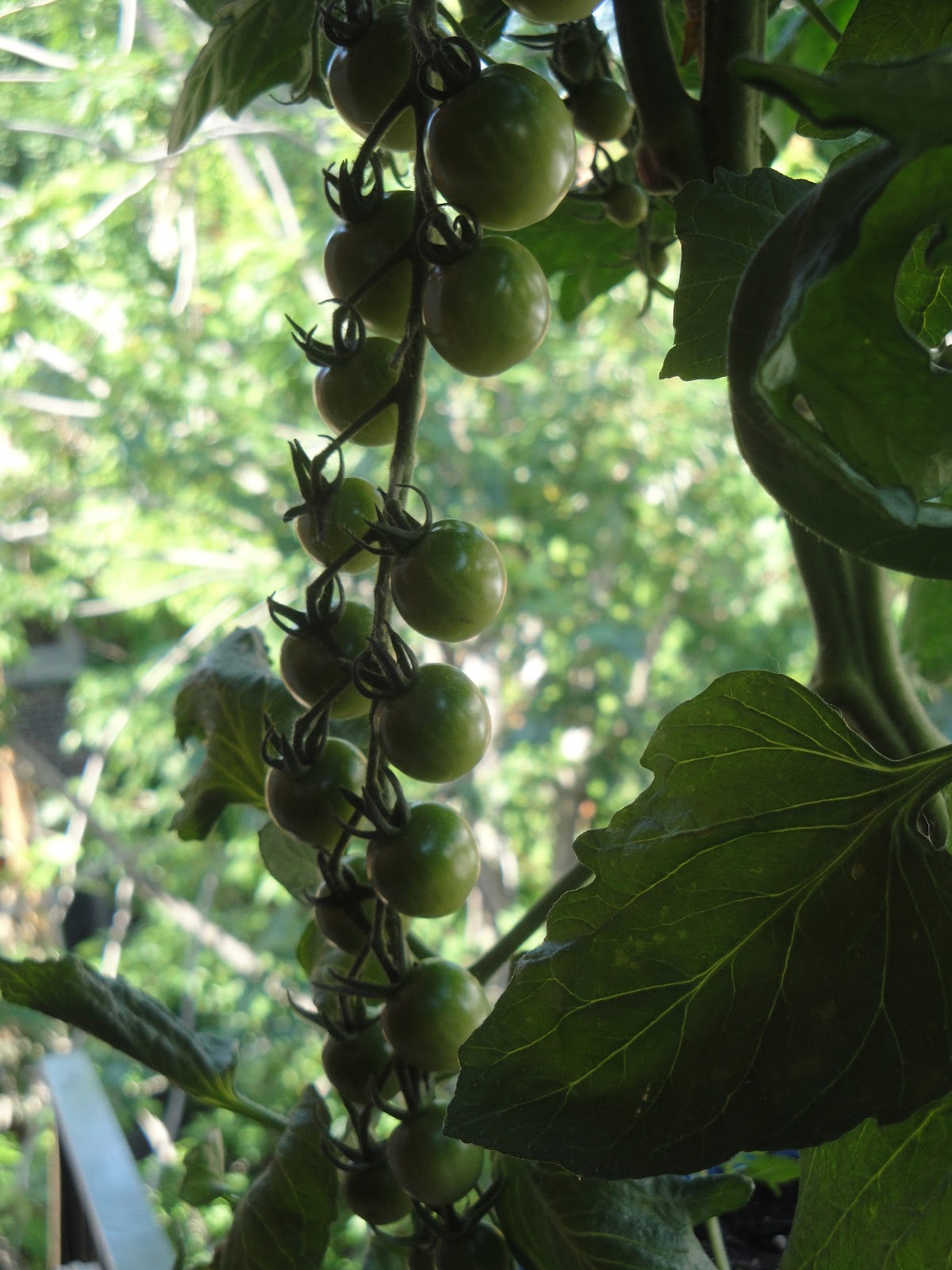
This island has potential.  The summer time brings such an explosion of life!  Balconies are full of tomatoes plants everywhere, strawberries hanging down, basil, onions, roses...

We're coming close to solstice.  Which also means Saint-Jean-Bapstiste.

What is it gonna be?
Another drunken celebration of our gregarious tendencies, or ... an event?  I want to see things move forward... so bad, though I know the resistance is real and widespread.  Here, amongst my people, we are ready to take a chance...

I was thinking.
Québec has a strong history of syndicalism.  I haven't read much about the topic, actually.  I don't know much about the struggles in the sixties; but I do know that today's unions are often considered as power thirsty as their counterparts, bosses and owners.
What if the unions got rid of bosses and owners?
What if workers united together, and between industries, to create a large network?  What if the superfluous disappeared?
Could we make it work?
That's the question !


I have been working at Touski for two months now; and I am witnessing a wonderful experiment in self-management, of team work, of doing business, and making food for the people.
You should see the amount of emails that go around on our mailing list list, each day.  But it works.  We are all concerned.  We are all asked to do a bit of extra work, and take some responsibilities, in order to make the restaurant prosper...

I love it.


And after work, I like to take my camera out... 


Noticing that a great number of schools were indeed founded by the religious community.


Roduction Éalisations Ndépendantes de Ontréal


Tuesday, June 12, 2012

Of minds and men (Mtl, Moscow, Mind)

Création d'espaces créatifs
All things are well in the midst of the Squirrel's Spire.

  Beautiful encounters over the past few das, the past few weeks.  I am trying not to make sense of it all but rather to experience it, with trust.  With breath.  
If the results of this experiment in abundance have been positive so far, I simultaneously feel another strong emotion... The depth of the Unknown, the compulsive fears and reactions, the anxieties of eminent change, of a potentially profound transformation.

Power to the Neighborhoods!
(Oui!)
As the Second Quiet revolution is starting to take place, we, the people, and I, actually, are starting to wonder... what's the point again?
''Le tintamarre des Casseroles'' is still happening, every night, though in reduced numbers now.  It has been going on since May 18th.  That's almost one month!  Every night, some... citizens get out and start following sidewalks and banging on their pots and pans.  Neighborhoods concentrate and relate, in this demonstration against the undemocratic absurdity of Loi 78.  Oh yeah, that's why!

But people also go to work everyday.  They also eat and so they cook or buy food.  They go for a drink or two, they see their friends.  We want the revolution AND life as usual.  We want to eat well and to be surrounded by people we love.  And why not?  You can't be on the battlefront at all times; because then, what are you fighting for?
Is the movement losing its breath?  I don't know, 'cuz I haven't been to the protests!

I am fighting for the Beauty and the interconnection in All things.  I am fighting for the Mystery of Life.
But sometimes I find it hard to sustain the fight.


Thoughts?  If the human species disappeared, it would take no more than a hundred years for planet Gaïa to rejuvenate Herself.
We are not indispensable.

 By now, we have to acknowledge that, since our arrival, we have been the most destructive species on Earth.  We need to acknowledge this reality, our reality, if we want to move forward.

And so once more it seems it comes down to some primary Guilt.  Damn guilt.
When you mama gave birth to you, it was the most painful and mystical experience... and yet.
 It's just how it is.

(Plus we now have epidurals anyway.  Not that I'm against it, just that we have adapted to make birth less painful and less dangerous.  Less mothers die I suppose.  That's a good thing!  But we get born in these conditions now, shielded and numbed from the pain of birth, and so we carry this on later in life, using more drugs, which I am not saying I am against either... given that it's all interconnected, and that the Earth also gives us these plants...)
(I could go on and one with musings on sacred medicine, but that'll have to be for another time.)


In short, all in all, consciousness is quite a phenomenon...

What are they trying to sell to us?


Une affiche, un manifeste non-signée. (Centre-Sud.)
 Of course I am trying to make sense of what's going on.  Why wouldn't I?  Why wouldn't a tree drink from its roots and tend toward the Sun?


 I don't need a lot of money.  What would be nice, however, is a good camera...


P.S. Remember !  The whole world is going through its revolutions.  One hundred thousand people gathered yesterday in Moscow, to overtly protest Putin's government and ask for new elections.  

Since embarking on his third presidential term, Putin has taken a stern stance toward the opposition, including signing a repressive new bill last week introducing heavy penalties for taking part in unauthorized rallies

Read more: http://www.canada.com/news/Tens+thousands+flock+anti+Putin+protest+Moscow/6768552/story.html#ixzz1xbCWp9cE
Yep.  It's happening in Russia right now.  Same thing!


A famous photo from Germany.  Cops suddenly take off their helmets and escort the anti-capitalist protests taking place in Frankfurt...  May 19, 2012.   (That was about two weeks ago.)


And in Poland, also yesterday!  :D  This is in parliament.

Thursday, May 31, 2012

A Day in a De-Growth Life

I like the work set up that I have going on right now.  I work three shifts per week at the restaurant, and I have four days off.  That's barely part-time...
So what do I do with the rest of my time?  (How do I make ends meet?)
I'm living very well, thank you.

Actually, I've now found a complementary job. Yep, I'll be joining the ''Echo'Scouade'', a team of animators-educators, which tours some of the biggest festivals in order to raise awareness on the topic of waste management, i.e. recycling your bottles while on site...and at home.
Between the two jobs, I should be able to feel a certain financial stability this summer.
And I still get to have about three days off each week.

My point in sharing all of this is to share one example of a life that is possible... A life of quality, of not being ruled by a work schedule, a boss, a mortgage.
What I'm really talking about is tied to a concept I've been musing over for some time: de-growth.

A couple of weeks ago I attended an international De-Growth Conference.  There, eminent professors and lecturers talked about different aspects of the transition our civilization might want to get into.
De-growth means stepping away from the illusion of happiness as progress and profit.
To me, it seems to point towards greater sanity and health, as well as creativity... and intimacy.  Instead of isolating ourselves by spending forty hours tiring ourselves out at work, coming home being exhausted, watching tv as an easy way into mindless relaxation, and wondering about that yearning for deeper and more meaningful relationships... We could work half, or even three-quarters of that time, and spend the remaining hours enjoying the presence of people we love, perhaps growing some plants that will give us food, and coming to terms with our fears of nothingness...
Don't you think?

I fear nothingness.
I fear the changes that are happening.  But I love the changes that are happening.
It has to do with Time, in part.

Am I inhabited by that old millennial, apocalyptic thinking?  I don't think so.  I don't think the end of the world is coming.  At worst, the human species would perish within the next fifty to two hundred years.  At best, we create a more sustainable world for ourselves.  Chances are, we're shifting from His-story to another kind of story...

Either way, Life and our Consciousness of it All is Divine and Beauty-full.

We could really use more networks of bike lanes and installations that make it easier for everyone who can use bicycles to get around.  We could rush less, move more.  We could spend less, and help each other more.  We could take time to communicate with our neighbors, get to know each other.  We could solve problems together.

Today, I ate breakfast with seven other people.  Then I cut my friends hair on the balcony, and after that I gave an intro of an astrological reading to a friend and I cleaned around the house.  After lunch I juggled a little bit outside while waiting for my other friend to return with his bicycle.  We talked about the choices he's trying to make, his aspirations and his fears.  We talked about going for a bike ride to the Canal Lachine.  But then a girl from work - she's gorgeous! - happened to walk by our house as we were sitting on the porch, so we invited her to sit with us a little bit.  We hung out, with two of my roommates.  We talked about synchronicities, about ''the hundredth monkey effect'', morphic fields (we didn't have the names for those phenomenon but that's what we were talking about), and collective consciousness.  We talked about sharing our greatest potential within the communities you are part of.
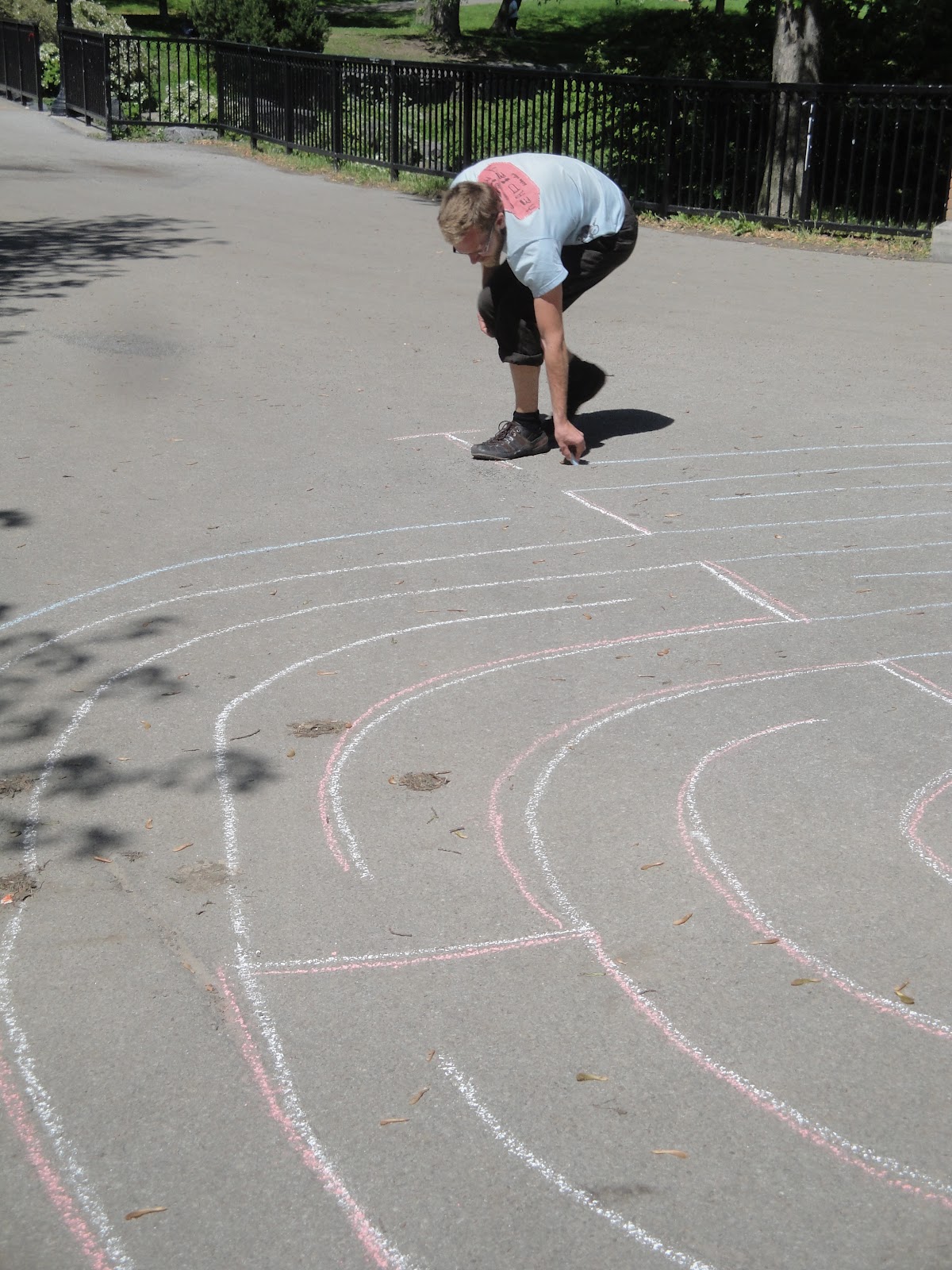
And then A. and I went to Parc Lafontaine, and we drew a huge chalk maze in the middle of a path.  People walked by with a smile.  They asked a few questions.  They wanted to walk it and they did once we finished the piece.  Two park workers drove by. ''We're making ephemeral art,'' I told them.  ''I was just taking a look'', one of them said with a smile.

We went to the market and bought lettuce and radishes (grown ''in Québec''), some pears, a mango, grapes, and avocados (grown far away), roasted sunflower seeds (where from?) and some balsamic and oil to make a fresh salad.  We made dressing out of mango pulp, garlic, ginger, lemon, balsamic, grape, and sesame oil.  We sat on the balcony and feasted while reminiscing about the intensity of yesterday's storm...
Yesterday, a crazy storm fell on Montréal.  Dark clouds and thunder quickly led to heavy... heavy rains, which, we soon learned, turned into flooded tunnels and metro stations!!!
Nature is mighty.

The climate here is so different than what it is in the Bay Area... I loooove these warm summer storms!

And tonight, I'm finally going out to dance!  It's been months since I've made it to a good dubstep party...

You can follow your bliss.  Take part in the beauty of existence.


Wednesday, May 23, 2012

''Special Law'' kicks in a new season in Montréal


Une tite rangée de polices à cheval (pas des chevaux blancs, bien sûr!) avant le début de la manif.  Il était sympa le mec, et je fût impressionnée de par sa volonté à dialoguer.


Last Friday the Liberal government passed a special law to try to put an end to the strike...
Any organism, association, or person who organizes a public demonstration that counts at least 50 people is now required by the law to provide, at least 8 hours before the start, the exact rally point, the route, and the time length...
And if the police don't like it, they can ask the demonstrators to change their plans.

WTF?
This is supposed to ''keep and regulate the right to demonstrate''. .. But wait a minute!  Why should we obey these rules and voluntarily relinquish our power (numbers) to you, when what we are precisely trying to do is to emancipate ourselves from this abuse of your power?  And what about you really informing us about where you're leading this country?

This is clearly an attempt to try and control the power of public demonstrations... But the people aren't that stupid.  In fact, this special law might have been the worst strategic move that the government could make.
Because now, the general population is switching sides!  They are getting in the streets, along with the students!
We are denouncing fascist policies.
We are celebrating the potential of a nation, united.
(I always ask myself: and then what?)

I thus finally went out to my first demonstration last Friday.  Calling time: 20h30.  Place: Parc Émilie-Gamelin.
Number of demonstrators: more than fifty.
A few photos taken in the few days since that event...

Les chevaux n'ont par contre pas voulu commenté sur la nouvelle loi passée par le gouvernement Charest:
Loi Spéciale 78


Friday, 19 MAI 2012
I was not impressed when I saw the row of police on horses overlooking the beginnings of the rally.  However, I was impressed, after I got closer, to find this man actually engage in a dialogue with a young man.  Soon, more people came by...
We are so thirsty for that communication... we wish we could get through to the humanness behind the armor.


French-Canadians have a long history of fighting for self-determination, freedom, and equality.  French-Canadians have always been a majority here in Québec, but our values are shared by many...
In today's struggle, the divide is not language.  It's money.  Dirty money.  Dirty politics.  And we invite all those who feel called by our values to join us.


La soif d'auto-détermination, de liberté, et d'égalité du peuple Québécois remonte à très, très loin...

''We have become the ferocious beasts of hope''

''Angry but pacific.  (Don't hit me)''

Nous marchions pacifiquement... quand tout d'un coup les policiers  ont cru bon de charger sur la foule avec des bombes lacrymogènes.  J'étais à environ 40 mètres, alors pour la première fois,  j'ai pu sentir cette odeur poivrés... voir les gens autours de moi qui toussaient (... et c'était pas des étudiants, mais des adultes de la population générale.)
Apparemment, ils cherchaient à nous diviser.
...
Ils n'ont pas réussit.


Manifestation de casseroles
(pots and pans protests)


In 1971 Chile, the dictatorship (Alliende) passed a law that made any assembly of more than 4 people illegal.  Chileans protested from right in front of their houses... with pots and pans.  Since then, a number of ''cacerolazos'' have taken place in Argentina and in Spain.  But the most recent and amazing results from this type of protest movement happened in Iceland (why didn't we hear of it in the media?), when the nation banged their pots and pans to the point of making the right-wing government resign, in 2009.  Read more about the Kitcheware Revolution here.

Now... it's happening in Montreal city.


Lundi 21 AVRIL, 20h- 22h.  

Sur l'Avenue de Lorimier, au coin Marie-Anne, tout le quartier sort de chez lui pour faire la révolution des casseroles: monsieur et madame tout le monde, les jeunes familles, les ados, les personnes âgés, les professionnels... un voisinage se rencontre enfin!!
Et on fait du bruit, pour dénoncer la loi Spéciale.
Et on fait du bruit, parce que c'est tellement l'fun faire de la musique ensemble.

Avenue de Lorimier, on Monday night. We heard a neighbor banging on his pots and pans... A gesture to denounce and protest against the Special Law.  Soon, other neighbors joined in... and more... until the whole neighborhood was out of their apartments, on their balcony or on the sidewalks.
For many- including my roommates and I - this was the first time we were interacting with our neighbors.  
And we banged those pots and pans... for almost 2 hours.
Cars honked. We jammed.  We smiled..
We connected.

And today? Well after marching- and dancing and chanting - throughout downtown Montreal for three hours, we went home to have dinner. And at eight o'clock...  it happened again ! 

Pots and Pans !!!

If this was in a movie.. we'd think it's too surreal to be true.

Monday, May 21, 2012

From Spring to Summer... the Movement keeps on...

Helicopters are filming everything.  In the streets, violent clashes are taking place.. at this very moment.
The government of Québec just passed a ''special law'' making popular assemblies illegal.  Bad move: now it's explicit: you are fascists.
It's a strong word, but it's a reality: the government is desperately trying to repress the revolution.  Riot squads are out, day after day.
It's been 98 days.

The temperature has been particularly hot here in Montreal, and it got me thinking...

We are entering Summer season.  This means that Spring is ending, and what does that mean for the movement?  We've been calling it the Québec Spring, but now a new season is at our door...  What will it look like?  How long can the students persist?

They have been made to look like their are alone with their cause.  Everyday we talk about the situation, and everyday I raise the same point: for change to occur, there needs to be more sectors of society that join the movement.  Students don't have much power... they are just a bunch of idealists.  They're not part of the machine yet, so they can't actually stop it.  They can make a lot of noise, but it's easy for the common people to overlook what they are trying to say.

Who can say that this crisis does not concern them?  Who can say that education isn't the concern of everyone?  Who can say that they wish for education to become accessible only to those who 1) can afford it, or 2) play the game and get into debt?  Who can say that this isn't going to increase the gap between the rich and the 99%?

Now, some may say that they understand all of this, and they still choose to denounce the student movement.  Those people do not value socialism.  They have opted for the race... to the mountain top; they may believe it's a matter of ''survival of the fittest.''
They haven't understood the concept.

The fittest are those who know how to work together, how to share, how to communicate.  The fittest are those who understand that we are all interconnected.

I don't understand how the movement can be so isolated still.  Their are plenty of supporters: teachers, parents, professors, workers, thinkers, artists, doctors even... They are out there, marching every night.  They march in peace, by the thousands, and not a single newspaper is talking about that.  The media focus on the violence...

It must be the movement's ''fault'', in part.  How come they didn't try to get more unions to show support?  Now is the new season.  This Summer, every one who believes in a more equal and loving society must get up from in front of the tv screen and get out to see what is happening.

Historically, revolutions happen when the discomfort becomes too great; when too many mothers become unable to feed their families.  Then, they take to the streets.  It is true, many of us are quite comfortable and well-fed in today's Québec.  (Though many struggle, too.)
History is a spiral, however.  There seems to be a pattern unfolding... a mix of repetition and linearity.  And to me, something very special has the potential to take place.

Sure, we have made it this far.  Sure, we take long hot showers and we eat fancy foods.  We have worked hard to acquire all of this, we deserve it, and we shouldn't complain with our mouths full.  We shouldn't make a fool of ourselves by raising up our hopes, or ideals, our utopias...

Or should we?
Québec is a relatively comfortable nation.  It is a nation, yes.  We are proud of our unique identity, even though we are still working at defining it.  But the world is One now, more than ever.  My generation barely remembers a time before the internet.  We can choose to travel or work abroad, we are fully aware of the global village and of the issues other nations struggle with.  We are well aware, also, that we are all in it together.
This is why we march in the street.
This is why we want to bring about a revolution.   From our place of privilege, we want to create an even better world for our children to grow up in and take care of.  We want the integrity and equality of all human beings to be recognized.  We want to organize in ways that can reflect and sustain that.

If you are reading this from another country, please tell me, have you heard about the Student Protests?  Do you know about the DAILY confrontations between the police and the people?  Do you understand what I'm talking about?