About this clown

My photo
I often feel that we're all spinning slowly... like a mirror ball. Yes, we are all mirrors to each other. And so, it is the Light between us that I hope to help reveal and celebrate. /// J'ai souvent l'impression que nous sommes une boule disco qui tourne lentement. Nous sommes tous des miroirs pour les uns les autres. C'est donc la lumière qu'il y a entre nous que j'espère contribuer à souligner et à célébrer.
Showing posts with label quebec. Show all posts

Friday, August 16, 2013

Interculturalisme québécois

Je me suis inscrite comme bénévole à l'école d'été de l'Institut du Nouveau Monde: ''une école de citoyenneté aux airs de festival pour les 15 à 35 ans''.

Parmi mes camarades anarchistes, il y a bien sur le débat sur le ''citoyennisme''; je vous mets un bon article sur le sujet : ici. Selon certains, la démocratie dite participative n'est qu'un leurre, un panacée qui soutient la légitimité de l'État et de ses corollaires: capitalisme libéral basé sur l'exploitation et l'inégalité des classes, oppression systémique, etc. La participation citoyenne opte pour la réforme et non pour la révolution, elle s'inscrit dans un modèle qui délègue le pouvoir à une classe dirigeante, laquelle, en ce monde capitaliste, ne peut qu'être liée, ouvertement ou non, à la classe des affaires). Bref, d'un point de vue radical, le citoyennisme nuit à la lutte pour la justice et l'égalité des classes.

En bonne balance, je me permets de verser de l'eau dans ce vin. La démocratie participative ne m'inspire pas particulièrement, d'une part, parce que je ne crois pas que nos dirigeants écoutent réellement. L'INM peut publier de jolis rapports de concertations populaires, il me semble que le gouvernement s'en contre-fou.

Par contre, je pense qu'il est parfaitement utile et nécessaire d'inviter le peuple à parler de politique, à apprendre l'implication, la conversation. Qui sait, plus on vivra l'expérience de l'assemblée et de l'organisation politique, de la mobilisation, de la démocratie directe, plus on réalisera qu'on a peut-être pas besoin de chefs politiques! (Encore ici, je ne suis pas certaine qu'il ne faille pas une forme quelconque de centralisation du pouvoir pour que mouvement ait lieu. C'est physique.)

Mais c'est d'interculturalisme que je voulais surtout parler aujourd'hui, puisque j'ai eu la chance de participer à la conférence de Gérard Bouchard (voir commission Bouchard-Taylor) ce matin.
Fait magique: j'ai hier soir fait la rencontre d'une femme qui écrit justement son mémoire sur les limites de l'interculturalisme (avec un débouché sur la puissance de l'art clownesque!!!)

J'étais donc impatiente d'entendre les propos de celui qui est en fait la référence sinon l'architecte premier du concept d'interculturalisme.

Le site de ce livre contient un bon r.ésumé: ici


Heureuse d'entendre que ce concept d'interculturalisme est un produit de la psyché québécoise.  Heureuse dans mes trippes, parce que tout ça s'inscrit dans une vision personnelle et dans mon analyse... (best-seller à venir...)

MAIS. Que d'imperfection!

Nous avons le devoir de questionner.  Je questionne donc:
Qu'entend-t-on par le mot ''culture'' ? Éternelle question!! Tout le monde peut s'oser à une réflexion générale: la culture c'est euh... ça passe par la langue, par l'histoire aussi. Bouchard nous parle de valeurs communes qui se sont forgées au fil d'expériences collectives singulières.  Lorsqu'on lui pose la question, il définit la culture nationale québécoise en citant 1) la défense de la langue française, 2) la notion d'affranchissement et 3) le culte de l'égalité et de la justice sociale. ''Ce sont là des valeurs absolument universalisables'', rajoute-t-il.

Si on me posait la question à moi, je proposerais aussi les valeurs de solidarité et du ''bâtir''. Bien que cette dernière idée doive absolument devenir sujette à la redéfinition.

Puis de suite, je questionnerais le concept de culture nationale. Car si la culture naît vraiment de l'expérience commune, il me semble que notre focus soit peut-être, en fait, mal placé. M.Bouchard lui-même le souligne: le concept de la nation fluctue dans l'histoire. Il sert différentes fonctions à différents moments.
Selon Bouchard, c'est un concept qui demeure très pertinent dans le contexte mondial et néolibéral actuel. M.Bouchard considère que la nation devra servir à nous protéger contre les perversions du néolibéralisme.  Il souligne qu'entre 1970 et 2000 le Québec a su non seulement conserver l'intégrité de l'État et de ses politiques sociales (vraiment?), mais que nous avons même vu une diminution de la pauvreté. Je n'ai malheureusement pas de sources à citer et je suis un peu sceptique, mais il existe apparemment une études sur le cas. Bref, l'État-nation aurait encore sa fonction.

La culture nationale servirait ainsi à permettre l'orientation du politique. Sans culture nationale, par de cohésion politique. Mais faut-il absolument relier nation et État ?

Et que faire de tous les autres phénomènes culturels qui composent nos sociétés contemporaines?

J'ai dernièrement commencé à réfléchir davantage sur les dynamiques inter-générationelles, par exemple. N'existe-t-il pas un fossé culturel plus large entre les personnes qui sont nées avant l'avenement du téléphone, les baby-boomers et les enfants de l'an 2000, qu'entre une Marocaine et un Salvadoréen de 25 ans qui étudient tous deux en Ingénierie environnementale ? Il me semble qu'on ne peut pas parler de valeurs et de cultures sans admettre que la mondialisation nous a menés à vivre des expériences transnationales.

L'interculturalisme est pris dans un paradigme d'État. Bouchard ne le dit pas comme ça, mais il y touche presque lorsqu'il admet que la question autochtone relève d'une autre problématique. Il aurait discuté avec des Innus et quelques autres qui se posent d'ailleurs la question: ''les autochtones sont-ils québécois?'' Bonne question! Les autochtones ont peine à établir un rapport de force politique avec ceux qui les ont volé. Se réclament-ils de l'État québécois ? Qu'on-t-ils d'autres ? (Beaucoup, mais on n'en parle pas!)

En terminant, j'aimerais encore une fois traiter de la psyché québecoise et de son insécurité. Car c'est malheureux à dire, mais c'est beaucoup ça la culture québécoise!

Je lui ai posé la question à notre M.Bouchard. ''Que pensez-vous de la possibilité, et même de la ... souhaitabilité pour le Québec de se sortir de la conception de ''majorité fragile'' (reprenant ses mots) et menacée?''

Sa réponse fut insatisfaisante mais intéressante:

''On ne peut pas nier ou se défaire du coefficient sociologique d'insécurité. Par contre, cela aussi fluctue dans l'histoire.  Prenez par exemple la révolution tranquille. À cette époque, les Québécois-es n'étaient pas du tout empreints du sentiment d'infériorité. Et qu'est-ce qui s'est passé?  Et bien ils avaient cessé de se regarder comme une minorité canadienne française au Canada et ils ont vu qu'ils étaient une majorité au Québec. À cette époque, les Québécois-es étaient fier-es.''

Note à moi-même: cette source de fierté-résilience-confiance à laquelle j'aimerais tant voir le monde de demain s'abreuver, et bien, elle a déjà coulé dans les parages. Je ne sais pas les nuances de la fierté québécoise de l'époque, et les temps (et les cultures) ont bien changés, mais au moins, grâce à cette perspective, je conçois l'espoir que le Québec ne s'enlise pas éternellement dans la peur et la victimisation.

L'interculturalisme, c'est s'ouvrir à la différence. Mais pour s'ouvrir à la différence et à l'Autre il faut d'abord arrêter d'avoir peur de soi-même.

Sunday, August 4, 2013

''Présence Autochtone'', racines et aspirations


Je songeais à un truc...

Il leur fallait ''la foi'' pour survivre ces hivers, pour défricher et bâtir sur ces terres.  Il leur fallait une enceinte où produire de la chaleur humaine. Combien d'églises ont joué ce rôle rassembleur?  La religion catholique est partie intégrante de notre histoire et j'aimerais qu'on en discute.

Je ne parle pas verser nos économies dans la dîme des prêtres, de se laisser marcher sur la tête, ou de sacrifier nos corps pour la procréation de la race (bien que, comme je tiens toujours à le rappeler, il nous fasse aussi reconnaître que nous ne parlerions peut-être pas français aujourd'hui n'eût été de l'injonction de procréer ). Je ne parle surtout pas de poursuivre dans la voie de la négation de notre élan vital, de baigner dans la culpabilité et la peur. (Car nous devions aussi être ''sauvage'' pour apprendre à vivre ici.)


Je m'adresse au peuple québécois tout en m'adressant à tout le monde.


Cette semaine à Montréal se tenait la vingt-troisième édition du Festival ''Présence Autochtone''. Que dire...

Entre le sentiment malaisant que me procure ''La place des Arts'' et ses odeurs de Panopticon (ou comme si l'art pouvait se restreindre à des espaces choisis, prédeterminés, bétonnés, encerclés, commandités!), et la part de soulagement que je ressens à voir cette présence...
Un teepee moderne, géant, accroché à 40pieds dans les airs par une grue. Malheureusement la photo que j'ai prise est prisonnière de mon appareil photo qui est vraisemblablement kaput (émoticon triste) (Serait-ce le moment de m'offrir la caméra de qualité dont je rêve depuis un long moment?), mais la scène est génératrice de sens... (Quelques photos que je ne peux pas partager - vivement les Creative Commons- et qui vous donneront une idée se trouve sur le site de nul autre que... Loto-Québec, fier commanditaire! (Émoticon ''ironique'')

Je tergiverse tant! Ève, reviens dans le droit chemin.

Bref. J'ai adoré mon expérience de ce ''festival''.
1) Découverte de l'artiste Shauit, musicien et chanteur reggae, natif de Maliotenam sur la Côté-Nord: du rap-reggae en Innu! (Talk about reclaiming a language et prendre la parole!) 

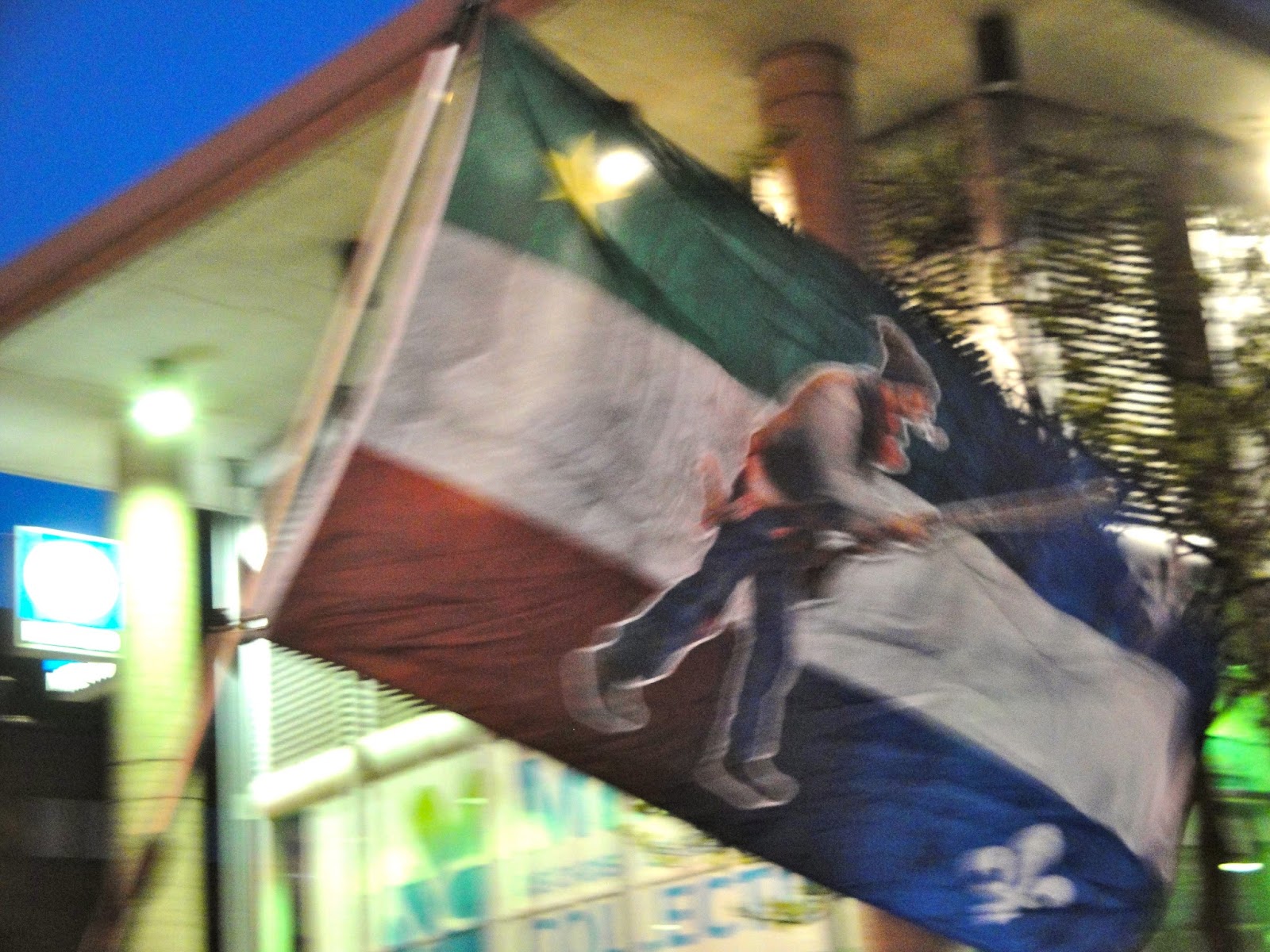
2) Rencontre et conversation avec Yvan.  J'ai vu Yvan pour la première fois mercredi soir dernier, lors de la projection du film ''Ramer d'une seule voie'' ( Cliquez ICI pour le voir: ça vaut le 15minutes.) au Musée McCord.  Il était dans l'audience, tout simplement.  Dans le film, un drapeau que j'aperçois pour la première fois:


Vendredi soir donc, sur la place des Arts, le même drapeau.  Je m'approche pour m'enquérir un peu au sujet du symbole, etc.  Je me faufile dans la foule et me retrouve devant cet homme, Yvan, longs cheveux raides et noirs, yeux pétillants, ceinture fléchée et colliers traditionnels. Dans sa contenance par contre: la vibe d'un ''québécois''. Son accent, son nom, son aura.  Bref, j'apprends que le signe d'infini a été adopté par la communauté Métis.
'' On est tous issus du métissage.''
''Nos ancêtres se sont alliés. Les colons étaient des hommes et des femmes courageuses, notre culture est une culture de la terre d'ici, des conditions et des besoins d'ici.  Notre culture est remplie de la présence autochtone: nos canots, nos raquettes, nos textiles, notre courge et notre maïs, notre langue...  Notre emphase tend à porter sur l'inimité, sur la blessure et les autres facettes souffrantes de la colonisation.  Certes, il est essentiel qu'on se fasse ce devoir de mémoire.  Mais serait-ce possible que le temps soit venu pour outrepasser la grande blessure et pour entreprendre un dialogue qui continue d'aller de l'avant?

Un autre drapeau déjà aperçu: blanc avec un arbre dessiné dessus: La famille. ''Et ce drapeau-là, tu peux m'en parler un peu?'' ai-je demandé à Yvan.
''Ça c'est La famille. Ça veut dire qu'on est tous une famille et qu'on doit se rappeler ça, des racines vers le tronc, puis les branches, nos parents, d'autres branches, nous-mêmes, et nos enfants...''
''Et notre connexion avec la terre'' je rajoute.
Il me sourit. ''Oui'' ''Et y'a les racines surtout, parce que si on coupe les racines, l'arbre meurt.''
''Nos aînés, nos ancêtres...''

Euh...
Partage d'un ''pregnant silence'' (une belle expression que les anglophones utilisent). Et je lui confie, ''sauf que c'est justement quelque chose qui me fait peur; au Québec, cette relation défectueuse avec nos aînés, notre incapacité à conjuguer la ''vie moderne'' et le prendre soins de nos parents. (À ce sujet, un l'Institut du Nouveau monde entretient un dossier TRÈS intéressant: http://www.inm.qc.ca/a-propos/paroles-de-linm/la-declaration-des-generations-2011) Ça ne me donne pas beaucoup d'espoir.''

Yvan me regarde et me dit, d'un ton scintillant:  ''C'est pour ça qu'il faut qu'on regardes dans les yeux des enfants. C'est eux qui nous montre la Vie.''

Une conversation de quinze minutes, droit au fond des choses. Amen

Je n'ai pas fini ma tirade sur l'Église et la spiritualité au Québec.  C'est évidemment un travail en cours/ work in progress.  But you get the point...
J'ai dis qu'il fallait la foi.  J'aimerais qu'on parle du mot.

Église sur une réserve près de New Richmond, dans la Baie des Chaleurs.


Friday, December 21, 2012

La fin d'un Monde

C'est la veille de la fin du monde et je me sens bien.  J'habite dans un coeur battant.
Un nouveau monde commence demain.  À travers les tueries, la souffrance, les guerres, l'esclavage... en chute libre au creux d'un futur qu'on dit ne pas pouvoir connaître d'avance.
Sauf que le problème, c'est que le futur n'existe pas.  Et en même temps, il existe aussi: c'est nous qui le créons.  Le future, le telos, c'est une projection de l'esprit humain.

C'est la veille de la fin d'une histoire.  La veille du solstice de 2012.  Le temps et l'espace s'apprêtent à prendre une nouvelle dimension.

Mon présent est vraiment merveilleux, because I come home to an open heart: a open home.   Parce que c'est pratiquement ''un open house'' ici, for our friends, visitors, family, friends of friends, etc.  We are seven and satellites, a kind of nucleus for nomads particles to find a home, for an instant.
We leave or heart open, so we learn from each other.
Three languages, four including music.  Cooking.  Building.  Sharing.  Growing seeds and sprouts and picking up the excesses from the capitalists' dumpsters.  Trying to live radically: trying to live from our roots.  Though we all come from elsewhere, from another part of the world.

Moi, fille d'ancêtres quelconques, de colons Français immigrant dans un nouveau Pays.  Et je me demande: Qu'elle était leur relation avec ceux qui habitaient sur ces terres?
Ils sont venu s'y établir, les Européens; ils sont chercher des richesses, développer des marchés, puis coloniser, cultiver, et évangéliser... Ils sont venus raconter leurs histoires d'un futur meilleur...

Meilleur que quoi?  Meilleur pour qui?

Eux qui perdirent leurs mythologies d'éternel retour des choses se mirent éventuellement à adopter de nouveaux mythes... des mythes de: progrès.  Une ouverture est créée.  C'est demain qu'il faut viser.  Demain, il y aura plus, plus de grain, plus de surplus, plus de sécurité ...

Nous avons si peur de la disette, de la pénurie.
Nous avons appris à focaliser un supposé état de manque.
Ceux qui détiennent les moyens d'exploitation, de transformation, et de distribution de nos ressources se rient bien de nous voir perdre nos moyens, de travailler comme des imbéciles et de courir contre la montre pendant qu'eux amassent les richesses en évitant de mettre l'épaule à la Roue (de la Vie)...
(Nous produisons beaucoup désormais.  Il y en aurait surement pour tout le monde.)

Au fond,
La Vie et la Mort son comme le pouls d'un temps infiniment profond.  Nos petits ''je'' ne font que passer dans la grande parade de l'Histoire, et encore plus dans celle du Temps...

Considérons...

- 408 million years ago, the first amphibians ''appear'' on Earth - planet Earth, that is; where we live today - the first insects, and the first spiders from the Silurian period and bring about what we apparently label the ''Devonian period", which is of course part of the Canbraic Era.

Then, 
All through this time the earth was changing. 
In the Triassic period, all the continents were joined together in one huge landmass. Climate was hot and dry but with rain seasons. The first tree ferns and coniferous trees were starting to appear. 

In the Jurassic period the climate changed as the huge continent was breaking up. There were now forests of cycads, conifers and gingko, all plants that still exist today. 

In the Cretaceous period (that's: 144 million years ago), the continents had separated and each had its own flora and fauna. However, Australia and Antarctica were still joined together. There were now flowering plants such as magnolias and waterlilies.

The first cell with a nucleus?  2.100.000.000 years ago.
Homo Erectus: 2, 500, 000 years ago.  

And then, barely two million years later, two MILLION years, homo sapiens emerges and begins to sapiens itself: a new form of self-consciousness develops...

Neolithic humans developed agriculture 8,000 years ago.

Two millennia ago, a Son of Man claimed himself Son of God.  King of a non-Earthly Kingdom, where there would be no wars, no slavery, no injustice.  Jesus was the awaited savior a of people without land, the one who would die and live again to purge the world of its darkness.  The Sun of God, the one who would live and die to bring us Light, just like old god Dionysos. 

Before that, at about 2,500 years ago, it was the son of an aristocratic man from the metropolis of Athens, a man named Plato,who laid the foundation of Western Philosophy and Ethics.  He told us of the man Socrates, who taught citizens how and why to think for themselves...

In this geological perspective, what is 2013?

What is December 21, 2012?
The astronomical calculations of the indigenous people of Mesoamerica.  A long cycle is ending: one Baktun of some 394.26 years, a cycle which is itself but a fraction of a bigger cycle that is also ending...
I heard about special cosmic phenomena that would apparently be taking place, like:
The supposed prediction of an astronomical conjunction of the black hole at the center of the Milky Way galaxy with the winter solstice Sun on December 21, 2012, referred to by Jenkins in Maya Cosmogenesis 2012: The True Meaning of the Maya Calendar End-Date (1998)
Is there really a black hole at the center of the Milky Way !!?

The Milky Way?  Can we really see that far outside of ourselves !?  Historically as well as cosmically, why deny it: we are so small.  Are we thus also insignificant?
Peut-on vraiment voir aussi loin à extérieur de nous-même?  Historiquement et astronomiquement parlant, pourquoi le nier: nous sommes tellement petits.  Mais alors, sommes nous pour autant insignifiants?

Voilà ce que j'en comprends.
Demain, je prendrai le temps d'écouter la souffrance de mes contemporains.  Je sais que je vais aussi ressentir la souffrance de notre Terre Mère, les guerres de nos pères, les peurs de nos frères et soeurs.  Je ressentirai l'Histoire, la pre-Histoire, le Temps Profond.  Je m'émerveillerai aussi certainement avec une dose d'ambivalence et une fascination intarissable, de voir nos constructions, notre architectures, nos organisations, si imparfaites.  Je m'émerveillerai d'être sapiens sapiens, de pouvoir être témoin de tout ça: le temps, l'espace.  Je serai reconnaissante, de pouvoir ressentir un flocon de neige sur ma peau, de pouvoir concevoir et admirer son unicité, son éphémérité...


Thursday, August 30, 2012

Meanwhile in Gaza

I just wrote another blog about the politics of Québec.  Less than a week before our provincial elections, I'm humbly trying to contribute to the betterment of a society that I truly consider to have much potential (there are so many resources laying around here!!).  I'm hoping to bring up not one, but several coherent - and inspiring - perspectives, that would account for the complexities of our situation, all the while offering both rational and emotional grounds. (Trying to be integral?)  I am calling for an urgent move that brings us beyond the politics of fear, hate, and war.

I am dreaming of autonomy and intelligent self-management, while... in the Gaza Strip, Palestinian children are being tortured, every single day and unabashedly.  We might be in denial once again, because a nation is being occupied and the world ''community'' (always a good word to ponder) says absolutely nothing.  Well some people are speaking up and denouncing the violent apartheid system that's taking place in Israel.  Palestinian villages have been displaced.  Houses were demolished or taken over, and the people that lived on those lands - up until 1948 - are now waiting inside shrinking territories.
The Wall is built and it keeps eating up Palestinian gardens: Israeli settlements are spilling over.  The army is everywhere: check points and fences sprout like aggressive weeds, and military planes fly intermittently over the heads of these people effectively reminding them: : we got you.

Sorry to bring this onto you. It's just that it needs to be talked about.

Last night my roommates and I watched a documentary, called ''Le rire contre les larmes'' (Laughter against Tears), which followed a French troupe of Clowns Without Borders during their mission in Gaza.
(The following video is a different one... but :D )

My roommate M. was in Palestine last Spring, and she feels very strongly about the Israeli occupation. She told us that there is currently a boycott against Cirque du Soleil to protest against against their going to Tel Aviv. ''You can't put the people of Israel and their government in the same boat, '' I said, trying to defuse her anger.  (I thought of my dear Jewish and Israeli friends, and I didn't like M. pointing her finger at them!) And so a passionate debate ensued, and M. refreshed our memory about the history of the past 60 years and the fact that it is getting worst everyday.  I studied this shit in college and I know it is real: a whole nation, a whole culture is being slowly exterminated.  Genocide. We exchanged points of view to try and lay out the fullest picture, only to settle on the eternal conclusion that it is and will eternally be complex.  Of course, the youth of Israel is also victim of the situation.  Personally, I dare hoping that the mandatory draft is debated, and that few are those who go through it without realizing what is at stake.  Yet it takes superhuman powers to muster the courage and defy one's culture, to stand against the draft and face years of imprisonment. Everyone's fucked. We agreed on that. So M. said, ''I just can't deal with people who go on denying what is happening.'' And I wish I could do something.  I wish I could do something for indigenous people everywhere, in Québec, Brazil, Tibet, Kurdistan, Palestine, etc.  I wish I could learn some good tricks on the diabolo, and muster the courage to join Clowns Without Borders.  I wish I could tell everyone: ''We are with you.  We don't know how to go about it, but with all our hearts we see your humanness, your resilience, and your beauty.''
You can visit Clowns Without Borders' website, by clicking here.  You know this is deep healing work. One way to call for the end Apartheid in Israel is to join the Boycott and Divestment Campaign.  Learn more about this international movement here, or on the BDS website,  here.


As always, I welcome any respectful comment and questions about this post... We all feel passionately about those things that we identify with; let us all learn to notice this phenomenon so as to engage in functional debates in which we may all learn and broaden our horizons and our capacity to love.

À une semaine des élections

La balle est dans les airs!
(manif du 22 juillet)

Je me sens un peu prise entre deux langues, but what's new?

Nous sommes à quelques jours des élections.
Selon les médias- ceux qui ont le jeu des ficelles dans ce théâtre de marionnettes qu'est la scène d'information populaire- ce sera le Parti Québécois qui prendrait le pouvoir...

Je ne comprends pas très bien.

Ici dans ma bulle, sur le plateau Mont-Royal, il est plus qu'évident que le peuple a soif d'une politique tellement plus intègre, et radicale.  On vote Québec Solidaire parce que c'est le parti qui valide nos besoins et nos demandes:

On ne peut plus se permettre de nier la crise écologique et de persister dans la voie obsolète et pernicieuse d'une industrialisation gavé au pétrole et autres ressources non-renouvelables.  On à mal au coeur de savoir que nos terres agricoles se font de plus en plus ''dézoner'' dans l'étalement de la banlieue.  On veut parler du futur, prendre les moyens de bâtir les réseaux et les structures qui pourront faciliter l'évolution de la nation.

On a la rage, c'est vrai.  On n'en peu plus de l'hypocrisie, de la manipulation, et de la peur.  On s'indigne devant l'opacité des milieux financiers et administratifs.  On s'efforce de dénoncer la corruption et le manque flagrant d'éthique des instances au pouvoir.


Je n'aime pas porter accusations ni m'entendre qualifier d'autres humains de malveillants.  Mais il ne faut pas fermer les yeux non plus: le système néolibéral est un véritable merdier.  C'est une fausse à mensonges, un manège de violences cachées...


 C'est difficile de vivre en sachant et en comprenant l'étendu de la violence commise par l'élite.  Je ne veux pas paraître révoltée comme une adolescente, mais je le suis.
J'apprends à célébrer la lumière, la créativité, et l'interconnectivité.  J'aspire à partager des moments de joie et de communion avec de plus en plus de citoyens, de la campagne à la métropole.  Je crois à l'autonomisation (empowerment) par l'art et l'éducation populaire.  Je prends refuge avec le Buddha, le Dharma, et la Sangha.  Je sais qu'il n'y a rien que le présent; l'existence est une série de carrefours où se pose, avec chaque respiration, une nouvelle question.  Nous avons toujours le choix.

Alors pourquoi choisir le PQ?
Parce qu'on ne veut plus des Libéraux et qu'on croit que le vote stratégique est la seule solution?
Parce qu'on a peur de ''perdre notre vote'' si on suit vraiment notre conscience-coeur?
Parce qu'on entretient de vieilles rancunes, parce qu'on a peur de regarder de l'avant et de rêver à un avenir meilleur?
Parce qu'on a peur de l'espoir inhérent en chacun de nous?
Qu'est-ce qu'ils ont a offrir, le PQ?  (Péquistes, je vous invite à me répondre!)

Il portait jadis l'étendard d'un projet de souveraineté-association.  Aujourd'hui, c'est Option Nationale qui prend la relève.  Le PQ m'apparaît comme un parti sclérosé, réactionnaire et tout aussi avide de pouvoir que le parti Libéral.

En fait, parlons-en!  Comme il est bon de sentir le renouveau de la question ''nationale'' au Québec!  (Ou est-ce seulement dans une partie du milieu francophone Montréalais?)
Je sais pertinemment que le débat est plutôt embryonnaire pour l'instant.  Je sais très bien qu'il attise les passions.
Or les Québécois n'ont pas envie de se chicaner.  On n'a pas envie de se chicaner avec nos proches.  On préfère être confortables, au chaud,  et la programmation télévisée de la prochaine saison semble fort intéressante.

Le fait est qu'il reste beaucoup de place au développement de meilleures habitudes démocratiques au Québec.  Nous avons de très bonnes bases - don't get me wrong.  Le printemps érable aura re-réveillé la fibre politique et militante québécoise.
Parce qu'il est impossible de considérer l'expérience québécoise sans admettre les dynamiques de pouvoir qui y jouent.
De ce fait, nous sommes fondamentalement politiques, quoique nous sommes aussi prisonniers d'une mentalité dualiste et antagoniste.  Et nous pourrions peut-être apprendre l'art de la négociation, de l'écoute, et de la communication non-violente ?  Peut-être alors serions nous capable de discuter des projets de sociétés autours d'une bonne table, avec les membres de notre famille et autres gens qui ont des opinions différentes?  Peut-êter pourrions nous identifier les besoins qui nous unissent, et travailler ensembles à la réalisation des étapes servant à y répondre le mieux possible.

Un duo de pancartes qui m'a fait verser une larme de joie

Au risque de me répéter: Il serait grand temps de transcender notre mentalité de victime.  Il serait grand temps de faire le recensement de nos forces et de nos valeurs.

J'anticipe l'élection du 4 septembre avec un brin de doute, pour ne pas dire de dégoût.  J'ai l'impression que plusieurs citoyens auront vécu une mini révolution grâce à tout ce qui s'est profilé dans les derniers six mois, et que nous pourrons dénoter une petite part de changement.  Or j'ai bien peur de voir le status quo l'emporter à nouveau.


Wednesday, August 1, 2012

politics and the phenomenology of paradox

Sitting in my former school, the California Institute for Integral Studies. Soaking in. Reading and meditating on the different objects of my attraction.  On the one hand, mysticism and the taste for a free, unconditioned experience of Life.  On the other hand, visions and fears concerning the condition of matter, humankind, society, and Mother Earth.
I've been reading Mircea Eliade on Yoga.  I've also been seeking those with explicit inclinations towards consciousness studies... taking full advantage of this special Bay Area spirit.  It's clear to me, a region produced by the frontier mentality had to be permeated by idealism.  This place was born out of the necessity and capacity to see further, to open up paths into the unknown, to envision riches and dig for it.  The gold rush is of the past, but furher riches are being unearthed here. 
We've colonized land to the very edge of the new continent, and so came facing the unchartered territories of the mind, aided by the wisdom of Indigenous (behind) and Asian (ahead) cultures... This to me is one of the greatest gifts of San Francisco.

I am re-membering the pieces of my own journey.
I am considering the nature of time, and space.
I miss Montreal and the nation of my ancestors.  And in the material plane I wonder, I feel, that I can contribute something of what I've been learning...

Back in Quebec, the elections have been officially announced by the prime sinister - uh, minister.  Given what has sprung out of the "Printemps Erable", Charest might be right on one point: these could be the most important elections in the history of the province.  Or not.

It's 2012.  How many are able to dare and be visionaries?  How many would agree with my intuition; that we too are of a certain frontier mentality?  We are made up of pioneers (though we were first enslaved to the Catholic Church, and since then, to our fears and victim mentality.), ingeneers (for we had to keep ourselves warm and sufficiently fed) and hard-working families.  We were multicultural from the start, all immigrants on indigenous territory.  We have wide spaces and tons of ressources; water, minerals, wood.  We have circumstances, which point to warmer climates and future population growth.

We have so much potential.  If we acknowledge it.
If we can truthfully consider the power structure and the dynamics that are making up our society.  If we can keep talking amongst neighbours to revitalize the connections we have with one another; if we can let this be a strength that helps us out of fear and stagnation.  If we can imagine what is possible through emancipation and cooperation.

I cannot deny my vocation for political philosophy.  I also cannot deny my understanding that there is an Ultimate reality, beyond the illusion of separation and the fear of ego death.
I wonder how to honor both.
I am sitting at the California Institute of Integral Studies.

Sunday, June 17, 2012

solstice on the island...

We're getting closer to the solstice here.

A people of festivals.  A people that used to go to Church every Sunday... ?

I see many movements... There's a huge movement, to create spaces for neighbors to meet one another and talk about common realities.  I see organizers.  Leaders.

I had an idea for a new creative ''manif'' ...
I see hundreds of people dancing... une gigue!  (a jig)

Imagine everyone crossing arms and spinning, meeting one another with a laughter, a face, a look in the eyes... skipping around and switching partners, until we meet everyone and make 'them' dizzy watching us from their glass towers and helicopters!

It would be such a gesture, to dance... Emma Goldman's revolution.

Or Nietzsche's revolution - as far as my exegesis goes - for it is an unleashing of our greater potential as creators.

We don't go to Church anymore.
In the summer time, we sit on our front stoops and our balconies.  In the winter, however, we sit facing the television, still.  And that's definitely another angle of the revolution we must look into! (The concentration of the media is REAL my friends... )


This island has potential.  The summer time brings such an explosion of life!  Balconies are full of tomatoes plants everywhere, strawberries hanging down, basil, onions, roses...

We're coming close to solstice.  Which also means Saint-Jean-Bapstiste.

What is it gonna be?
Another drunken celebration of our gregarious tendencies, or ... an event?  I want to see things move forward... so bad, though I know the resistance is real and widespread.  Here, amongst my people, we are ready to take a chance...

I was thinking.
Québec has a strong history of syndicalism.  I haven't read much about the topic, actually.  I don't know much about the struggles in the sixties; but I do know that today's unions are often considered as power thirsty as their counterparts, bosses and owners.
What if the unions got rid of bosses and owners?
What if workers united together, and between industries, to create a large network?  What if the superfluous disappeared?
Could we make it work?
That's the question !


I have been working at Touski for two months now; and I am witnessing a wonderful experiment in self-management, of team work, of doing business, and making food for the people.
You should see the amount of emails that go around on our mailing list list, each day.  But it works.  We are all concerned.  We are all asked to do a bit of extra work, and take some responsibilities, in order to make the restaurant prosper...

I love it.


And after work, I like to take my camera out... 


Noticing that a great number of schools were indeed founded by the religious community.


Roduction Éalisations Ndépendantes de Ontréal


Monday, May 28, 2012

Réflexions sur le St-Laurent


Life goes on... so fast!
Je ne sais pas quoi penser de se qui se passe.

Le Québec, ma tête,
en effervescence,
À voir une identité se forger,
les tensions qui l'habitent
Les peurs et les espoirs les plus fous

À parler de la langue
le français et l'anglais co-habitant sur une île
depuis 370 ans
Ville-Marie l'utopie
...

En ces temps politiquement chauds
En ce printemps de l'année 2012
Des manifestations d'hommes et de femmes
d'enfants et d'aînés
d'étudiants, de générations,

Des voisinages qui s'animent finalement
Des jardins communautaires

I am getting a privileged perspective into what it might be to be anglophone and live in Montréal, because I am seeing my friends looking for work and facing a reality I never considered before... to work here, you need to speak French.
And that's a good thing, I think.  I think I think.
This is how we preserve a language.  This is how we keep it alive.  The money, the economy, drives exchanges and thus keeps our connections alive.  What happens to our beautiful français if we let English take over the world of our daily transactions?
(C'est comme ça qu'on préserve une langue!  C'est comme ça qu'on la garde en vie.  L'argent, l'économie, c'est ce qui créer nos échanges et garde en vie nos connections. Non?  Qu'arrive-t-il à notre français si beau, lorsque l'anglais commence à s'imposer comme unique langues du monde des transactions?)  (C'est ce qui est arrivé au 20e siècle.)

The reality is that Montréal has always been populated by both Anglos and Francophones.  And there were Native inhabitants too, and soon came the Irish, the Italians, the Portuguese, the Chinese, the Vietnamese, the Haïtians... (who am I forgetting?) and now the Arabs, the Africans.. the Canadians, the French!

I asked my friends, ''Do you feel... discriminated against?''

''I love French and I think we should all learn to speak it'', responded K.
''I think one should come here and expect (I always rather thought ''to respect'', perhaps in my feeling victimized?) to live in a new language.  It's like going to Spain.  You can't say 'I should be able to work in English!''', explained E.

Québec is another, different place.

It's not too late to make something of it.

It's not the Berlin Spree, but it's still gorgeous.
(coucher de soleil au Canal Lachine)

Métro quelconque
We've been living in two ghettos, and that's perfectly okay.  in a way.
Two cultures of different values, or business meets religion.
(Two fundamental activities for humankind, I must say.)
...


Civil engineering
 
''It's a very interesting dynamic here,'' added E., ''because you can easily live and go by in Montreal without speaking a word of French.''

C'est bien vrai.

Quoi que tout le monde n'ose pas parler de politique.  ''On ne devrait pas parler de politique dans sa  famille.  Ça enflamme souvent les discours.  On le prend personnel.  C'est trop désagréable.''
''Oh! Je ne pourrais jamais afficher mes opinions politiques au travail!''

Quelle tristesse!  Pourquoi ne pourrions-nous pas débattre des meilleurs façons de vivre ensembles?  Pourquoi ne pourrions nous pas apprendre, dans nos écoles, à discuter et à écouter, à dialoguer et à médier, à s'organiser et à gérer tous ensembles les secteurs de nos vies qui nous concernent tous?

Je sais, je sais. Mais pourquoi ne pourrions-nous pas au moins essayer?


Je reviens encore à Nietzsche, mon éternel compagnon... Il y a ceux qui choisissent encore de se faire mener.  Ils préfèrent la loi du moindre confort, ils ne prenne qu'un minimum de responsabilités et se contente d'un minimum de liberté.
Et ils y a les sauvages, les illuminés, ceux qui ont le besoin de faire pousser la barrière du possible.  Ceux qui voient au-delà de la servilité confortable et se sentent appellés à la Créativité...
Ils y a ceux qui se veulent maîtres d'eux-même.

Bien sûr personne ne l'est vraiment.  Les forces du subconscients sont bien réelles après tout.  Il faut rester humble dans cette histoire d'Übermensch.

Orion nebulla / La nebuleuse Orion

Wednesday, May 23, 2012

''Special Law'' kicks in a new season in Montréal


Une tite rangée de polices à cheval (pas des chevaux blancs, bien sûr!) avant le début de la manif.  Il était sympa le mec, et je fût impressionnée de par sa volonté à dialoguer.


Last Friday the Liberal government passed a special law to try to put an end to the strike...
Any organism, association, or person who organizes a public demonstration that counts at least 50 people is now required by the law to provide, at least 8 hours before the start, the exact rally point, the route, and the time length...
And if the police don't like it, they can ask the demonstrators to change their plans.

WTF?
This is supposed to ''keep and regulate the right to demonstrate''. .. But wait a minute!  Why should we obey these rules and voluntarily relinquish our power (numbers) to you, when what we are precisely trying to do is to emancipate ourselves from this abuse of your power?  And what about you really informing us about where you're leading this country?

This is clearly an attempt to try and control the power of public demonstrations... But the people aren't that stupid.  In fact, this special law might have been the worst strategic move that the government could make.
Because now, the general population is switching sides!  They are getting in the streets, along with the students!
We are denouncing fascist policies.
We are celebrating the potential of a nation, united.
(I always ask myself: and then what?)

I thus finally went out to my first demonstration last Friday.  Calling time: 20h30.  Place: Parc Émilie-Gamelin.
Number of demonstrators: more than fifty.
A few photos taken in the few days since that event...

Les chevaux n'ont par contre pas voulu commenté sur la nouvelle loi passée par le gouvernement Charest:
Loi Spéciale 78


Friday, 19 MAI 2012
I was not impressed when I saw the row of police on horses overlooking the beginnings of the rally.  However, I was impressed, after I got closer, to find this man actually engage in a dialogue with a young man.  Soon, more people came by...
We are so thirsty for that communication... we wish we could get through to the humanness behind the armor.


French-Canadians have a long history of fighting for self-determination, freedom, and equality.  French-Canadians have always been a majority here in Québec, but our values are shared by many...
In today's struggle, the divide is not language.  It's money.  Dirty money.  Dirty politics.  And we invite all those who feel called by our values to join us.


La soif d'auto-détermination, de liberté, et d'égalité du peuple Québécois remonte à très, très loin...

''We have become the ferocious beasts of hope''

''Angry but pacific.  (Don't hit me)''

Nous marchions pacifiquement... quand tout d'un coup les policiers  ont cru bon de charger sur la foule avec des bombes lacrymogènes.  J'étais à environ 40 mètres, alors pour la première fois,  j'ai pu sentir cette odeur poivrés... voir les gens autours de moi qui toussaient (... et c'était pas des étudiants, mais des adultes de la population générale.)
Apparemment, ils cherchaient à nous diviser.
...
Ils n'ont pas réussit.


Manifestation de casseroles
(pots and pans protests)


In 1971 Chile, the dictatorship (Alliende) passed a law that made any assembly of more than 4 people illegal.  Chileans protested from right in front of their houses... with pots and pans.  Since then, a number of ''cacerolazos'' have taken place in Argentina and in Spain.  But the most recent and amazing results from this type of protest movement happened in Iceland (why didn't we hear of it in the media?), when the nation banged their pots and pans to the point of making the right-wing government resign, in 2009.  Read more about the Kitcheware Revolution here.

Now... it's happening in Montreal city.


Lundi 21 AVRIL, 20h- 22h.  

Sur l'Avenue de Lorimier, au coin Marie-Anne, tout le quartier sort de chez lui pour faire la révolution des casseroles: monsieur et madame tout le monde, les jeunes familles, les ados, les personnes âgés, les professionnels... un voisinage se rencontre enfin!!
Et on fait du bruit, pour dénoncer la loi Spéciale.
Et on fait du bruit, parce que c'est tellement l'fun faire de la musique ensemble.

Avenue de Lorimier, on Monday night. We heard a neighbor banging on his pots and pans... A gesture to denounce and protest against the Special Law.  Soon, other neighbors joined in... and more... until the whole neighborhood was out of their apartments, on their balcony or on the sidewalks.
For many- including my roommates and I - this was the first time we were interacting with our neighbors.  
And we banged those pots and pans... for almost 2 hours.
Cars honked. We jammed.  We smiled..
We connected.

And today? Well after marching- and dancing and chanting - throughout downtown Montreal for three hours, we went home to have dinner. And at eight o'clock...  it happened again ! 

Pots and Pans !!!

If this was in a movie.. we'd think it's too surreal to be true.

Monday, May 21, 2012

From Spring to Summer... the Movement keeps on...

Helicopters are filming everything.  In the streets, violent clashes are taking place.. at this very moment.
The government of Québec just passed a ''special law'' making popular assemblies illegal.  Bad move: now it's explicit: you are fascists.
It's a strong word, but it's a reality: the government is desperately trying to repress the revolution.  Riot squads are out, day after day.
It's been 98 days.

The temperature has been particularly hot here in Montreal, and it got me thinking...

We are entering Summer season.  This means that Spring is ending, and what does that mean for the movement?  We've been calling it the Québec Spring, but now a new season is at our door...  What will it look like?  How long can the students persist?

They have been made to look like their are alone with their cause.  Everyday we talk about the situation, and everyday I raise the same point: for change to occur, there needs to be more sectors of society that join the movement.  Students don't have much power... they are just a bunch of idealists.  They're not part of the machine yet, so they can't actually stop it.  They can make a lot of noise, but it's easy for the common people to overlook what they are trying to say.

Who can say that this crisis does not concern them?  Who can say that education isn't the concern of everyone?  Who can say that they wish for education to become accessible only to those who 1) can afford it, or 2) play the game and get into debt?  Who can say that this isn't going to increase the gap between the rich and the 99%?

Now, some may say that they understand all of this, and they still choose to denounce the student movement.  Those people do not value socialism.  They have opted for the race... to the mountain top; they may believe it's a matter of ''survival of the fittest.''
They haven't understood the concept.

The fittest are those who know how to work together, how to share, how to communicate.  The fittest are those who understand that we are all interconnected.

I don't understand how the movement can be so isolated still.  Their are plenty of supporters: teachers, parents, professors, workers, thinkers, artists, doctors even... They are out there, marching every night.  They march in peace, by the thousands, and not a single newspaper is talking about that.  The media focus on the violence...

It must be the movement's ''fault'', in part.  How come they didn't try to get more unions to show support?  Now is the new season.  This Summer, every one who believes in a more equal and loving society must get up from in front of the tv screen and get out to see what is happening.

Historically, revolutions happen when the discomfort becomes too great; when too many mothers become unable to feed their families.  Then, they take to the streets.  It is true, many of us are quite comfortable and well-fed in today's Québec.  (Though many struggle, too.)
History is a spiral, however.  There seems to be a pattern unfolding... a mix of repetition and linearity.  And to me, something very special has the potential to take place.

Sure, we have made it this far.  Sure, we take long hot showers and we eat fancy foods.  We have worked hard to acquire all of this, we deserve it, and we shouldn't complain with our mouths full.  We shouldn't make a fool of ourselves by raising up our hopes, or ideals, our utopias...

Or should we?
Québec is a relatively comfortable nation.  It is a nation, yes.  We are proud of our unique identity, even though we are still working at defining it.  But the world is One now, more than ever.  My generation barely remembers a time before the internet.  We can choose to travel or work abroad, we are fully aware of the global village and of the issues other nations struggle with.  We are well aware, also, that we are all in it together.
This is why we march in the street.
This is why we want to bring about a revolution.   From our place of privilege, we want to create an even better world for our children to grow up in and take care of.  We want the integrity and equality of all human beings to be recognized.  We want to organize in ways that can reflect and sustain that.

If you are reading this from another country, please tell me, have you heard about the Student Protests?  Do you know about the DAILY confrontations between the police and the people?  Do you understand what I'm talking about?

Sunday, April 29, 2012

The sap of r)evolution

It's hard to make sense of what's been happening; there are moments when I wonder: how I can consider myself to be a writer, when I'm not actually writing?  Though )at the risk of being redundant) somehow it also makes so much sense:The readjustment, the adaptation, the unceasing movement of impressions and emotions... my need to let this process unfold within, in its own time, and away from the screen.  There is so much happening inside, that I can't keep up the transparent and immediate processing the way I usually do.

Transparent and immediate processing has been a cause of mine.  Lately, I've embraced what I consider to be a yin approach (my own sense)... no words, no conceptualization... only this ineffable mystery of unconscious gestation and silence.


... Meanwhile...
in the streets of Montréal city...
a revolution is wanting to take place.

The students are still on strike!
Protests and marches are happening daily now.


Two days ago (April 25th), I watched this video on Facebook:


I watched this video and I thought of one thing: Prague.

Such mobilization, such fervor, such numbers... It's so important that we remember the amount of power that a people can have, if only enough individuals dare get out and stand up, together.  ''Un pueblo, undo, nunca sera vincido!''
Hold on seers, revolutions take months to unfold... evolutions take centuries.

Now let me say this,
My roommates have been passionately involved in the student movement, while I have personally found it more difficult to fully identify with the arguments and the cause.  I am not in school anymore, for one thing; but that's not a real reason, because I still consider the education system to be the concern of all citizens.  So the reason why I've been tentative about wearing ''the red square'' - the symbol of this strike - is because I don't think we're highlighting the real issues, the real incentives, the real needs...

 And besides, I am after all a good Libra; I can very well empathize with multiple perspectives.

''These students are complaining with their mouths full; tuition in Québec is still one of the lowest in America, and in the world.''
True, and...

''Education is at the very foundation of a society.  In a true democracy, it should be public and free.''
This needs more exploration and nuancing, but I'd say that I basically agree.

''The costs of living have increased so much over the past thirty years; if we want the employees of those institution to earn a fair wage, we need to raise the prices we pay to attend schools.  If we want to keep the universities open, we need to raise tuition.''
Are we talking about finally valuing the work of our teachers?  Then I'm in.  But even here, we'd only be  talking about professors... intellectuals... the elite.  What I really want to see happening is for society to acknowledge the most fundamental role and function of all the people who educate our children, starting with parents, and nannies, kindergarden ''technicians'' (as we call them here) and high school teachers.

One more thing on this.  We need to ask about the management of university funds.  Where would the extra money would be going exactly?  Those currently earning the highest salaries are not our professors, they are the top administrators, those whose job is to bring more funding to the busin... I mean, the school.
Well it's out now, I've said it: Yes, universities are businesses.
(I played four years of NCAA soccer.  I saw it from the inside.)

That's what the strike is really about.
It's not about a few hundred dollars.  It's about capitalism hijacking and corrupting what should be our most valued and noble insitutions.  It's about the mixing of money and knowledge.  It's about something that's not turning quite right.  Something in the equation sounds contradictory... if we live in a popular democracy, where equal citizens get to exercise their reason... that critical thinking... should we not teach how to thing critically?  Should we not focus on emancipation rather than student loans?

Slogans are easy to shout.
The issue is so much more complex and it runs so deep.  We are having a hard time verbalizing what it is.

As far as I'm concerned, that's why the movement is unstoppable.  It is bigger than us.  
 I am talking about that unconscious undercurrent, el rio abajo, that invisible power streaming under the surface... sweet maple sap rising up : we have termed it: 

''Le printemps érable'' (a pun on ''arab Spring'' and ''maple Spring'').

When discussing the situation, I always make sure to underline that what's going on is part of a global transition.  We generally seem to agree.  Nations stand up to their tyrants, corrupted bankers are being uncovered, ice caps are melting faster than ever.  The temperature is rising.
(What year is this again? Oh yeah... it's 2012.) 


From Berlin to Warsaw, Istanbul, Toulouse, and Cadiz.
The revolution is breathing...
(All pictures I took this Fall)


But to get back to the topic at hand.

''If we make university free, people will stop valuing it.  Kids won't take it seriously, and they won't have the incentives to take their responsibilities.''
Really?
Sure, it's true that my debts are ''forcing me'' to get on the boat and join the system.
That's where the problem lies.  Too many westerners are stuck in jobs that alienates them.  Depression is a real plague.  (I bet xanex has a lot of money to put towards university research programs!)  Wouldn't it cost less to society in the long run, if we invited students to try all the classes and the programs they might be interested in, so that they'd be able to choose what really sparks their interest?  Wouldn't we be glad and impatient to take responsibilities in a world that aligns with the values of our generations?

Do we truly need monetary incentives to wanna contribute to the world as best as we can?  Could we not learn to value things for its own sake?

Nietzsche prophesized it: transvaluation is needed.

To be continued...


Feel free to post your opinion and enter the conversation.