
About this clown

My photo
I often feel that we're all spinning slowly... like a mirror ball. Yes, we are all mirrors to each other. And so, it is the Light between us that I hope to help reveal and celebrate. /// J'ai souvent l'impression que nous sommes une boule disco qui tourne lentement. Nous sommes tous des miroirs pour les uns les autres. C'est donc la lumière qu'il y a entre nous que j'espère contribuer à souligner et à célébrer.
Showing posts with label ecological. Show all posts

Tuesday, May 15, 2012

De-Growth and Re-ligare

Most days are made of labour and wonder, boredom and anxieties, delights, communions, and questions.
Most days I pray, not in the form of penitences but in giving thanks, and praise.
Every day, I wake up with the knowledge of one world,
one planet, cast in a spiraling dance,
since hundreds of thousands of years,
and I, descendant of an exploding star
pondering
the feeling, of wind on my skin
this phenomenological presence
in the midst of an ''ecological crisis''

not only am I anthropocentric
I am also ego-centric
for I am trapped within the confines of my body
craving for an umbilical connection with All there is
an embrace
not as a hope that my thirst be quenched
but as a celebration, of the dance
pushing and pulling
sinking and soaring
between Mother Earth and Father Sky
a child, a navel and a star gazer
knowing myself, as the Self,
as one concentric being of possible becomings
amongst infinite networks, of centers also unfolding
amongst patterns, of a Life,
Self-organizing


Today I attended a conference that's taking place on the Concordia campus.  I hadn't planned on going.  It got decided over breakfast and freshly baked banana bread.

My roommate was looking at the program trying to decide which panels and activities to go to.  I had heard about she and A. signing up to volunteer and attend that De-growth conference, all week.  I was curious, but I also thought to myself: ''Well, here's another wonderful thing happening in Montreal and I won't get to be part of it... because it's expensive and overwhelming, for it's attracting all those wonderful people who are involved in the gardening movement... and blablabla... how come I can feel so close to this intellectually and yet not get more involved?  What's keeping me from getting my hands dirty?  blablabla...''

In short, I hadn't planned this day.
But there I was, 9 in the morning, biking down Rue Sherbrooke along with two of my friends.  Sunshine in and out.
How did it happen?  She said there was a film being presented this morning, and she wasn't sure she wanted to go because it was so nice outside.  I asked about the title of the movie, and she answered: ''Journey of... ''
'' ... of the Universe!?'' I interrupted with a big smile.
''Yeah''.
''Oh my God!  That's my professor!', I explained with overflowing enthusiasm.  ''I totally want to see that movie!''
''I bet you could just get in like that,'' she said, ''they don't really monitor.''

And so I walked into Concordia University's auditorium.  And there he was on big screen: Brian Swimme, one of my dear professors from the California Institute of Integral Studies.

Invited for this projection were three imminent panelists: two professors from Yale - creators of the Yale Forum on Religion and Ecology - and the producers of the film: Marie-Evelyn Tucker and John Grim, whose names I have heard so much about during my time at CIIS, as well as William Rees,
professor of public policy at the University of British Columbia... and the originator of the ''ecological footprint'' idea and co-developper of the method.


Listening to Brian Swimme reiterate his wonder about the unique circumstances that made human consciousness possible in the Universe, hearing talk about that 14 billion years old journey to this new scientific narrative, witnessing his praise of play and wonder being communicated to people gathered right here, in the province of Québec... I personally experienced the bridging of what often comes off as two worlds...
San Francisco meets Montréal!  My mind: hyper stimulated, the way it gets when I attend those ''academic conferences''.
(''In my days'' while I worked both at UMaine and for CIIS Public Programs, I attended a hella those lectures and conferences, and I've been reflecting on that recently as I went through the résumé process.)

But it wasn't only CIIS and Montréal, it was my bachelors at UMaine also, the environmental and political philosophy papers, the thought process...
I was inundated with flashbacks from my trajectory, hearing my own personal worldview and conclusions being investigated.
Part of an important conversation.

So I guess that the International Conference on Degrowth in the Americas is right along the lines of my work.  I might not know exactly what this work is, I suspect it is going to play out in several aspects, but I cannot deny that I am strongly tied with this community of thinkers and ecologists.

I regularly get down on myself, for I find it difficult to see that even though my understanding points to the necessity of re-learning re-lating with the natural world, of re-incorporating and re-localizing the process of food production, even though I know and praise the importance of urban agriculture, I still haven't planted a seed this year!
I'm surrounded with people who do, though.
I tell myself it'll unfold in due time, when I have landed a bit more in my new reality (Is six months long enough?).  I tell myself that it's good I am surrounding myself with all these community and guerrilla gardeners while I'm attending to whatever needs to happen in my own life at the moment.  I am learning by osmosis, through conversations and observations mostly.  I am cultivating kefir.

I did dig up rocks in my friends' gardens last week, when I went to St-Élie-de-Caxton to spend a Monday afternoon with the ground, massaging the Earth's body, turning mama's soil and giving her oxygen so that seeds can grow.

Little by little... I am grounding into something... and that's something is changing, evolving, at a pace unprecedented.

I have physical theater plays flashing in my head, doctoral theses waiting to get delivered, and dance phrases burning to get drawn in space and time...

I have visions, and Professor Tucker said that's exactly what we need right now: visions to guide us.

I have visions.


Monday, February 27, 2012

8e Feu: je me souviens.

Hier soir, j'ai écouté un excellent documentaire, à la fois très divertissant et instructif.

8e Feu: Les autochtones et le Canada
(Il y a quatre épisodes, j'en suis au milieu du deuxième)

Saviez-vous que les autochtones canadiens représentent le plus haut taux croissance démocratique au Canada?  Saviez-vous que plus de 50% des autochtones vivent en ville, et que la moitié d'entres eux ont moins de 25 ans?

Pourquoi y a-t-il deux fois plus de jeunes autochtones que de blancs qui vivent sous le seuil de la pauvreté?  Pourquoi se suicident-ils à chaque semaine?  Pourquoi tant de problèmes de dépendances, et de violence conjugale?


Encore une fois, il est difficile de se pencher sur ces questions sans se buter à la ''culpabilité blanche''.  Le concept (''white guilt'') est généralement utilisé dans le contexte de l'histoire et des répercussions de l'esclavage aux États-Unis, mais il peut tout aussi bien être appliqué à la réalité Canadienne et Québécoise.


En fait, c'est peut-être encore plus complexe lorsqu'un peuple se sent déjà victimisé, comme le sont souvent les Québécois francophones.  Comment peut-on être coupables lorsque nous avons nous mêmes été victimes des Anglais?  Tel est le narratif, l'histoire qu'on se raconte.
Il est vrai que la couronne Britannique a prit le pouvoir sur les terres des colons de la Nouvelle-France et que c'est elle qui a conçu la Loi sur les Indiens.
Mais encore.  Aujourd'hui, ce sont autant d'anglophones que de francophones qui sont portés à nier la discrimination systémique qui afflige les nations autochtones.
Qui est le plus victime?  Il serait temps qu'on révise toute cette histoire et qu'on se donne l'opportunité de regarder de l'avant et de célébrer les différentes cultures qui constituent notre pays.  Culturellement, les Québécois francophones ont besoin de s'auto-déterminer au de toujours se définir par l'antagonisme et rce sentiment de victimisation.  Les autochtones aussi ont besoin de s'auto-déterminer... seulement jusqu'à présent on ne leurs a pas beaucoup donné la chance.

Personne n'aime baigner dans la culpabilité.  C'est plus facile d'éviter et de nier, de couper court en se référant aux stéréotypes: ''Les Amérindiens sont des lâches, des alcooliques, et des joueurs compulsifs, etc.''  (Saviez-vous que le jeu de hasard faisait autrefois partie d'un contexte sacré?)  ''Ils n'ont pas à se plaindre! Ils ne paient même pas de taxes!''

Faux.

Pour qu'une personne autochtone n'ait pas à payer d'impôt ou de taxes, elle doit résider et travailler dans la réserve.  Est-ce inutile de préciser qu'il n'y a pas beaucoup de boulots offerts dans les réserves?  Donc, la vérité c'est qu'au moins la moitié des autochtones canadiens paient les mêmes taxes que tout le monde.  Et oui, ils paient également leur comptes d'Hydro-Québec.

D'autres feront plutôt comme moi, qui ai tendance à romancer et idéaliser.  ''Les Amérindiens n'étaient-ils pas les experts du développement durable?''  D'autres encore s'approprieront la culture et les pratiques spirituelles des peuples autochtones sans même avoir la décence de demander la bénédiction de ceux-ci.  Cette question (i.e. l'appropriation culturelle) en est une autre que je trouve assez complexe.  J'aimerais beaucoup en discuter avec les principaux concernés.


Bref, il y a des choses dont on doit parler.  Pour le l'ensemble des habitant du territoire canadien puisse vivre sainement, il faut que tout le monde prenne part au débat.  Il faut qu'on s'écoute et qu'on se donne le temps et l'espace pour vivre et partager les émotions et les questions qui nous habitent.

Visioner ce documentaire est un bon point de départ et c'est pourquoi j'en fais la promotion:

8e Feu: Les autochtones et le Canada

Québec: je me souviens.  Mais de quoi?  Et dans quel but?

Friday, February 24, 2012

Situating the Species

Someone recently told me, ''Humans are animals, and as such we are meant to relate with our immediate environment through our senses, through our body.'' (So far, so good.)  Then she added, ''It's not normal, it's not healthy, for us to be bombarded with information about the state of the global economy, etc.  It's too much stress, and it brings us way up in the mind...''

This was a response to me bringing up that I would like to create space for people, to really feel the depth of emotion they feel when they ponder the current crisis.  It's an economical and ecological crisis.  (It is an ecocrisis.)  I partially agree with that comment, although from an evolutionary perspective, I am resistant to this idea that ''we were not supposed to''.

I think it was meant to be this way... and that we're coming full circle in order to embark on a new leg of our journey.

Consciousness has morphed tremendously since the advent of our homo sapiens ancestors.  The evolution of consciousness is a reality.  Look carefully and you'll see the parallels between developmental psychology and the growth of humans society!  From undifferentiation to rebellion to integration, it's a never ending process that everyone experiences.

One aspect of this is how humans have pushed technological innovations (through their imagination first, which is beyond the five sense), from the mastery of fire and the creation of the wheel, to the building of steam engines, nuclear reactors, and global positioning systems.  Each new discovery has transformed the fabric of society.  Each new invention has transformed the relationship of humans within time and space and amongst themselves.  Today we are finally remembering the fundamental fact of our interconnectedness with the entire world.  Today, we can experience more empathy for the Other. A marvelous book on the connection between the advances of technology and the grown of empathy is called The Empathic Civilization (2009), by Jeremy Rifkin.

It couldn't have been any other way.  We are social animals, who have created beyond themselves, projected ahead of time through our minds eyes.  We have imagined.  We have dreamed.  We have created.

And we've migrated and colonized, and relocalized.  Today we urbanites find ourselves uprooted, piled up in offices and lined up in subterranean mazes.
We get to see the insides of the matrix we live in.  Roads, tubes, neurotransmitters and all.
EarthRise

Complex systems are difficult to behold and comprehend.  That's why our species had to compartmentalize, first, throughout the ''mental'' (to use Jean Gebser's terminology) era.  We had to analyze, to understand, to control... to divide and conquer.  The prerogative of a great deal of ''methodological'' thinking, especially since the Enlightenment.
But the problem is that we can't and should not conquer nature, because wildness is the source of our creativity.  Wildness is necessary to our survival.


Yet it's true; beholding the present situation is overwhelming.  What can I do, now that I know the statistics: in 2010, it's an estimate of 925 million people that were undernourished, and this  in spite of the fact that, ''World agriculture produces 17 percent more calories per person today than it did 30 years ago, despite a 70 percent population increase''?   

What am I to do?

I think about... ecology, because that's how I've come to look at politics, spirituality, psychology... even the arts.  It's all interconnected.

Witnessing this incredible web of connections and relations... It humbles me, and it makes me so much greater than myself, all at the same time!

This being said, the systematic study of ecology, as a science, is a relatively new :
Ecology is a sub-discipline of biology, the study of life. The word "ecology" ("Ökologie") was coined in 1866 by the German scientist Ernst Haeckel (1834–1919). (wikipedia)
The greek word ''Öko'' means ''house, which means that ecology is the ''science of the house''.


It was 1968 - only 44 years ago - when the astronauts of Apollo 8 took the famous Earth Rise photograph (above) and for the first time gifted humankind with a new perspective of our home, as seen from outside.
Two generations ago, they'd never seen a picture of the Earth taken from space!  Just ponder that.

Ecology is a new field.  It's an ongoing observation of the all the complex and intertwined relationships that make up this web we call Life.  Am I to be derogatorily labelled ''hippie'' for the simple fact that I actually understand the significance of all of this? 

Yes, I care about the environment I live in.  Yes, I get emotional when I look at this mess we've created for ourselves.  It makes me wanna know the next room's occupants, my neighbors.  It makes me wanna learn their language so I can have a conversation with them around the table.

And it makes me want to localize myself and re-awaken to my five senses and my body's wisdom.  It makes me want to grow and prepare the food I eat, instead of relying on chemical fertilizers and gas guzzling transportation and plastic wrappings.  

I want to hold and celebrate the sublime immensity and of the matrix.  I want to send my roots down so that I can bear my fruits, in time.  That's what I mean by coming full circle.  We don't need to roam anymore.  We don't need to hurry either.  We have each other plus myriads of other living friends to get to know better.  Here, now.

Thursday, February 16, 2012

Bios-que-faire?

Psychic tension.  Tension psychique.
I've been offered a job... in a wonderful independent bookstore!  Biosfaire offers books on everything from permaculture to Buddhism, to anthroposophy, holistic health, and transpersonal psychology, to community living, consciousness studies, and super foods...

I had walked in there out of curiosity, and did something I never quite dare to do by asking, ''Do you guys happen to have a job opening?''
''Well yes, actually, in March.  You can give us your résumé.''
So I did.  I printed the appropriate version and walked over there (It's 10 minutes from where I live right now, and it'll be a ten minute bike ride once I move to my new place ... and get a bike) to find the owner doing her inventories.
''I studied Philosophy, Cosmology, and Consciousness'', I said, handing my résumé.  ''So your place pretty much feels like home!''
''Where did you study that?'' she asked.
''In San Francisco.  I just returned.''

She called me about a week later, that is, a few days ago.  ''Honestly,'' she told me, ''you are over qualified for this retail and service job... However, I do think you would have a good time working with us.''
I do too.  The problem is that it doesn't pay anything.  I mean, 16$/hour at a community center is already quite basic... But this.. is not even close to that.

I don't know what to do.
I just turned in an application for a position with the most amazing Non-Profit organization, called Exeko.  There, I'd get to use words, and symbols, as well as my social skills (I'd work in communications), in order to represent and promote artistic, cultural, and educational programs which are taking place with indigenous, incarcerated, and mentally disabled populations!  I mean, talk about an integration of my interests!
But what if I don't get it?

Maybe working in the hub of holistic health would be just as perfect...
I'd get to smell everything that's being published (oh! the scent of a freshly-printed book!), I'd certainly get to discuss eco-psychology, power of intention, and planetary wisdom with clients; I'd be able to speak that language on a day-to-day basis.  I'd be surrounded by the work of those I emulate.  I'd be inspired... and-or overwhelmed.
I was just telling a friend about feeling overwhelmed when I'm in a bookstore sometimes.  I want to read them all, and comment on them all.      I want to write them.  (But not all).

I was just telling another friend, that regardless of my stance against capitalism and consumerism I actually want to be financially comfortable.  I don't know exactly how that's done.  I guess the more you have and the more you fear of losing it anyway.  And what's being ''comfortable'' ?  I've lived with the premise that keeping my needs in check is a good start.  Do not succumb to the consumerisssss serpent.  Do not get fooled by advertisement.  So many get into debt trying to fulfill an emotional gap with stuff.  I just have to make sure I don't do that.  I just have to make sure I spend my money on what really matters...

But. 9, 75$ for an hour?

Acting out of fear? (of not finding something else)
Or acting out of love? (I've always dreamed of working in a library... and this is the best independent library in town!)

What do to?

Friday, February 10, 2012

Permaculture in Lebanon!

I found an answer to a question I asked in an earlier post I had titled Arab Winter in Montréal.  There IS permaculture in the Middle East!  How do I know?  Because there is a Facebook page, of course.

https://www.facebook.com/pages/Permaculture-Lebanon/242823612458499


A little research tells me there's even more!  There is permaculture in Palestine, I found out through a blog called Land and People: http://landandpeople.blogspot.com/2009/04/permaculture-as-necessity-not-choice-in.html.

Tangently, but relatedly enough, I just watched a video of Joanna Macy, who is a leader.  I never got the chance to see her in person, but her work, and especially the class she teaches through CIIS called The Great Turning, which she teaches through CIIS, has inspired a great deal of my PCC colleagues.  A number of them say she changed her life.
So please have a taste:


Life is good.
I'm living by myself in a big empty apartment... meaning I have my own dance and yoga studio.  Space!
Soon I'll be moving in to live with six people (12, on two floors, to be more precise.)  That's what I've been talking about for so long: community living.
I am excited.  I am anxious.  I'm a bit scared.
I'm... trepidatious :)
And adventures keep unfolding...

May yours be blessed as well, my sisters and brothers!

Sunday, February 5, 2012

Ecovillage.. in the name of ?

The revolution is happening.
Well, it has the potential of happening.
And I feel a bit scared.

I am facing an opportunity to step into what I have been professing to be my dream!  (Careful what you wish for, hehe).  Less than two months after my return to the native land, and I have already found and met a group of people who speak the language of permaculture, who share visions of organizing into ecovillages.  They speak the language of permaculture and they agree that it is essential that we begin to learn, how to grow our food, and how to grow... socially, together.
I've been thinking about socio-political organization for at least ten years now.  I've been talking about egalitarianism, and community-living for almost as long.  Yesterday, as I sat in the living room of a fellow visionary and discussed the potential of the ''Institut de desurbanisation'', I gradually came to feel the significance of my conclusions.

The idea would be to live communally, in the city, while preparing for a transition to the ecovillage.  We'd be learning several skills to regain some autonomy, like sewing, knitting, canning, brewing, fixing and renovating the house, etc.  That's exactly what I've been ranting about for the past six months!
But the thought of actually doing it: living and working together, makes me a bit dizzy.  Have I grown to comfortable in my individualistic modern ego?
The truth is, I don't know these people as well as I know the friends I have had over the past fifteen years.  With my old friends I have sweated and fought (most of us played soccer together), won and lost, cried and laughed.  We have witnessed and supported each other through idyllic and horrendous love stories, through break-ups, confusions, joy and dreams... We have been through so many changes together...
Now there is a brand new group of people I could be moving forward with.  We could be entering a new phase of change together.  We could create change!
But we don't know each other yet.
And is that even what scares me the most?

Or is it the thought of eventually leaving the city?  No more world-music parties, no more impromptu meeting at the pub for a drink, no more sitting in a café with my laptop, no more dance classes, no more théâtre, no more daily multiculturalism.
Do I want to retreat from all of that?

In the name of energetic autonomy, in the name of food security, in the name of building an example of what could be...

In the name of every human being who is being oppressed, beaten, starved, raped, and forgotten... just because they live on a land where natural resources are being extracted...  In the name of voluntary simplicity... of anti-consummerism... In the name of indigenous people in Northern Canada, who are watching their last frontier getting drilled and destroyed by the oil industry...
In the name of fresh water and the hundred of animal species who have gone extinct over the last fifty years... In the name of heavenly Pacific islands, which are now slowly sinking under raising levels of ocean waters... In the name of ghettoized populations being plagued with pollution emanating from irresponsible industries and the spread of landfills (it's called 'environmental racism, look it up)...
In the name of my Cuban, Mexican, and Salvadorean amigos, of Palestinians and Israelites, of Syrians, Russians, Tibetans... in the name of my neighbors in Hochelaga-Maisonneuve... In the name of PEACE, in the name of Love for this planet and all the wonders it has gifted us with...

In the name of Life, simply.
Out of fear that we'll end up blowing each other up for fear of scarcity?

I am trying to re-trace the line of thought that brought me here today.

In the course of my political, environmental and philosophical studies I have come to consider most wars and injustice as symptoms of deep-seated unconscious fears (that stem from the illusion of separation).  Fear of lacking.  And from that fear, the sprouting of greed, lies, violence.
Peace doesn't mean the absence of struggle or dialectic.  But it does mean the end of violence.

In the course of my study I have come to value egalitarianism as an ideal to strive for, if we are to develop a sustainable peace.  And I have come to value wildness as the necessary source for creativity to keep flowing.

I'd like to eat food that is wholesome.  I'd like not to depend on the industry for my sustenance.  I'd like solar and wind power to replace the nuclear.
We're not mature enough, as a species, to make use of such powerful a tool.
We must learn how to live together.

Sunday, January 29, 2012

Dreams are bubbling

I am tired, but I'm happy.  Life is good and full of new connections.
And I like connections.  They mean more mirrors, more reflections, more truth.
There is so much I want to convey that I run the risk of going abstract.  It happens like that a lot.
But the theme of today was Grounding, so in that spirit I will make an effort to focus my entry a bit.
And besides, I am extenuated.
I just got back from an important meeting.  No, it wasn't a job interview.  It was a preview of a possible future though, a taste in what my life's work could be... of what life could be.

There were 37 of us and we came from many different regions of the province of Québec.  (In case you wonder: that's 1,667,926 square kilometers, which is three times the size of France, and a big 20 percent of the USA.  In short: the province of Québec is LARGE.)

Some of the people there already knew each other through the Occupy Montreal movement, others came form small villages that are 5 hours away from the big city.  Some were veterans of the 70s and the 80s commune experiments, some of us don't remember a life before the advent of the internet.
I didn't know anyone; I had only had a few cyber exchanges with one of two of the organizers.  We came from the four corners and spanned at least two generations, but we all shared one basic intention:  the creation of a self-sufficient and healthy eco-community, according to the principles and philosophy of permaculture.
37 strangers, one utopia.
For where is this place going to be?  Are we talking about one, or more communities?  What land(s) do we have available?  What does the process involve?  What resources do we already have?
Do we mean the same things?

Permaculture means that we recognize how fundamentally interconnected and interdependent we are.  It means we are ready to see, observe, and learn from what's before our eyes: the Earth is wise and she is teaching us about diversity, complexity, and unity.  She's teaching us about relationships, cycles, and change.  She's teaching us about equilibrium.

We have had enough of buying into the false promises of the capitalist system.  We don't want to waste anymore resources and time: we'll create the alternatives.  We'll build new models, propose new ways.

Changes happen at the periphery.  If Darwin was right, the fittest organisms will be the ones living on.

There is so much I would like to revel into while reflecting back on today's experience.  But I want to go sleep for now.  It is only the beginning...

A wonderful experience is in the works...

Sunday, January 15, 2012

Arab Winter in Montréal

Calligraphy-Graffiti touches me so deeply!
Arab Winter Exhibition @ Fresh Paint Gallery.
My discovery of the metropolis continues.

I did go to the open house for that physical theater class.  It was good to move in the studio, it was good to emote.  However, I couldn't help comparing the teacher with the one I had in San Fran.  I miss James Donlon!

After the open house, I made my way to another free activity I had read about on the web.  It was called ''Révolution: Bilan et Perspectives,''  and was organized by the Collectif Tunisien au Canada.


For an entire day, Cinéma du Parc turned into a cultural and political hall.  The collective had organized a full program, with conferences and debates, art exhibitions, films and documentaries, food and flags and culture.  I wondered if I might be one of the few white girls in the room.... and I was.
But it was good.


I got there just in time for the second conference, which was entitled: ''Arab revolutions and the international geopolitical situation.''  The panel consisted of three university professors: two in the field of political science and international relations, and one historian.

Serious intellectuals agree to not know what to do.


I sat in the movie theater with my little plate of Tunisian goodies and a cup of black coffee.  Then I got out my notebook and a pen, ready to delve into the topic of Arab revolutions and international relations.  I felt that I was reconnecting with a part of me I seemed to have left behind five years ago, at the term of my internship with Global Exchange.  I felt that I was back in Maine, studying international affairs and working for professor Baktiari, talking about national security and international relations, and going to conferences in West Point and meeting professors and ambassadors... getting a taste of ''the scene.''

I've actually been pondering this previous time in my life, recently, because I'm working on my résumé and all.  Thus I am revisiting, wishing to integrate the political thinker part and the creative spiritual part of me, all the while finding myself back in the region where I existed as a child and a teenager, before I did all these years of university.  No doubt, this is all a big spiral.

The first lecturer didn't move me.  In fact, I had a hard time following his talk.  He sat back and spoke from such a disenchanted place.  ''First of all, I have to state that I'm speaking from a subjective standpoint,'' said he. (Thank you Mr. Raboudi, for acknowledging that).  He explained: ''This is not an Arab Spring, as people say.  It has been a cold and bloody winter.''  He paused.  ''But I guess people need to romanticized whatever liberation movement takes place.  It gives us hope.''  (This is all paraphrased)

Yeah, I remember my bachelors in international affairs.  Disillusion and cynicism show up quickly.  Same old games and manipulations, same old diplomatic paradigms.  Any idealist is bound to hit the wall.  And it hurts so much you have two choices: to harden up, or to walk another path.

Luckily, the next panelist made me feel better.  His voice was much warmer, and he spoke clearly and intelligently.  Yet he didn't deny the stalemate and gravity of the geopolitical situation.  Leaders might have gone but the regimes themselves aren't much different.  Money is lacking; there's that humongous debt still burdening African nations.  As long as business and tourism are the main avenues for profit, power is bound to remain centralized.  The changes that need to happen for people to gain freedom and security are deeper and more radical.
At this point I'm thinking- rather, a voice is screaming in my head: ''Empowerment through decentralization! ...  Micro-financing... of sustainable communities and farming project!  Etc.''
I want to know whether those topics are even on the table over there.  Would I come off as culturally illiterate and a ''first-world-centric'' fool for talking about the potential of co-operative models, and community gardening and agriculture in the Middle East?  Probably.

The third panelist is also engaging.  He says he didn't pay much attention when the rebellions started in Tunisia, a year ago.  As a historian, he saw that ''non-organized, spontaneous movements never created sustainable changes.''  Historically, leaders will first try to repress the protests, and then perhaps make a few concessions. Nothing changes, at least not unless the bigger powers (the U.S.) decide it would benefit them.  BUT, this time, he was surprised.  The departure of Ben Ali had not been planned by the US government.  What happened is that people discovered their own power, and THAT, is revolutionary.

As he explained, ''A government falls, but the dissidents have no alternatives to propose.  In the first de-colonization wave, in the 1960s and 70s, the Left fought for socialism and nationalism.  Today, they have lowered every standard and are asking for a bare minimum.  They want dignity, and basic human rights.''

Arab Winter Exhibition.
180 St-Catherine Est. Montréal
Of course, the question was raised as to whether or not there was a connection between the Arab Spring and the Occupy movement.  Scholars were ambivalent and uncommitted with their answers:  ''There is an undeniable parallel and mutual influence, but we must remember that we're talking about different cultures.''

I personally believe there is much more than a parallel.  The 99% are demanding accountability, equality, and justice.  The 99% are pointing at fraudulous behaviors on the part of the elite, and at the absurd imbalance of power that results from that.  This is not very different from what caused uprisings in North Africa.  We are talking of about neoliberalism, centralism, and fraud and hypocritical propaganda.


It is true, the roaring of ''civil society'' has a different meaning in countries that have been ruled by dictators.  For Tunisians to debate and speak freely about politics is a big deal and it should be celebrated.
Still, the root causes seem to be the same.

Why is it so hard to see, that the counterweight to neoliberalism might be localism-communautarism?  That the continuous use of highly centralized energy resources is bound to centralize power in the hands of the few?

One lecturer said, '' Civil society must organize at a national level to come up with coherent demands and alternatives.''  I disagree.  While cultural nationalism can be an beautiful and powerful thing, I don't believe it is the best solution when it comes to economics.  Bioregionalism makes more sense.


Throughout the day, I thought about what my friend asked me before I left for the event:  ''Ève, can I ask you... what is your interest in going there?''

Houssem and another friend tell me about freedom of speech
in Tunisia, pre-Jan.14 2011.
I went there because I wanted to inform myself on what happened in North Africa, and what is going on now.  I like to try to understand what is going on in the world, and to know what aspirations other human beings may have.  I want to hear about what they dream of, what they think about, what they hope and what they see.  I want to fraternize with people of different cultures, because our home, the planet, has gotten smaller and the family is getting bigger... and family ties can become a powerful thing when calamity arises.  Suffering is an essential part of existence.  We're all in it together.
I went there to expose myself to the debate, and experience that phenomenon: flashes of knowing.  When a statement makes me react at the core, not emotionally though, rather intellectually, creatively.  It's not something I have control on; sometimes my brain synapses seem to spontaneously connect to create new pathways, and visions appear and they make so much sense.  Perhaps not in the immediate future, but in the long run, I can see things unfold.
I went there to gather new perspectives and challenge my own opinions.  I went there to refresh my memory on the realities we have to deal with.  I know I can easily forget the gap between my visions and what life is really like, down on earth.  So I make sure to keep exposing myself to real life, like power dynamics, and the problem of ''evil'' (though I'm not quite able to accept the idea of evil as an intrinsic phenomenon.  I've come to consider that it has its roots in fear.), and the conundrums tied to agriculture in general.
At the same time, however, it's a way to fuel the fire and the flame alive.


This Algerian woman raises the crowd with her rapping and singing!


Please feel free to comment, ask question, enter the conversation.  I might be wrong in many ways... I am asking to be challenged and enlightened... I am hoping to generate thought, in you as in myself...

Thank you.

Sunday, November 27, 2011

where-topia?


I am feeling very inspired by this experience I've been having at Torri Superiore.  I've loved working with and for other people.  I've loved sharing meals with everyone.  I've loved going for long walks in the mountain or down to the river.  I've loved discussing the hopes and challenges associated with sustainable living.  I've loved meeting people of all ages and cultures, who have made this radical commitment and actually made it happen. Oh, and I've loved not even seeing money over the past 4 days or so.

Of course, this place isn't perfect.  Consensus is a slow and sometimes frustrating process, organic agriculture comes with a load of natural challenges, regulations at the regional level often impede desired innovations; and money is scarce, which means that certain things must get prioritized over others.  The food supplies, for instance, come partly from a regular grocery store, so everything served here isn't actually organic.  It's a shame and a blatant contradiction.  It's a compromise this community have decided to make.


I wonder how an ecovillage would work in Québec.  I wonder what designs are best suited for our harsh winters.  I'm excited about doing research on the subject.
I wonder how much land costs, how open-minded and supportive governments might be.  I wonder who wants to manifest a project like this with me.
I wonder where I'd want to root down into this.  In Beauce?  Near Montréal?  Or just somewhere without such long and cold winters?  Which bioregion do I want to work with?


I wonder if I'd easily move on from a life of such mobility to a more localized lifestyle.  Because that's what sustainability calls for.  (Planes are the worst!)
And that's what community calls for too.

Yesterday my "job" was:
1) Hanging clothes in the sun
2) Cutting vegetables to feed 30 people (while listening to Red Hot Chili Peppers and sipping champagne.)


Today my "job" consisted in hiking up (about 20 minutes)
to the donkey patch and retrieving the battery of the fence
to bring it back so they could recharge it.


This is everything I have come to believe in:  egalitarianism, community, process, ecology, anti-consummerism, education, simplicity, and a true embodied, integrated lifestyle.

Yes, I am extremely inspired.  I can't wait to meet people from the permaculture guild in Montreal.  I can't wait to visit my friend Valerie and see what kind of eco-house she has built for herself in New Richmond, Gaspésie.  I can't wait to find those radically (radical= roots) minded folks, who are emancipating themselves from the modern capitalist and individualist mindset and taking their power back by learning how to take care of themselves, their community, and their environment.


I just don't know if I can survive the winters.


Saturday, November 26, 2011

"How long are you staying?"


Torri Superiore, day three.

I got here on Wednesday, in the late afternoon, after a long and pleasant day of tribulations.  I had come from Marseille and got dropped off in Nice for a quick swim in the Mediterranean Sea (it's the Cote d'Azur; who needs a bathing suit?!), followed by a bit of impromptu slacklining with some local people I met on my walk to the train station. 

Swimming in the Mediterranean:
Check!


I bought a baguette and some cheese, and caught the train that would cross the border into Ventimiglia, Italy.

I arrived in Torri a bit later than I had expected, which meant that I wouldn't get to do my share of work-exchange before spending my first night here.

I was told that there were no other guests at the moments, and that there might also not be much work for me to do.  "I can walk the dog" I said while immediately realizing how stupid the comment was.  "No, I'm sure we'll find something for you," said Simmons, "Let me find Nina, she must be around somewhere."  And he left me in the office for a little bit.  

I browsed through the library and found a small section of books in English.  There were a few titles I was interested in: "It's the End of the World as We Know it, and I could use a Drink," "The Transition Handbook: from Oil Dependency to Local Resilience," or perhaps one of the many titles on the topics of Ecovillages or permaculture.... but in the end I decided to borrow a book  about the works and legacies of the great Sufi mystic, Mevlana Jalaluddin Rumi.  It looked like a small and powerful book, and I thought it would draw a nice thread to my recent sojourn in Istanbul.  I hadn't known this before Ezgi told me, but Rumi spent a lot of his life (between 1228 and 1241) in the Anatolian city of Konya, where he is now buried.

I met Nina, Korean-born, adopted by German parents and she showed me through to stone labyrinth to my room.


Torri Superiore is home to about 25 permanent dwellers.  Most are Italians and Germans; and the common language is Italian.  The kids all speak both Italian and German, plus a bit of English! 

There are more people involved and living here temporarily.  Some are here as seasonal workers, like Adrien (from France), who came specifically for olive harvest, or Ido (from Germany) who came to visit his brother and gather gallons of olive oil to go sell in Switzerland.  Others seem to have a more "long-time noncommittal relationship" with the community, like Simmons, who is originally from Australia (but spent many years in British Columbia and Vermont) and who contributes with his expertise in organic farming.  Dusan is a young Serbian man who's been working here for the past couple months while looking into buying some land in the area.  Peter says he comes here four times per year, to take a vacation from Berlin, and to spend some time with his son Daniel, who is the initiator of this marvelous experience.  

Adrien enjoys a glass of wine during lunchtime
taking a break from picking olives all morning.

In the early stages of the project, it was all about restoration of this historical building.  The building was in ruins, and it took a couple of years of extremely hard work to fix it, before Daniel and Nina could move in.
"It was all about bringing life back," he tells me, "Bringing life back to the place... and to our self."
"And what does one need to know in order to do this?" I asked longingly. "Plumbing and electricity and stuff?  How to build things? Right?"
"You learn by doing it.  That's what we did."


Today, Torri Superiore is a marvelous little village onto itself, a veritable hamlet; with its many living quarters, its kitchen and two-level dining room (big enough to accommodate up to eighty workshoppers/tourists during the high season), its carpentry room, yoga room, playroom, rooftop spaces, etc.  Everything is beautiful, and highly functional!  


There are as many different models of ecovillages as there are communities.  I'm told that what makes this one special is the historical building, and the fact that it is located in a touristic area.  This allows for Torri Superiore to generate the greater fraction of its income through organizing classes and workshops, and hosting tourists from all over Europe.

This money belongs to the cultural association and can be reinvested in the ecovillage.  But what we have here is a mixed economy system, (i.e. living quarters are owned privately) which means that each person is also responsible for their own finances..

An Italo-German picnic = a feast!
(yes, we ate for over an hour)

Community living tends to be cheaper than "mainstream living", because it allows for the sharing of many skills and resources.  
Unfortunately, the steepness and quality of the land here brings many agricultural challenges, so a lot of the food has to be bought from the city.   Moreover, Torri Superiore has to abide by county and regional development regulations and all, so they have yet to be granted the permits they need in order to install more solar panels and become more energetically self-sufficient.  In the meantime, they also get their electricity, and the aqueduct system (and the internet, of course) from the "outside world".
  
As far as leadership goes, they have explained to me that important decisions are made through consensus, and that minor ones are generally decided by whomever deems them important enough to show up to the meeting.
They've been meeting weekly for twenty years.
There are three main subgroups to address different issues in specific areas: the guest house, farming, and the building.  
However, everyone takes turn doing certain tasks, and all must volunteers in other areas.  
My understanding is that these groupings have occurred somewhat organically, as each person gravitated towards their area of interest.

Picking olives involves hitting branches in order to make the fruits fall down,
and gathering them in big nets.
  
Which brings me back to one of my initial observations upon arriving here.
I wandered around the building, familiarizing myself with the silence of the valley and trying to figure out my way up and down and around.  So I encountered and greeted a few people ("Ciao!"), and what I found noticeable was how they all, without exception, asked me the same exact question after the initial "where are you from?".  They all asked: "How long are you going to stay?"

This, to me, points to the core of an experience like this.  It's all about time; it's all about commitment.  

I am finding/feeling some clarity since I've been here.  It's certainly easier without the distractions of the city; without grocery stores and shopping malls, without street lights, and without locks on the doors.  It's easier to feel good, centered.  

And perhaps it also helps that I have actually been working quite hard.  Harvesting olives in the mountains, working physically, concretely, climbing trees like I never imagined I could climb trees before... focussing on keeping a stable foothold, staying focussed and in the moment, with nature, amongst trees pregnant with yet another miracle of life.  No time to see my mind run astray into the future.
  

And so for now I must go to sleep.
Though there is much more to share...

Fruits of our labor


Wednesday, November 23, 2011

going to work in Utopia

I am leaving Marseille in a few hour.  I'm getting a ride to Nice, with Olivier from covoiturage.fr .  From Nice, I'll get a train to Ventimiglia, which is on the boarder of Italy.  Then, I will catch a local bus that will bring me closer to where I am to stay for the next six days: Torri Supperiore.
Torri Superiore is a small ecovillage that is home to twenty permanent resident and open to non-resident to come and learn about different aspects of sustainable living, i.e. permaculture, bio-fuels, green buildings, consensus leadership, etc.
Dating from the 13th century, the village consists of three main buildings with over 160 vaulted rooms, all linked by an intricate labyrinth of stairways and terraces. Its complex and fascinating structure has been compared to a labyrinth or fortress, built on the side of the mountain.
I am so excited!  Yes, I get to experience utopia for a week.  But most of all, I am impatient to... work!  I've been roaming the continent for two months like this, working almost exclusively from my brains, writing several hours a day.  But I haven't sweated so much, I haven't done much physical work, I haven't seen the fruits of my labor and how it is useful, in a concrete, material way.
So there I go...

I'll be in touch :)

Wednesday, November 16, 2011

Europe Smokes

It was disturbing in Berlin, living in an omnipresent cloud of cigarette smoke.  Inside their houses, their apartment, inside bars and train stations, everywhere, everyone smokes!  And as it turns out, it's been the same in Prague and now in Istanbul.


I even got on board for a while, seduced by that strange idea I got somewhere - movies? - that coffee (or wine) and cigarettes make for a good time.
Polluting one's body is not a good time.
Inhaling vitiated air, fighting for oxygen, feeling one's eyeballs dry up and itch, waking up with the breath of a train chimney… what's pleasurable about that?
Yet we do it, we roll and lit that tobacco like there is no tomorrow
Wait a second!
Is that why people smoke so much?  Is it because we believe there's no tomorrow?
I've come up with this loose theory that Europeans might have a more nihilistic/fatalistic attitude towards their health, because of they have that special flavor of existentialism, and that special relationship with the weight of history.  

"As the archeology of our thought easily shows, man is an invention of recent date.
And one perhaps nearing its end." (Michel Foucault)
(Istanbul)

When the streets you walk on have been the theater for corteges of emperors, and kings, for crusades and plagues, revolutions, trenches, bombs, dictators, and now still this heartless, ever-so-absurd neoliberalism… When your history is so blatantly filled with suffering and double-edged promises of "progress" … you might not see as much of a point in trying to keep yourself "healthy."

Nature and Civilization
(Berlin)
  When you know war first-hand, on your own land, you might have a harder time according importance to your own individual health.  You might even hope to die from lung cancer, before the atrocities happen again.

Smoking tobacco is not evil in itself.  Tobacco is a medicinal plant, after all.  Tobacco was used in ceremonies, in peace pipes that bounded treaties.  (I guess it has always brought people together, in a way.)  I'm all for medicinal plants. 
We gotta take the power back!
(Leipzig)
But I'm not too sure about tar, DDT, arsenic, cyanide, and everything else!!  I'm not too sure about the ethics of Malboro, Gauloises, and Camel.

In these times of truth speaking, of demanding for accountability and of acknowledging the gap in power dynamics, I wonder… why are we giving away so much of our will-power to them?
Why are we giving away our desire and ability to take care of ourselves?  Why are we following tobacco corporations down the dark sooty  tunnel of decay and death?  Why are we so eagerly contributing to the pollution of our atmosphere, treating our bodies the same way we treat the planet?

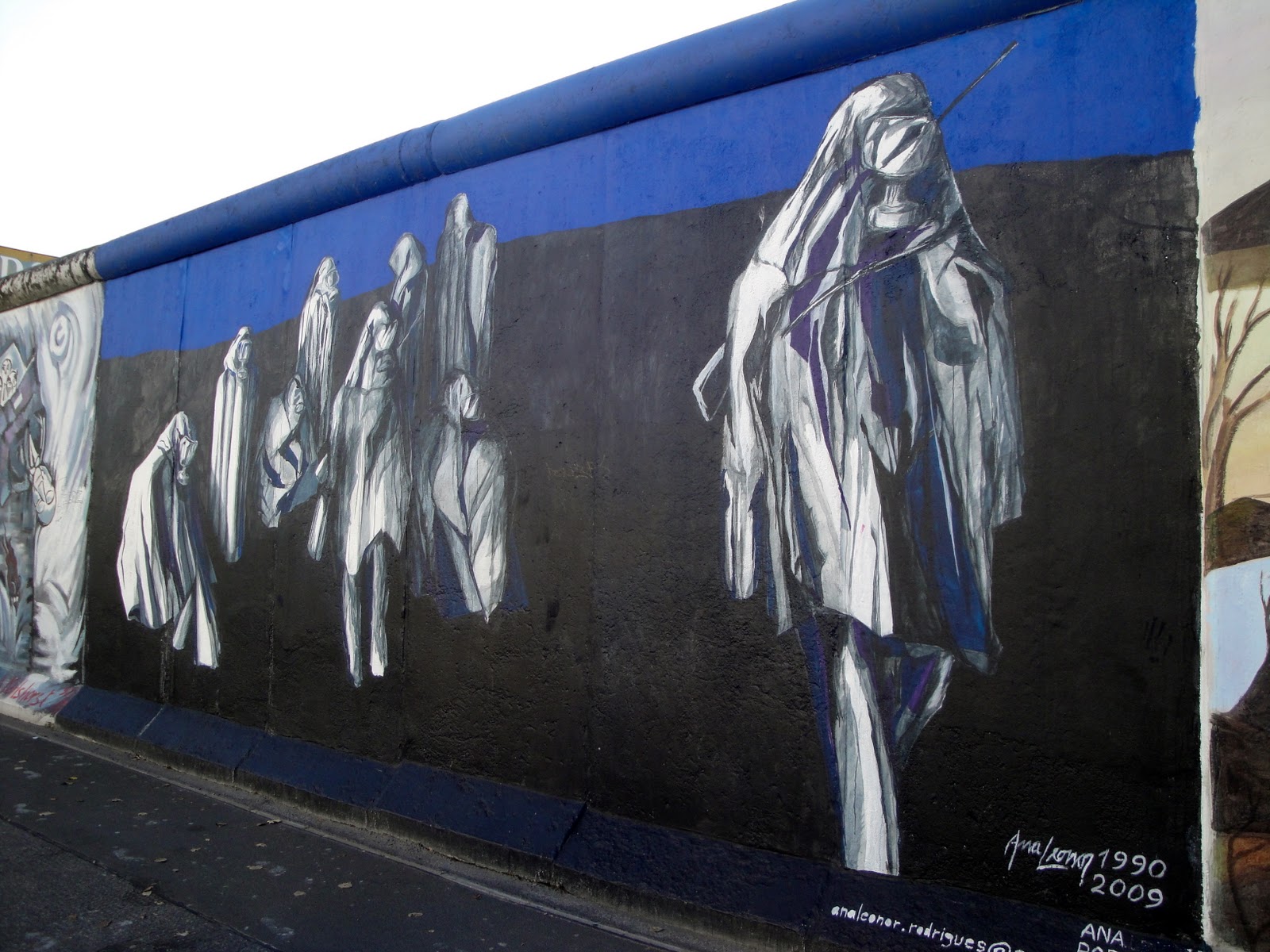
East Side Gallery
(Berlin)


I know, it's far from easy to quit.
Addiction is a phenomenon to ponder.  It is everywhere in many forms.  (We'll talk about sugar in a future episode.)  We tend to see addiction as a personal affair, but it is also-so-social... and in the case of tobacco, so gregarious.

I don't want to romanticize cigarette smoke anymore.  I don't want to feel the inside of my body turning black.

Yes indeed, a behavior reflects a state of mind.  Sometimes I imagine myself as that weightless stream of smoke, going up into the ether, eventually dispersing, free.  Somehow, I associate smoking with freedom; with taking a vacation from the buzz of modern life.  
Sometimes I need to regroup myself, get out of the crowd for a moment, be with my thoughts and feelings for a moment.  I don't need to smoke a cigarette to take that break, but for some reason that's the normal thing to do.  Sitting alone on the curb looking at the stars would raise too many questions on my state of mind.

Finally taking time to write these thoughts down,
(Thanks, perhaps, to rainy Istanbul.)

I've been feeling a bit alarmed, obviously.  I've been dreaming of clean air.  I wonder if there exists a city where it is easy to take care of one's body/self.  I could use their momentum.

Because everything is habit.
Everything is habit.